An end-to-end incident coordination platform is a unified digital system that connects every stage of a critical response, from initial detection and alerting through task management, real-time tracking, and post-incident reporting, within a single operational environment. Rather than relying on a patchwork of separate tools, this type of platform gives every team involved in a critical event a shared view of what is happening, who owns each action, and what has already been completed.
The need for this kind of unified approach becomes clear the moment a serious incident unfolds across more than one team. Communication fragments. Accountability blurs. And the time between recognising a problem and actually coordinating a structured response can stretch far beyond what the situation can afford.
Consider the situation faced by a mid-sized UK financial services firm on an ordinary Monday morning. At 07:43, the network operations team picks up an alert: a third-party cloud provider is degrading. Within four minutes, IT tickets are being raised, a security analyst is escalating through a separate SIEM channel, and operations staff at two other offices are fielding customer calls about failed transactions. Nobody is working from the same picture.
By 09:15, one hour and thirty-two minutes after the first alert fires, a coordinated response is finally underway. A major incident lead has been identified, relevant stakeholders have been reached, and a working channel has been established. But the regulatory notification window is already tightening, the audit trail is a patchwork of consumer messaging app screenshots and forwarded email chains, and the incident log has had to be reconstructed from memory.
This pattern repeats across financial services, healthcare, utilities, and critical infrastructure. Incidents that could be contained quickly become prolonged and damaging because coordination collapses before it can form. The tools exist. The processes are documented. But without a platform that connects them, the response falls apart at the seams.
The Operational Risks When Incident Coordination Fails
A poorly coordinated incident response carries consequences that extend well beyond the operational disruption itself. In regulated sectors, the timeline matters as much as the outcome.
The Financial Conduct Authority’s operational resilience framework requires UK financial services firms to remain within defined impact tolerances for important business services during disruptions. Under the EU’s Digital Operational Resilience Act, financial entities must meet specific incident classification and reporting timelines. When coordination fails, compliance timelines fail alongside it.
Under DORA, financial entities face mandatory reporting requirements for major incidents. The clock starts the moment an incident is classified. A fragmented coordination approach does not pause that clock.
The human cost is equally significant. When teams work from different tools, receive contradictory updates, or wait for decisions stuck in email chains, cognitive overload compounds quickly. Response quality degrades. Decisions are delayed. Accountability becomes blurred because nobody can reconstruct, clearly and quickly, who said what and when.
In healthcare, a poorly coordinated response to a critical system failure can affect patient safety directly. In finance, it can trigger regulatory scrutiny, customer compensation claims, and reputational damage. The consequences are neither abstract nor unlikely, and they accumulate with every minute a response remains uncoordinated.
The Problem with Fragmented Tool Environments
Most organisations have tools. What they often lack is integration between those tools at the moment of an incident.
IT teams use ticketing systems. Security teams work from SIEM alert channels. Operations managers communicate by phone, email, or consumer messaging applications. Executives need a status summary but have no view of the live situation. Business continuity teams are working from plans that nobody else can access in real time.
Each tool does something useful in isolation. Under incident pressure, the absence of a shared operational layer means information travels laterally when it needs to travel vertically and fast. The financial services firm described above had three active escalation paths running simultaneously. None of them was wrong. But none of them was connected.
The major incident led, when they finally joined, had to rebuild the timeline from scratch. Not from a coordinated log. From messaging app screenshots, a forwarded email thread, and a phone call with the monitoring analyst who had been on watch since 07:43.
Where Traditional Incident Response Approaches Fall Short
For many organisations, incident response in practice means the following:
- A documented process that lives in a shared folder that staff may not be able to access during a network-impacting event
- A contact list that was last updated many months ago and may not reflect who is currently on duty
- A conference bridge number that assumes everyone can still connect when the affected service is the network itself
- A shared spreadsheet for tracking actions that relies on someone updating it manually while simultaneously managing the response
This approach is not inherently wrong for a low-complexity incident with a small team and a single clear failure point. But it fails reliably in three scenarios: multi-site incidents, multi-team incidents, and time-critical regulatory incidents. These three scenarios describe the most serious incidents.
Traditional processes typically assume a linear escalation path, where one team identifies an incident and passes it upwards. Real incidents are rarely linear. The financial services scenario involved three simultaneous escalation paths that collided rather than connected. A conventional process has no mechanism for handling that collision without significant human intervention and delay.
There is also the question of what happens when the documented process cannot be found under pressure. Studies of incident response consistently highlight that the availability of plans at the moment of need is as important as the quality of the plan itself. A business continuity framework that sits in a SharePoint folder three clicks away from the home screen is not a response capability. It is a document.
Challenging the Assumption That Notification Is Enough
A widely held assumption in the incident response space is that the primary challenge is speed of notification: get the right people alerted quickly, and the response will follow. Much of the incident management software market is built around this premise.
Notification is only the beginning. The question that follows immediately is, ‘Who does what next, and how is it tracked?’ Without a coordination layer, alerts generate activity but not direction. People acknowledge the notification, act independently, and produce a fragmented response that is difficult to manage, audit, or learn from.
A notification tells people something is happening. Coordination determines what happens next. These are not the same capability, and no tool designed to do one will reliably do the other.
The financial services firm had automated alerting. The monitoring system fired immediately. The people who needed to know were notified within minutes. The problem was not awareness. It was coordination. There was no shared task environment, no role-based accountability, and no mechanism for consolidating three active response threads into a single managed process.
This distinction between notification and coordination is central to understanding what an end-to-end incident coordination platform is actually for. Notification is the trigger. Coordination is everything that follows.
Interested in our Incident Management Software?
Flexible Incident Management Software to keep you connected and in control.
How an End-to-End Incident Coordination Platform Addresses These Gaps
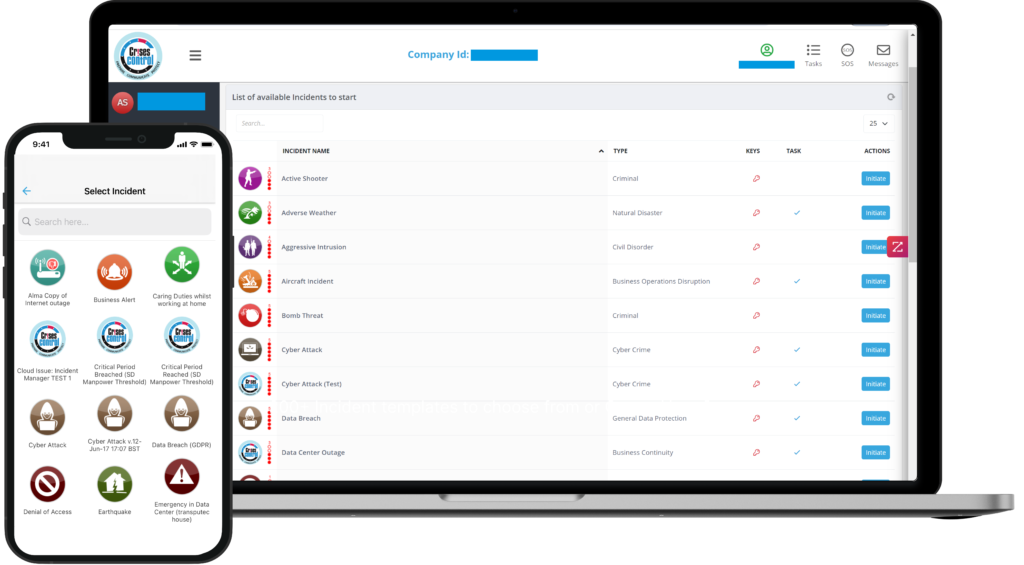
The gap that traditional approaches consistently fail to close is execution. Alerting tools notify. Planning tools document. Communication tools carry messages. None of these, individually, constitutes a coordinated response. What is missing is the execution layer: the mechanism that turns an alert into an action, assigns that action to a named role, tracks its completion in real time, and produces an auditable record across the full response lifecycle.
Most competitors in this space either notify people or document plans. What organisations under incident pressure actually need is a platform that executes the response. Built for real incidents, not demos.
A critical event management platform built for end-to-end coordination delivers value across five specific capabilities:
- Role-based response activation. When an incident is declared, the relevant response plan activates automatically, assigning tasks to roles rather than to individuals by name. This removes the dependency on knowing who is on duty and reduces the gap between declaration and first action.
- Multi-channel communication with two-way confirmation. Reaching people via a single channel is a single point of failure. Reliable incident coordination requires simultaneous notification across SMS, voice call, email, push notification, and in-app messaging, with confirmation tracking so coordinators know who has acknowledged and who has not.
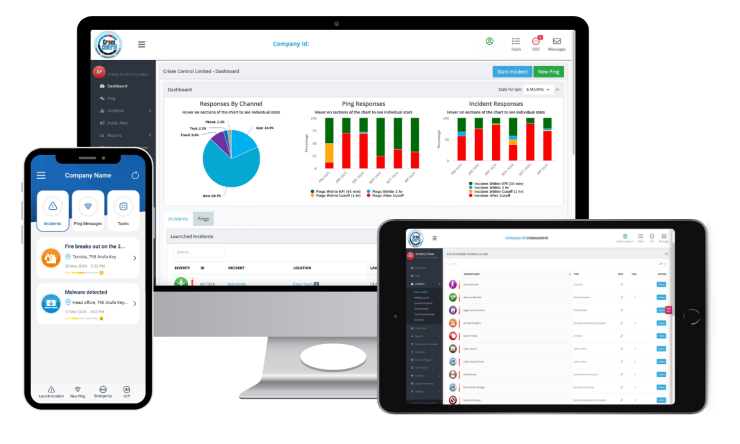
- Shared operational view across all teams. All teams, regardless of location or function, work from the same live dashboard. Security can see what IT is doing. Operations can see the current major incident status. Leadership can track task completion in real time without being pulled into the response thread itself.
- Real-time task management and escalation. Tasks are assigned, tracked, and escalated within the platform. Nothing depends on someone manually updating a spreadsheet or forwarding an email. Overdue actions surface automatically.
- Audit trail from minute one. Every notification sent, every task assigned, and every status update recorded automatically. This is not a reconstruction after the event. It is a contemporaneous record that satisfies both internal governance requirements and external regulatory obligations.
Practical Guidance for Organisations Evaluating Their Approach
For organisations reviewing whether their incident coordination capability is genuinely fit for purpose, the following questions provide a useful diagnostic. They apply equally to those evaluating incident management software for the first time and to those reassessing tools already in place.
Can your response plan be activated without manual distribution? If the answer is no, the first ten to fifteen minutes of any serious incident will be spent on logistics rather than response. That is a significant window of unmanaged exposure in a regulated environment.
Can all involved teams see the same live status? If the answer is no, the response is fragmented before it has even started. Parallel escalation paths with no shared view produce conflicting actions and a broken audit trail.
Can you produce a full audit trail within 24 hours of an incident? If the answer is no, post-incident reporting and regulatory compliance is at risk. Reconstructing a timeline from messaging apps and email chains after the fact is not acceptable under most regulatory frameworks.
Do your response plans reflect your current structure? Outdated plans can be worse than no plans: they create false confidence in a response capability that no longer exists. Plans should be reviewed and updated at least annually, and following any significant structural change.
For regulated UK and EU industries, including finance and healthcare, the stakes are particularly high. The best platform for business continuity and incident coordination in regulated UK and EU industries, such as finance and healthcare, needs to do more than alert. It needs to document, coordinate, and report in a way that satisfies regulatory scrutiny.
Recognised frameworks, including ISO 22301:2019 for business continuity management and ISO 22320:2018 for incident management, provide internationally accepted benchmarks for what effective coordination looks like. Organisations subject to DORA or the FCA’s operational resilience framework have additional compliance obligations that directly shape the technical and process requirements for any incident management software they evaluate.
Where Crises Control Supports End-to-End Incident Coordination
Crises Control is built as the execution layer for critical event management. The platform connects mass notification with task management, response tracking, and audit reporting within a single environment aligned to ISO 22301 and ISO 22320.
In a multi-site incident such as the financial services scenario described above, several of the coordination failures could have been addressed directly. The incident plan could have been activated the moment the monitoring alert fired, pushing role-based tasks to IT, security, and operations simultaneously. Two-way acknowledgement would have confirmed who received the notification and who had not. All three response threads would have been consolidated into a single dashboard, giving the major incident lead an immediate view of status across all teams from the point of declaration.
The full audit trail, from first alert to resolution, would have been generated automatically rather than reconstructed from memory. This matters not just for internal review but also for regulatory reporting, where the timeliness and completeness of incident documentation are subject to specific scrutiny.
For organisations considering how to coordinate multi-site incident response across IT, security and operations teams in real time, Crises Control provides the Incident Manager as the central coordination environment, combining real-time incident reporting and structured crisis communication within a single platform built for operational pressure.
The platform supports regulated industries through DORA-aligned incident workflows and GDPR-compliant data handling, making it a practical choice for UK and EU financial services and healthcare organisations that need incident management software aligned to their compliance environment. A full overview of the platform’s capabilities is available on the Crises Control products page.
For organisations already evaluating how incident management software compares with general-purpose communication tools for crisis coordination, Crises Control provides a structured alternative that integrates with existing communication stacks rather than replacing them.
Conclusion
An end-to-end incident coordination platform does not replace the human judgment that effective response requires. What it does is remove the structural failures that prevent that judgement from being applied in time: the fragmented tools, the missing audit trail, the contact list that was never updated, and the three escalation paths that nobody connected.
For organisations operating in regulated environments, the question is not whether coordination matters. It is whether the current approach can deliver it reliably, under pressure, at 07:43 on a Monday morning when three teams are already running in different directions.
If the honest answer is uncertain, the next step is to see what structured coordination looks like in practice.
FAQs
1. What is an end-to-end incident coordination platform and how does it differ from standard incident management software?
An end-to-end incident coordination platform connects every stage of a critical response, from initial detection and notification through to task management, status tracking, and post-incident reporting, within a single environment. Standard incident management software typically handles only part of this cycle, usually logging and tracking, without the communication, role-based task assignment, and automatic audit trail functions that full coordination requires. The distinction matters most under pressure, when fragmented tools produce fragmented responses that are difficult to manage, review, or defend to a regulator.
2. How does incident management software help organisations meet regulatory requirements in the UK and EU?
Incident management software with built-in audit trails, automated notification records, and structured response workflows provides the contemporaneous documentation that regulators expect. The FCA’s operational resilience rules and DORA both require firms to demonstrate timely detection, classification, and reporting of significant incidents. A coordinated response platform provides the evidence base for that demonstration, reducing the risk of regulatory findings arising from process gaps rather than from the incident itself.
3. Which industries benefit most from a critical event management platform?
Any sector operating across multiple sites, managing time-critical regulatory reporting, or coordinating across IT, security, and operations teams will benefit from a critical event management platform. Finance and healthcare face the highest regulatory exposure in the UK and EU, but utilities, higher education, local government, and critical infrastructure operators face similar coordination challenges. The unifying factor is the need to respond reliably, quickly, and with a documented audit trail that stands up to post-incident scrutiny.
4. What is the difference between mass notification and full incident coordination?
Mass notification sends alerts to the right people quickly. Full incident coordination goes further: it activates response plans, assigns role-based tasks, tracks their completion in real time, and generates a complete audit trail. Notification is the first step. Coordination is everything that follows. Organisations that treat notification as coordination are investing in the trigger while leaving the actual response to chance.
5. How should organisations evaluate whether they need an end-to-end incident coordination platform?
A useful starting point is testing the current approach against three questions: Can the response plan be activated without manual distribution? Can all involved teams see a shared live status? Can a full audit trail be produced within 24 hours? If any answer is no, the current approach carries operational and compliance risk. An end-to-end incident coordination platform addresses all three gaps within a single environment, providing the coordination infrastructure that regulated industries require.