Critical Event Management Software are cloud-based operational tools that help organisations detect, coordinate, communicate, and document the full response to disruptive incidents. For IT Services and IT Consulting firms, it sits above your ticketing, RMM, and ITSM tools as the execution layer that runs major incidents across multiple clients, captures the timestamped audit trail regulators now require, and aligns with ISO 22301 and the UK Cyber Security and Resilience Bill.
This guide answers the procurement-stage questions IT services and IT consulting buyers actually ask in 2026. It is written for technical and commercial leaders evaluating Critical Event Management Software for the first time, or reviewing an existing platform against tightening regulatory and operational requirements.
What is Critical Event Management Software?
The category emerged in its current form between 2018 and 2024 as three previously separate categories converged: mass notification platforms, incident management tools, and business continuity planning software. By 2026, the strongest platforms in the category run all three as a single integrated workflow rather than three loosely connected modules.
For IT Services and IT Consulting firms specifically, Critical Event Management Software is the layer that handles what happens when a Level 1 ticket becomes a Level 2 incident, when a Level 2 incident becomes a cross-client major incident, and when a cross-client major incident becomes a regulatory notification. The middle and upper stages of that lifecycle are the ones where most firms lose time, lose audit trail, and lose client trust. Critical Event Management Software is built to close those gaps.
Critical Event Management Software vs Incident Management Software: what is the difference?
ANSWER Incident Management Software handles the technical lifecycle of an IT incident (detect, diagnose, resolve, close), typically inside ITIL workflows and ITSM platforms like ServiceNow, Jira Service Management, or Halo. Critical Event Management Software handles the broader operational response above and beyond the technical fix: multi-stakeholder communication, cross-functional coordination, business continuity activation, and regulatory audit trail. The two are complementary, not competing. Most mature IT Services firms run both, with the platforms integrated.
The simplest way to think about it: ITSM handles the ticket. Critical Event Management Software handles what the ticket triggers when the impact extends beyond the IT team. A multi-client outage, a security breach, a supply chain failure, a regulatory notification deadline. Anything that requires a coordinated response across more than one team or external stakeholder.
What does Critical Event Management Software actually do during an incident?
Critical Event Management Software handles five operational functions during an incident. Each function maps to a specific stage of response that traditionally sits in a different tool or, more commonly, in nobody’s tool.
Detection and signal consolidation
The platform ingests alerts from monitoring tools, ITSM tickets, security platforms, and external feeds. Related signals are grouped automatically by signature, by client, by affected service, and by time. A single major-incident record is raised instead of three disconnected tickets in three different queues.
Multi-channel notification with confirmation
Notifications are routed to named owners across SMS, voice, email, push, app, and Microsoft Teams in parallel, with two-way confirmation. The platform knows who has acknowledged and who has not. If the primary contact does not acknowledge within a defined window, automatic escalation routes the alert to the named deputy.
Workflow coordination across stakeholders
Pre-built playbooks trigger when an incident is raised. Tasks are assigned to named owners. Status is tracked in real time. Client communications draft against pre-approved templates. Leadership sees a single dashboard rather than five fragmented updates from different channels.
Decision logging and audit trail capture
Every alert sent, acknowledgement received, escalation triggered, decision logged, and stakeholder notification timed against contractual or regulatory windows is captured automatically against timestamps. The post-incident review is generated from the live record, not reconstructed from email and Slack two weeks later.
Regulatory reporting and recovery
The platform’s audit trail feeds directly into regulatory report templates: 24-hour early warning reports, 72-hour full incident reports, ISO 22301 evidence packs, and retailer or client technical team timeline requests. Recovery actions are tracked through to closure, with post-incident analysis captured for the next plan iteration.
Critical Event Management Software is not a replacement for ITSM, RMM, or ticketing. It is the layer above them where the incident becomes a coordinated response across multiple teams, multiple clients, or multiple regulators.
Why do IT Services and IT Consulting firms need Critical Event Management Software in 2026?
Three converging pressures make Critical Event Management Software a 2026 procurement priority for IT Services and IT Consulting firms specifically, not a 2027 nice-to-have.
Pressure 1: regulatory scope is expanding
The UK Cyber Security and Resilience Bill explicitly brings managed service providers, designated critical suppliers, data centres, and operators of essential services into formal regulatory scope. Royal Assent is expected in late 2026, with phased implementation through 2028. The Bill requires a 24-hour early warning and a 72-hour full report to both sector regulators and the National Cyber Security Centre, with a two-tier penalty structure: £10 million or 2% of global turnover for standard breaches, £17 million or 4% for serious breaches, and £100,000 per day for ongoing contraventions.
IT Services firms providing managed services to UK clients will be expected to evidence their own incident response process, not just support their clients’ processes. The audit trail their Critical Event Management Software produces becomes regulatory evidence.
Pressure 2: incidents are scaling
The UK NCSC managed 204 nationally significant cyber incidents in the past 12 months, more than double the 89 recorded the previous year, and 429 cyber incidents in total. 95% of UK critical national infrastructure organisations experienced a data breach in 2024. The Jaguar Land Rover Category 3 systemic event in 2025 affected over 5,000 UK organisations and caused an estimated £1.9 billion in UK economic impact. Many of those 5,000 organisations are clients of IT Services and IT Consulting firms whose response capabilities are now under scrutiny.
Pressure 3: client expectations are tightening
Mature IT Services clients now ask for evidence of incident response capability during procurement, not just operational SLAs. The audit trail an IT Services firm produces after a major incident is read by the client’s own procurement, audit, and regulatory teams. Firms that cannot produce a defensible timeline within 48 hours of a major incident are increasingly losing renewal conversations to firms that can.
The UK NCSC managed 204 nationally significant cyber incidents in the past 12 months, more than double the 89 recorded the previous year. Most of them involved at least one MSP or IT Services provider in the response chain. (NCSC 2026)
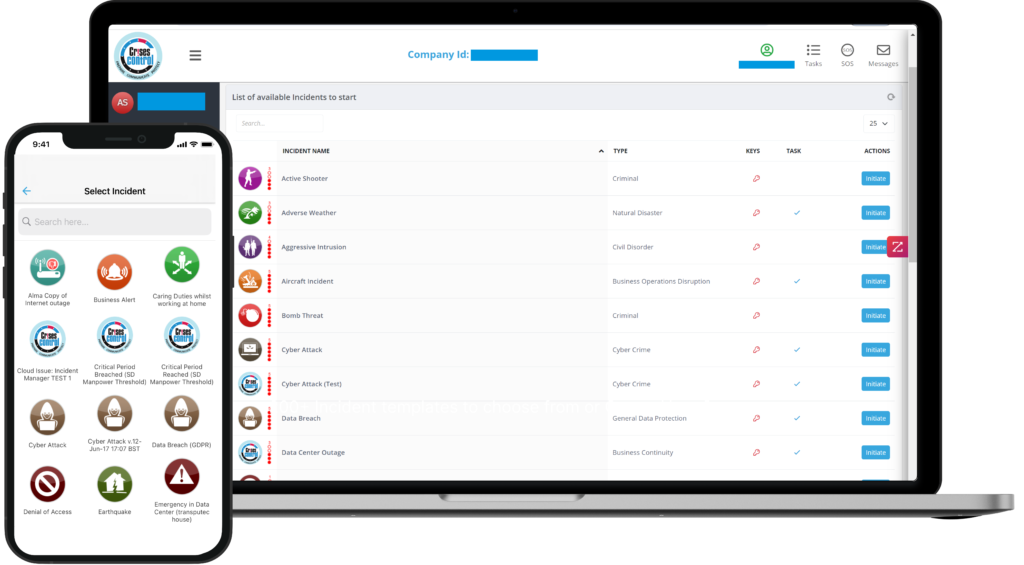
Interested in our Incident Management Software?
Flexible Incident Management Software to keep you connected and in control.
What features should IT Services and IT Consulting buyers look for?
Generic Critical Event Management Software feature lists miss most of what matters in IT Services procurement. The seven criteria below come from real procurement scorecards used by UK IT Services and IT Consulting firms in 2025 and 2026.
Multi-tenant separation
Client A’s incident record cannot leak into Client B’s audit trail. Information that crosses tenant boundaries inside the IT Services firm must do so under controlled rules, not by accident. Multi-tenant separation is the entry criterion for serious IT Services use, and most generic crisis platforms do not have it.
Cross-tenant correlation
The same platform issue affecting multiple clients should raise one major-incident record with linked tenant impacts, not four independent records running in parallel. This is the capability that prevents the most common IT Services escalation failure: four separate L2 engineers handling four versions of the same root cause.
Multi-channel notification with two-way confirmation
SMS, voice, email, push, app, and Microsoft Teams or Slack, all delivered in parallel with two-way confirmation and automatic escalation to named deputies. Email-only or single-channel platforms fail when the on-call engineer is between systems.
ITSM and monitoring integration depth
Native or webhook-based integration with ServiceNow, Jira Service Management, Halo, Freshservice, ConnectWise, Autotask, Datto, and monitoring stacks like Datadog, New Relic, PagerDuty, and Splunk. Read-only integration is not enough. The platform should be able to raise, update, and close incidents bidirectionally across the ITSM layer.
Pre-built client communication templates by tier
Different client SLA tiers need different communication cadences, channels, and detail levels. The platform should hold templates by tier and incident category, draft messages from the major incident record, and route them on the timing window each client’s contract specifies.
Continuous timestamped audit trail
Every alert, acknowledgement, decision, task, and external notification captured automatically. Exportable on demand for client review, ISO 22301, ISO 27001, and CSR Bill regulatory reporting. The audit trail should be generated by the platform, not assembled by the engineer after the fact.
Modular, multi-tier commercial model
Per-user pricing scales poorly across IT Services firms with seasonal contractors, agency engineers, and rotating on-call rotas. Per-message pricing exposes the firm to bill shock during real incidents, which is the worst time to be metering messages. Look for modular pricing by site, by capability, or by client tenant.
How does Critical Event Management Software integrate with the existing IT Services stack?
Critical Event Management Software is layered above your existing operational tooling, not in place of it. The strongest deployments integrate across five categories of system.
|
Stack layer |
Common tools in IT Services |
How Critical Event Management Software integrates |
|
ITSM and ticketing |
ServiceNow, Jira Service Management, Halo, Freshservice, ConnectWise, Autotask, Datto |
Bidirectional API or webhook. Tickets raise incidents, incidents update tickets, audit trail shared. |
|
Monitoring and observability |
Datadog, New Relic, PagerDuty, Splunk, Dynatrace |
Webhook-triggered. Monitoring alerts feed straight into the major incident workflow. |
|
Communication and collaboration |
Microsoft Teams, Slack, Outlook, mobile push |
Native integration. Alerts appear in the tools teams already use; acknowledgement captured back. |
|
HR and identity |
Azure AD, Okta, Workday, BambooHR, internal HRIS |
SAML SSO and SCIM provisioning. Shift rotas and on-call data flow into routing rules. |
|
Security operations |
SIEM, SOAR, EDR, security playbooks |
API feed. Security incidents trigger crisis workflows with regulatory reporting attached. |
Strong Critical Event Management Software does not replace anything in this stack. It connects to all of it and runs the response layer above it.
How is Critical Event Management Software priced, and what should the procurement scorecard include?
Critical Event Management Software in 2026 is typically priced in one of three models: per-user (£8 to £30 per user per month), per-contact (£0.50 to £2.50 per contact per month plus message volume), or modular per-capability (banded fixed fee by site, tenant count, or capability set). IT Services and IT Consulting firms with rotating headcount and multi-tenant operations typically find modular per-capability pricing the most predictable over a three-year contract. Expect implementation costs of £2,000 to £15,000 depending on integration depth.
The full procurement scorecard should cover technical, operational, regulatory, commercial, and vendor fit. The questions below are the ones IT Services and IT Consulting buyers should ask in vendor demos and in formal RFPs.
Technical fit
Does the platform support multi-tenant separation as a core capability, not a configuration overlay? Does it correlate signals across tenants automatically? What ITSM and monitoring integrations are native vs webhook-based? Does it support SAML SSO and SCIM provisioning? What is the data residency model for UK and EU clients?
Operational fit
How long does typical deployment take for a 50-seat IT Services firm? For a 500-seat MSP? What pre-built playbooks ship with the platform, and how easily can they be customised? What training is included? How is shift-aware routing configured, and who maintains it?
Regulatory fit
Is the vendor itself ISO 22301 and ISO 27001 accredited? What templates exist for CSR Bill 24-hour and 72-hour reporting? How is the audit trail exported, and in what format? What regulatory frameworks does the platform pre-align to: ITIL, ISO 22301, GDPR, DORA, BCM standards?
Commercial fit
What pricing model is offered, and what triggers cost escalation? Is message volume metered? Is implementation included? What is the renewal cadence and price-lock structure? What does the year-three total cost look like for an MSP that doubles in headcount during the contract?
Vendor fit
How long has the vendor been in the category? What is the customer success model: dedicated CSM, regional support, time zone coverage? What reference customers exist in the IT Services and IT Consulting vertical? What is the vendor’s product roadmap for AI-led detection, regulatory reporting automation, and cross-tenant correlation in 2026 and 2027?
How Crises Control delivers Critical Event Management Software for IT Services and IT Consulting
Crises Control is the Critical Event Management Software platform purpose-built for IT Services and IT Consulting firms managing multi-client incident response under tightening regulatory scope. The platform itself holds ISO 22301 and ISO 27001 accreditation, which means the standards are built into the product rather than configured on top.
Multi-tenant by design, cross-tenant by default
Client tenants are separated at the data and access layer. When the same incident signature appears across multiple client tenants, the platform raises a single major-incident record linking them all. One investigation, one response team, one audit trail, multiple parallel client communications drafted from the same root record.
Multi-channel alerting with two-way confirmation
The Crises Control mass notification system reaches engineers, NOC staff, client technical contacts, account directors, and external stakeholders across SMS, voice, email, push, app, and Microsoft Teams, with two-way confirmation. The account director’s WhatsApp is no longer the single point of failure.
Pre-built playbooks and ITSM integration
The Crises Control Incident Manager and Task Manager run the parallel workstreams of a major incident response. Pre-built playbooks ship with the platform; bidirectional integration with ServiceNow, Jira Service Management, Halo, Freshservice, and the major monitoring stacks means alerts and updates flow both ways.
Regulator-ready audit trail
Every action captured automatically in the Crises Control audit trail. 24-hour early warning and 72-hour full report templates draw directly from the live record. Dual notification to sector regulator and NCSC routes through the platform’s notification engine. Exportable on demand by clause, by client, by timestamp.
Modular pricing built for IT Services economics
Pricing is modular and tier-based rather than per-user enterprise. IT Services firms with rotating contractors and multi-tenant operations typically pay less than they would for legacy enterprise platforms at equivalent capability, and the cost does not balloon as headcount fluctuates. Implementation is measured in weeks rather than quarters.
If your current Critical Event Management Software cannot produce a defensible 72-hour timeline under the CSR Bill, the next regulator-facing incident is the one that proves it. Book a demo to see the platform run.
What a working Critical Event Management Software setup looks like in an IT Services firm
A working setup recognises cross-client incident patterns at the first ticket, not the fourth. It runs the escalation through structured workflow rather than WhatsApp and email. It produces a timestamped audit trail by default. It feeds the 24-hour and 72-hour regulatory reports directly from the live incident record. It scales modularly as the firm grows, without per-user pricing penalising the addition of seasonal staff. And it integrates natively with the ITSM, monitoring, and identity stacks the firm already runs.
IT Services firms that adopt this approach do not eliminate incidents. They turn the five-stage escalation spiral into a controlled, evidenced, regulator-ready process. The incident still happens. The commercial and regulatory consequences do not.
If your firm cannot answer the procurement-fit questions above with confidence today, the next major incident is the one that decides whether you keep the client relationship and stay on the right side of the upcoming regulatory regime. Book a Crises Control demo.
FAQs
1. What is Critical Event Management Software in plain language?
Critical Event Management Software is a cloud-based platform that consolidates incident detection, multi-channel notification, workflow coordination, and audit trail capture into a single system. It is the operational layer that runs the response to a disruptive incident, sitting above your ticketing, ITSM, and monitoring tools. For IT Services and IT Consulting firms, it is the layer that handles cross-client major incidents and produces the regulatory evidence required by ISO 22301 and the UK Cyber Security and Resilience Bill.
2. How is Critical Event Management Software different from Incident Management Software?
Incident Management Software, typically inside ITSM platforms like ServiceNow or Jira Service Management, handles the technical lifecycle of an IT incident: detect, diagnose, resolve, close. Critical Event Management Software handles the broader operational response: multi-stakeholder communication, cross-functional coordination, business continuity activation, and regulatory audit trail. ITSM handles the ticket. Critical Event Management Software handles what the ticket triggers when the impact extends beyond the IT team.
3. Why do IT Services and IT Consulting firms need Critical Event Management Software in 2026?
Three pressures converge in 2026. The UK Cyber Security and Resilience Bill brings managed service providers and designated critical suppliers into formal regulatory scope, with 24-hour and 72-hour reporting requirements and penalties up to £17 million. The NCSC managed 204 nationally significant cyber incidents in the past 12 months. And mature IT Services clients now ask for evidence of incident response capability during procurement, not just operational SLAs. Critical Event Management Software provides the operational capability and the regulatory evidence in one platform.
4. What does Critical Event Management Software cost?
Three pricing models dominate the category in 2026: per-user pricing (£8 to £30 per user per month), per-contact pricing (£0.50 to £2.50 per contact per month plus message volume), and modular per-capability pricing (banded fixed fee by site, tenant count, or capability set). Implementation costs typically run £2,000 to £15,000 depending on integration depth. IT Services firms with rotating headcount and multi-tenant operations usually find modular per-capability pricing the most predictable over a three-year contract.
5. Does Critical Event Management Software replace ITSM platforms like ServiceNow?
No. The two are complementary. ITSM handles the technical incident lifecycle inside ITIL workflows. Critical Event Management Software handles the operational response above the ticket: multi-channel notification, cross-functional workflow, client communications, and regulatory audit trail. Most mature IT Services firms run both, integrated via API or webhook so that tickets raise incidents and incidents update tickets bidirectionally.