
Written by Dr Shalen Sehgal | Crises Control CEO
A healthcare crisis management platform is not what most hospitals think it is when they buy one. The assumption going in is that the platform handles the crisis. The reality, discovered during a real incident, is that it handles the notification and leaves the response to everyone else.
The charge nurse who needs to know who is moving. The incident coordinator who needs to confirm the crash cart is coming from the right floor. The department head who needs a live picture of what is happening, not a phone call briefing that is already 90 seconds out of date. The compliance officer who needs a record of what happened that was not assembled from memory at 7 AM the following morning.
Those are the people a healthcare crisis management platform is supposed to serve. In most cases, the platform serves none of them after the alert has fired.
This post sets out what healthcare teams actually need from a crisis management platform. Not what vendors promise in a demo, but what the teams on the floor discover they need when the system is tested for real. For context on the specific coordination failures that make this so critical, see why hospital incident response coordination breaks down and how the five hospital emergency response phases actually unfold.
What Healthcare Teams Need That Most Platforms Do Not Provide
The needs of a healthcare team during a real incident are not complicated. They are specific. And they are consistently unmet by platforms built for corporate communications or adapted from other industries.
- The floor nurse needs to know her task, not the situation
When a Code Blue fires, the floor nurse does not need a summary of what is happening. She needs to know her specific role in the next 90 seconds. Is she the one going to Room 14B? Is she coordinating the floor? Is she managing the adjacent rooms while the response team works? A platform that sends her a broadcast telling her there is a Code Blue has told her something she already knew. It has not told her what to do.
The healthcare crisis management platform that serves her sends her a specific task with a specific instruction before she has time to wonder what is expected of her.
- The incident coordinator needs a live picture, not a phone
The incident coordinator’s job during a hospital emergency is to hold the whole response together: to know what has been done, what has not been done, who is moving, and where the gaps are. To do that job with a phone in her hand, making calls to find out what she should be seeing on a screen, is to do it badly.
Every phone call she makes to check on status is a phone call she is not making to manage the response. Every minute she spends constructing a picture from fragments is a minute the picture is getting more out of date. A healthcare crisis management platform that does not give her a live operational dashboard has not solved her problem.
- The on-call physician needs to be reached, not listed
The on-call rota changes every day. Twice a day at shift handover. The physician listed in the emergency plan as the primary contact may have rotated off 11 hours ago. The person who is actually on call right now is a different person, possibly unknown to the system, possibly unreachable through the channels the plan specifies.
A healthcare crisis management platform that routes alerts to named individuals fails at this hurdle every time the plan falls out of sync with reality. Role-based routing that draws from the current shift roster in real time never fails at this hurdle, because it never depends on the plan being current.
The administrator needs to make decisions, not gather information
By the time a serious hospital incident reaches the administrator, the situation has already moved on from whatever she was told. Every briefing she receives is a summary of something that was true 60 to 120 seconds ago. Every decision she makes is made on a picture she has already received second-hand.
What she needs is not a faster phone call. She needs the same live operational dashboard that the incident coordinator is looking at, accessible on any device, reflecting the current state of the response at the moment she opens it.
The gap between what healthcare teams need and what most crisis platforms provide is not a technology gap. It is an architecture gap. Most platforms were designed to communicate about an incident. Healthcare teams need a platform that runs the response.
Why the Alert Is the Easy Part
The crisis management software market has spent a decade improving alert speed and delivery reliability. Those improvements are real. Notifications now arrive faster, reach more channels, and confirm delivery more accurately than they did ten years ago.
What has not improved at the same pace is what happens after the notification lands. The task assignment. The acknowledgement confirmation. The automatic escalation when someone does not respond. The shared live picture. The documentation record that builds itself.
Research from TigerConnect found that improving coordination in code blue events at the University of Maryland Medical System improved survival to discharge from 17 percent to 25 percent. The alert speed had not changed. The coordination of what followed had. That is the part most crisis platforms have not addressed.
The alert is three seconds. The response is everything after. A healthcare crisis management platform that only optimises the three seconds has left the rest of the problem unsolved.
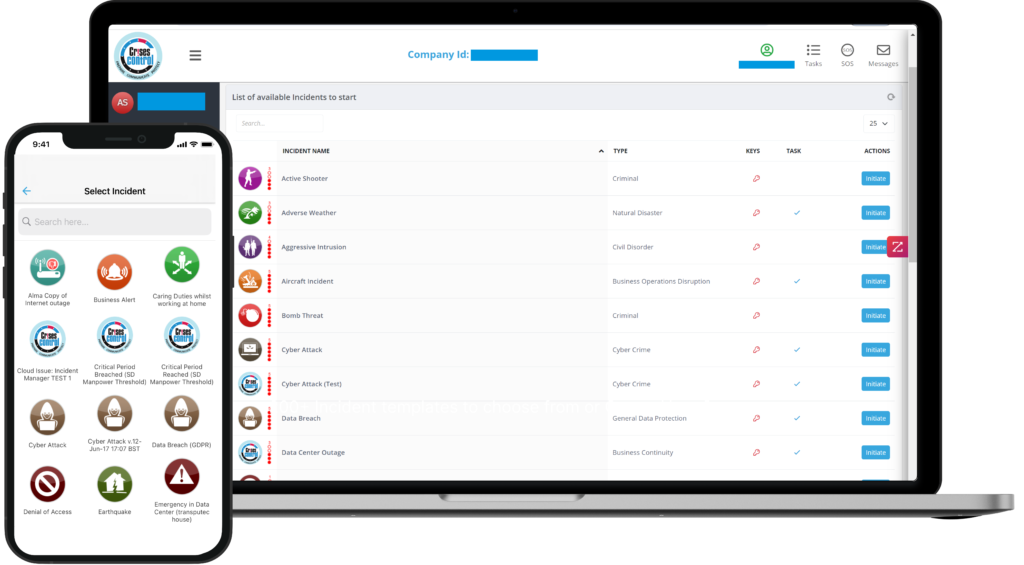
Interested in our Incident Management Software?
Flexible Incident Management Software to keep you connected and in control.
Four Things a Healthcare Crisis Management Platform Must Do After the Alert
1. Assign tasks to the right roles on the current shift
The moment the alert fires, the platform should be translating it into specific actions for specific roles. The crash cart task goes to the crash cart role on the active shift. The physician alert goes to whoever is currently on call, drawn from the live shift roster. The coordination brief goes to the charge nurse. Each person receives their task via the channel they will most likely be monitoring at that hour, across SMS, voice, push, and email, through the PING notification system, simultaneously, without anyone having to decide who gets what.
2. Track individual acknowledgements and escalate automatically
Once tasks are assigned, the platform needs to know whether each person has confirmed their role in the response. Not aggregate delivery stats. Individual acknowledgement by role, in real time. When a task is not acknowledged within the configured window, the incident management platform escalates automatically to the designated backup. No interruption to the incident coordinator being interrupted, without anyone making a phone call, without the gap being discovered three minutes later when it is too late to close it cleanly.
3. Give every decision-maker the same live picture
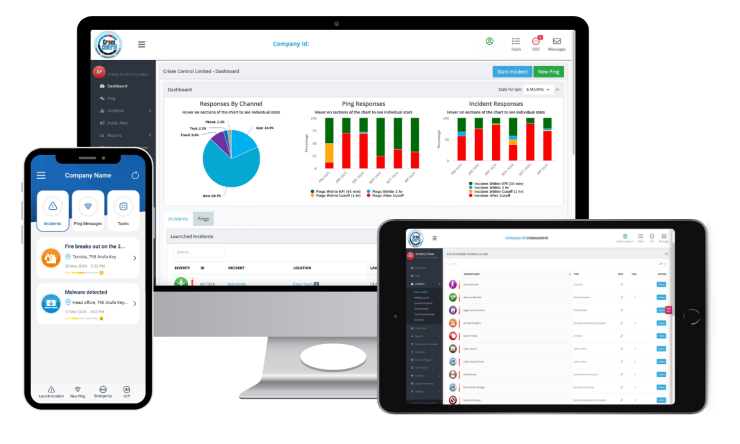
The incident coordinator, the department head, and the hospital administrator should all be looking at the same live operational dashboard at the same time. What tasks are assigned. What has been acknowledged. What is complete. Where the gaps are. The incident management platform provides this on any device, updated in real time, without anyone needing to feed it updates. The dashboard reflects the actual state of the response as it develops.
4. Log everything automatically throughout the incident
Every notification sent, every acknowledgement received, every escalation triggered, every task completed: logged automatically with a timestamp as it happens. By the time the incident closes, the CMS and Joint Commission compliance record already exists. No reconstruction from memory. No gaps from exhaustion. A complete, accurate, contemporaneous account of what actually happened. This is what a structured emergency response plan executed through the right platform produces as standard.
What Healthcare Teams Discover When the Platform Is Tested for Real
Post-incident reviews in healthcare tell a consistent story about platforms that appeared to work in procurement but failed in practice.
- The contact list was accurate when the plan was written
Staff change roles, go on leave, and rotate schedules continuously. A platform that routes to named individuals becomes less reliable every week the plan is not updated. By the time a real incident tests it, the plan may be months out of date. Role-based routing removes this failure mode entirely because it never depends on the plan being current.
- The platform could not reach people on the floor
Healthcare workers are not at desks. They are with patients, in theatres, in areas with variable connectivity. A mass notification system that relies on a single channel, whether mobile app, email, or internal system, and will miss people the moment they are in a low-connectivity area or focused on a patient. Multi-channel delivery across SMS, voice, push, and email simultaneously means the message finds the person regardless of where they are or what they are doing.
- The platform depended on infrastructure that went down
Ransomware, power failures, and network outages are among the most common serious incidents healthcare facilities face. A crisis management platform that requires VPN access, Active Directory authentication, or corporate email to function is unavailable in exactly those scenarios. The platform that runs on its own cloud infrastructure, entirely separate from hospital IT, keeps working when everything else stops.
- Nobody could produce the compliance documentation
When the Joint Commission surveyor asked to see the communication records from last month’s incident, the facility produced a document reconstructed from memory and partial notes. It was the only record that existed. A platform that logs every action automatically throughout the incident makes this scenario impossible. The documentation exists the moment the incident closes.
How Crises Control Delivers From Alert to Action
Crises Control is a healthcare crisis management platform built around the specific needs of the people described in this post: the floor nurse who needs a task, the incident coordinator who needs a live picture, the on-call physician who needs to be reached through current shift routing, and the administrator who needs to make decisions on real information.
When an incident is declared, PING delivers role-specific tasks across SMS, voice, push, and email simultaneously. Every person receives their specific action. Acknowledgement is tracked individually. Non-responses escalate automatically to the backup role without human intervention.
The incident management platform gives every decision-maker the same live operational dashboard on any device. Every action is logged automatically throughout the incident. The compliance record is complete when the incident closes. The platform operates on its own cloud infrastructure, independent of hospital IT.
To see how this performs against your facility’s real incident types, request a personalised demo.
FAQs
1. What is a healthcare rapid response platform?
A healthcare rapid response platform is a system that manages the structured response to a clinical emergency or other critical event, from the moment the alert fires to the point where the incident is documented and closed. It differs from a notification system in that it assigns specific tasks to active shift roles, tracks individual acknowledgements, escalates automatically when responses are not received, provides a live shared operational picture to all decision-makers, and produces complete compliance documentation automatically. The notification is the first three seconds. The platform coordinates everything after it.
2. Why do most healthcare platforms fail between the alert and the first coordinated action?
Because they were designed to communicate about an incident, not to coordinate the response to one. Notification tools broadcast alerts and log delivery. They do not assign tasks to specific roles, track individual acknowledgements, escalate automatically when someone does not respond, or provide a live shared picture to decision-makers. All of those capabilities require a different architecture, one built for operational coordination rather than message delivery.
3.How does role-based routing work in a healthcare crisis management platform?
Role-based routing assigns tasks to whoever currently holds each relevant role on the active shift, rather than to named individuals who may have rotated off or be unavailable. The platform draws from the current shift roster in real time. When a Code Blue fires at 2 AM, the crash cart task goes to whoever is fulfilling the crash cart role on the current shift, not to a name in the emergency plan that was last updated in December. If that person does not acknowledge within the configured window, the platform escalates automatically to the backup for that role.
4.What documentation does a healthcare crisis management platform need to produce?
CMS Conditions of Participation require hospitals to maintain documentation of emergency communication, including staff notification, coordination with external agencies, and patient tracking during emergencies. Joint Commission standards require audit documentation producible on demand during surveys. HIPAA mandates specific notification timelines and records when patient data is involved. A platform that logs every notification, acknowledgement, escalation, and task completion automatically with timestamps produces all of this as a byproduct of the incident response. No additional effort from staff is required.
5.How quickly can a healthcare crisis management platform be operational?
A purpose-built healthcare crisis management platform configured for clinical environments can typically reach operational readiness in weeks rather than months. The key variables are the number of incident types to configure, the complexity of the role-based notification structure, and the number of sites to set up. Platforms that require months of custom development before handling a standard hospital code type were not designed for healthcare from the outset.