
Written by Dr Shalen Sehgal | Crises Control CEO
A hospital emergency communication system is not tested during a Joint Commission survey. It is tested at 3:17 AM when a patient in Room 14B goes into cardiac arrest and the alert fires into the void.
The code button is pressed. The overhead page crackles. Somewhere, a phone buzzes. And then, for the next 90 seconds, nobody knows who is coming, who has the crash cart, whether the right physician got the message, or whether the message even delivered.
In those 90 seconds, the patient’s chances of surviving with minimal brain damage are falling. Not dramatically. Quietly. Second by second.
Most hospitals have a Code Blue protocol. Most of them have some form of notification system. And yet the same breakdown happens, in facility after facility, every single time: the alert goes out, and the coordination never starts.
This post walks through exactly what happens in those first five minutes, where it goes wrong, and what a hospital emergency communication system actually needs to do to close the gap.
Minute by Minute: What the First 5 Minutes of a Code Blue Actually Look Like
This is not a worst-case scenario. This is Tuesday.
Minute 1: the alert fires, but it fires everywhere
The overhead page goes out to the entire floor. The on-call physician gets a pager notification. A mobile phone in the nurses’ station buzzes. Three people check it. None of them are the crash cart team.
Most hospital notification systems broadcast to groups. That sounds sensible until you realise that broadcasting to a group is not the same as assigning a task to a person. The message went to everyone. Nobody owns it. The crash cart team will assume someone else is already moving. They are not wrong to assume this. They just happen to be wrong.
Minute 2: the right people have not been reached
The respiratory therapist did not get the page. She is on a different floor and her pager is showing low battery. The anaesthesiologist on call is in the middle of a procedure and cannot respond. The charge nurse, who should be coordinating, is still waiting to confirm whether the attending physician received the alert.
Two minutes have passed. Nobody has acknowledged the alert. Nobody knows this, because the system that sent the alert does not track whether anyone received it.
Research from TigerConnect found that hospitals using automated code blue notification systems saved an average of 78 seconds from alert to team notification. That 78 seconds translated into a patient survival improvement from 17 percent to 25 percent at the University of Maryland Medical System. A different communication system, the same patient, a different outcome.
Minute 3: people are running but nobody has a shared picture
Two nurses arrive. One has the defibrillator. One is looking for the crash cart that is stored on the adjacent ward. The attending physician, who did receive the alert, is running from the fourth floor and will arrive in ninety seconds. The family of the patient in the next bed has pressed their call button. A second nurse has gone to handle that.
Everyone is moving. Nobody knows what everyone else is doing. The incident has fragmented into individual actions with no coordination layer holding them together.
Minute 4: the documentation gap opens
Someone will need to produce a timeline of this response. Who was notified. When they arrived. What actions were taken in what sequence. The Joint Commission may ask for it. A legal team might request it. A post-incident review will certainly need it.
Right now, at minute four, nobody is documenting anything. They are trying to save a life. The documentation will be reconstructed later, from memory, from scattered recollections. It will be incomplete and it will not be accurate.
Minute 5: the response is running, but it started too late
The crash cart arrives. The physician begins. The respiratory therapist has been paged a second time and is on her way. The response is underway.
But three minutes and forty seconds elapsed between the alert firing and the first coordinated action beginning. In cardiac arrest, brain damage from oxygen deprivation typically begins within four to six minutes. The window was not missed by much. This time.
The alert did not fail. The alert went out immediately. What failed was everything after the alert: the acknowledgement, the task ownership, the coordination, and the shared picture. A hospital emergency communication system that stops at sending the notification has handled the first three seconds of a five-minute emergency.
Why Hospital Emergency Communication Systems Keep Failing the Same Way
The problems in those five minutes are not new. They have been documented, studied, and written about for decades. And they keep happening. The reason is not that hospitals do not care. It is that most hospital emergency communication systems were not designed to solve them.
Broadcast is not coordination
Sending a message to a group and coordinating a response are two different things. Broadcast tells people something is happening. Coordination tells specific people what they need to do, confirms they received it, escalates if they did not, and gives someone a live view of what is done and what is not. Most hospital notification systems do the first. Very few do the second.
Confirmation of delivery is not confirmation of response
A delivered tick on a message means the notification reached a device. It does not mean the person saw it. It does not mean they are moving. It does not mean they are available. It does not mean anyone knows whether the crash cart is coming from the right place. Delivery confirmation gives the incident coordinator a false sense of control at the moment they most need accurate information.
The system assumes the network will be available
A ransomware attack on a hospital’s IT infrastructure, a power failure affecting internal systems, or even a heavily loaded network during a major incident can all affect the tools staff rely on for communication. A hospital emergency communication system that depends on internal infrastructure has a single point of failure. In healthcare, that failure is not recoverable the way a file system outage is recoverable. The patient cannot wait.
Post-incident documentation is an afterthought
The documentation requirement is treated as something that happens after the crisis is over. This means the record is always incomplete, always partially reconstructed from memory, and always produced by people who were doing something more important at the time. CMS, the Joint Commission, and HIPAA all require documentation. Most facilities produce it. Very few produce it accurately.
Interested in our Incident Management Software?
Flexible Incident Management Software to keep you connected and in control.
What a Hospital Emergency Communication System Actually Needs to Do
A Code Blue is not a communication problem. It is a coordination problem that happens to start with a communication. The five-minute window described above did not go wrong because the alert was slow. It went wrong because the system did not know what to do after the alert was sent.
Here is what the right system does differently.
It assigns tasks, not just notifications
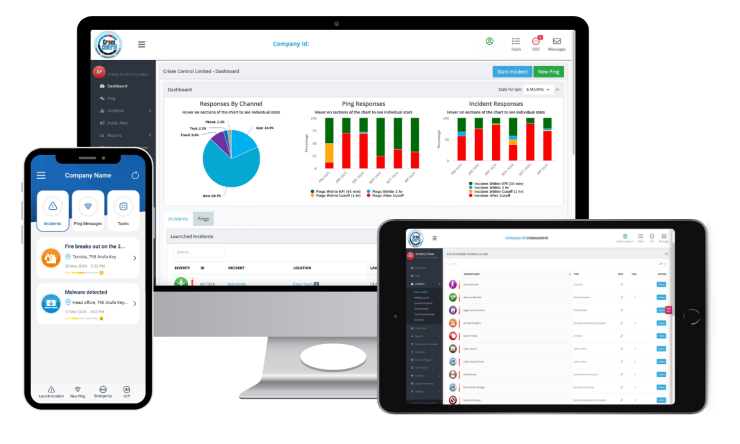
When the code button is pressed, the right system does not broadcast to a group. It sends a specific notification to the crash cart team, a separate notification to the respiratory therapist on duty, a different message to the on-call physician, and a coordination alert to the charge nurse. Each person receives their role in the response, not a generic alert. Each person’s acknowledgement is tracked individually through PING. If the respiratory therapist does not acknowledge within 60 seconds, the system escalates to the backup automatically. Nobody has to make a phone call to find out if she got the message.
It gives someone a live picture of the whole response
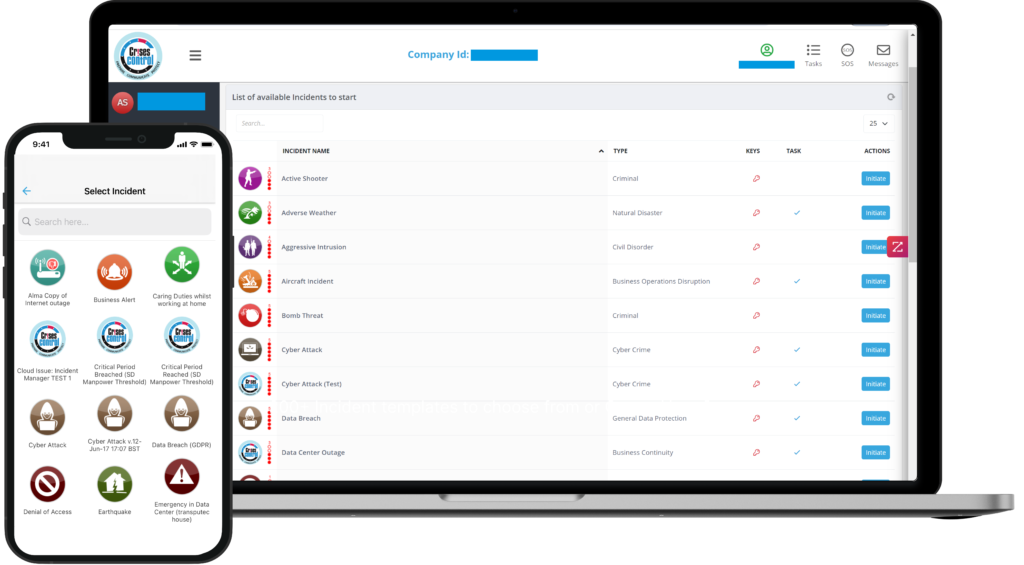
The incident coordinator needs to know, in real time, who has acknowledged, who has not, what has been done, and what is still outstanding. The incident management platform provides a live dashboard that shows every notification sent, every acknowledgement received, and every task still unresolved. Nobody has to chase updates. The picture updates itself.
It writes the documentation as it goes
Every notification sent, every acknowledgement received, every escalation triggered, every task completed: all logged automatically with timestamps as the incident unfolds. By the time the patient is stabilised and the team debrief begins, the compliance record already exists. It is not a reconstruction. It is a live record of what actually happened, accurate to the second.
It works when the network does not
The system operates on its own cloud infrastructure, entirely separate from the hospital’s internal IT environment. If the network goes down during a cyber incident, a power disruption, or a major surge event, the emergency notification system keeps running. It reaches staff by SMS and voice call when digital channels are unavailable. The communication does not stop because the infrastructure it normally runs on has been affected by the same incident it is trying to coordinate.
TigerConnect’s research across multiple hospital systems found that improving code blue workflows with automated notifications can reduce team assembly time by 2.5 minutes. In cardiac arrest, those 2.5 minutes are not a efficiency gain. They are the difference between a patient who survives neurologically intact and one who does not.
How Crises Control Supports Hospital Emergency Response
Crises Control is built for the specific conditions of healthcare emergency response: shift-based staffing, multi-site hospital networks, patient safety obligations that do not pause for technical difficulties, and regulatory documentation requirements that are assessed long after the incident is over. For a fuller picture of what a mass notification system for healthcare needs to deliver, see the earlier post in this series.
When a Code Blue is triggered, PING delivers role-specific alerts simultaneously across SMS, voice, push, and email. The crash cart team, the on-call physician, the respiratory therapist, and the charge nurse each receive the specific information and action relevant to their role. Not a broadcast. A task.
Acknowledgement is tracked in real time. If a staff member does not respond within the configured window, the platform escalates automatically to the backup for that role, without anyone making a phone call. The incident management platform gives the coordinator a live view of the entire response from a single dashboard on any device.
Every action is logged automatically. The CMS and Joint Commission audit trail builds itself throughout the incident. When the surveyor asks to see the documentation from last month’s Code Blue, you pull it up in under a minute.
The platform operates on its own infrastructure, independent of hospital IT systems. When the network is under pressure, the notification system keeps working.
To see how this works against your facility’s specific scenarios, request a personalised demo.
FAQs
1. What is a hospital emergency communication system?
A hospital emergency communication system is the platform that manages how a hospital alerts, coordinates, and documents its response to a critical event. In a Code Blue scenario, it delivers role-specific notifications to the crash cart team, the on-call physician, and support staff, tracks who has acknowledged, escalates automatically when someone does not respond, gives the incident coordinator a live view of the response, and logs every action with a timestamp for compliance documentation. It is different from a basic overhead page or group text system because it coordinates the response rather than simply announcing the event.
2. Why do Code Blue response times vary so much between hospitals?
The biggest variable is not the proximity of the crash cart or the experience of the team. It is the communication system. Hospitals that broadcast a generic alert to a group and wait for people to self-organise consistently have longer response times than hospitals that send role-specific notifications, track acknowledgements, and escalate automatically. Research at the University of Maryland Medical System found a 78-second improvement in team notification time after switching to an automated system, which corresponded to a meaningful improvement in patient survival rates.
3. How does a hospital emergency communication system improve documentation?
Traditional documentation of a Code Blue response is compiled after the fact, from memory and handwritten notes. It is incomplete and frequently inaccurate. A purpose-built system logs every notification sent, every acknowledgement received, every escalation triggered, and every task completed automatically and in real time, each with a precise timestamp. By the time the incident closes, the documentation already exists as a live record of what actually happened. This satisfies Joint Commission and CMS audit requirements without additional effort from staff who were managing the response..
4. What happens if the hospital's internal network goes down during an emergency?
A hospital emergency communication system that depends on the internal network, VPN, or corporate email has a critical vulnerability. Purpose-built platforms operate on their own cloud infrastructure, entirely separate from hospital IT systems. They reach staff via SMS and voice call alongside digital push notifications, so if internal systems are affected by a cyberattack, a power failure, or network overload, the communication platform keeps running. In healthcare, where IT disruptions and ransomware attacks are increasingly common, this independence is not optional.
5. What is the difference between a mass notification system and a hospital emergency communication system?
A mass notification system sends alerts to large groups simultaneously. A hospital emergency communication system does that and coordinates the structured response that follows: role-based task assignment, acknowledgement tracking, automatic escalation, live incident dashboards, and automated compliance documentation. In a Code Blue, you need both. The notification gets the right people moving. The coordination layer makes sure they move in the right direction, in the right sequence, with someone watching the whole picture in real time.