
Written by Dr Shalen Sehgal | Crises Control
A mass notification system is a technology platform that simultaneously delivers emergency alerts and critical information to every person in a defined contact list, across multiple communication channels, with delivery confirmation on each recipient, in a matter of seconds rather than minutes. On a construction site, where a single incident can put dozens of workers in immediate danger across multiple zones, levels, and employer boundaries, it is the difference between a coordinated site-wide response and a fragmented chain of phone calls that reaches the last person on the list four minutes too late.
A gas main is struck during groundworks. A fire breaks out in the welfare block. Scaffolding gives way on the north elevation.
In every one of these scenarios, the site needs to reach every worker, every subcontractor, every visitor, and every designated responder at the same moment. Not sequentially. Not through a chain of radio calls that requires each link to be available and paying attention. Simultaneously, with confirmation that each person has received the message, and with automatic escalation if they have not.
Most construction sites cannot do this. They have radios that reach whoever is on the correct channel. They have phone trees that take four to eight minutes to complete even when every person answers immediately. They have WhatsApp groups where messages sit unread beneath a backlog of daily site chatter. None of these is a mass notification system, and the gap between what they provide and what a real incident requires is measurable in response minutes and, in serious incidents, in lives.
Construction is consistently among the most dangerous industries globally. In Great Britain, 45 construction workers were killed at work in 2022/23 (HSE 2023). In the United States, the construction sector accounted for one in five of all worker fatalities despite employing a fraction of the total workforce (Bureau of Labor Statistics 2023). The industry’s own data consistently shows that delayed or incomplete notification is a contributing factor in a significant proportion of incident escalations.
This blog sets out exactly what a construction-grade mass notification system must deliver, why the tools most sites currently use fall short, how to implement a system that covers every person on a complex multi-employer site, and what the right technology platform looks like when it is working correctly.
Why Construction Sites Are the Hardest Environment to Notify Quickly
Every organisation with a duty of care to its workforce benefits from fast, reliable mass notification. But construction sites combine a set of physical, organisational, and technical factors that make the notification challenge significantly harder than it is in most other environments.
The workforce is physically dispersed across hazardous terrain
A large construction site is not a building with floors and fire escape routes. It is an evolving landscape of structures, excavations, confined spaces, elevated platforms, plant operating areas, and temporary welfare facilities. Workers in a basement level, on a roof, inside a confined space, or operating heavy plant may be entirely out of earshot of any verbal alarm and outside the effective range of a site radio that relies on someone monitoring the correct channel.
A mass notification system that delivers alerts simultaneously via push notification, SMS, and voice call reaches workers wherever they are on the site, regardless of noise levels, line-of-sight barriers, or radio channel discipline.
The workforce changes every day
On most construction sites of any scale, the people present on a given day are not the same people who were present the day before. Subcontractor workforces rotate with the programme. Specialist trades come on-site for a week and leave. Inspectors, surveyors, utility workers, and client representatives arrive unannounced. Delivery drivers spend 20 minutes on site and are gone.
A mass notification system that only holds a static contact list updated weekly is not a mass notification system for a construction site. It is a system for notifying the people who were on site last Tuesday. The contact management function of the platform must be dynamic, with pre-registration of subcontractors before they arrive, visitor access configured at induction, and automatic removal of contacts who have left the site.
Multiple employers mean multiple communication silos
A typical large construction site has the general contractor, a structural steelwork subcontractor, a mechanical and electrical contractor, a groundworks firm, a fit-out team, and any number of specialist trades operating simultaneously. Each has its own supervisory chain, its own preferred communication tools, and its own contact database. None of those databases talks to the others.
When an incident occurs, the general contractor’s notification chain reaches the general contractor’s workforce. It does not automatically reach the structural steelwork team working three zones away, unless a dedicated mass notification system with a unified cross-employer contact list has been configured specifically to do so.
Signal and connectivity are unreliable
Construction sites, particularly those involving basement levels, tunnelling, underground utilities, remote locations, or dense urban environments with signal shadow, regularly operate in areas with poor or intermittent mobile connectivity. A mass notification system that depends entirely on 4G coverage for delivery is not reliable in these environments.
The right platform supports offline queuing, where the alert is stored locally on the device and delivered when the signal is restored, and where alternative delivery channels (SMS via cellular network as a fallback from internet-dependent push notification) provide redundancy when primary channels are degraded.
What Radios, Phone Trees, and WhatsApp Actually Do in a Construction Emergency
Before examining what a mass notification system for construction must deliver, it is worth being precise about what the tools currently in use on most sites actually do when an incident occurs. The gap is not a matter of degree. It is structural.
Two-way radios
Radios are effective for site coordination in normal operations. In an emergency, they have several critical limitations. They require the recipient to be monitoring the correct channel. On a multi-subcontractor site, different employers often operate on different channels, so a site-wide announcement on the general contractor’s channel is not a site-wide announcement at all. Radios have no delivery confirmation: the person making the call has no way of knowing how many people heard the message and how many missed it. There is no task assignment logic, no escalation path, and no audit trail. The radio call is the beginning and end of what the tool can do.
Phone trees and sequential calling
A phone tree, where person A calls persons B and C, who each call two more people, is a common emergency notification method on construction sites that have not invested in mass notification software. Under ideal conditions, a 50-person phone tree takes between four and eight minutes to complete, assuming every person answers on the first ring. Under real incident conditions, where people are working in noisy environments, have their phones in their work bag, or are themselves near the incident, completion times of 12 to 15 minutes are common.
Twelve to fifteen minutes is not a notification delay. It is a response failure. In a serious construction site incident, the first 10 minutes determine whether the response is contained or catastrophic.
Interested in our Incident Management Software?
Flexible Incident Management Software to keep you connected and in control.
WhatsApp and consumer messaging platforms
Consumer messaging applications are not emergency communication systems. A WhatsApp message sent to a group of 40 people at 7.30 am on a busy site sits in a stream of notifications that includes yesterday’s programme update, a materials delivery query, and a photograph of a defect that needs remedying. The message may be read immediately by 10 people, within five minutes by 20 more, and not at all by the remaining 10 who have notifications silenced or whose phones are in a charging locker.
There is no delivery confirmation at the level an emergency requires. There is no escalation logic. There is no structured response capability. And there is no compliant audit trail. Under the documentation requirements of RIDDOR and the investigation standards expected by the HSE, a WhatsApp thread is not an incident record.
Single-channel notification platforms
Some construction organisations have invested in digital notification tools that send a single-channel alert, typically an app push notification or an email. These are a meaningful improvement over phone trees, but a single-channel system has a single point of failure. A worker whose phone is on silent misses the push notification. A worker without the app installed misses it entirely. A worker in a low-signal zone may not receive the notification until they return to a coverage area.
A genuinely effective mass notification system for a construction site delivers the alert across every available channel simultaneously, with independent delivery confirmation on each, so that the failure of any single channel does not compromise the overall notification.
Mass Notification System: 7 Requirements for Construction Sites
The following seven requirements define the minimum standard for a mass notification system that will function reliably on a complex construction site. Each addresses a structural limitation of the existing tools that most sites currently rely on.
1. Simultaneous multi-channel delivery
The system must deliver alerts across push notification, SMS, email, and voice call at the same moment, not sequentially. Each channel is a separate delivery path with independent reliability characteristics. Push notifications are fast but require internet connectivity and an installed app. SMS reaches any mobile phone on any network without an app. Email provides a secondary written record. Voice call reaches workers who may not notice a silent notification.
The alert is considered delivered when the recipient has acknowledged it on any channel. Acknowledgement on one channel does not cancel delivery on others until confirmation is received.
2. Per-recipient delivery confirmation and escalation
Sending the alert is not the same as knowing it has been received. The mass notification system must track delivery and acknowledgement status per recipient, in real time, and must escalate automatically to unacknowledged recipients through alternative channels or to their designated backup contact after a configured timeframe.
The incident commander must be able to see, at a glance, which responders have acknowledged, which have not, and which have been escalated, without making a single phone call to chase confirmation.
3. Unified cross-employer contact lists
The contact database must cover every person on site: directly employed workers, subcontractor operatives, visitors, client representatives, and the general contractor’s own management team. Contact lists must be pre-built for each subcontractor before they come on site and updated dynamically as the workforce composition changes.
Contacts must be grouped in a way that allows site-wide broadcasts, zone-specific alerts, role-based notifications (all first-aiders, all section foremen), and employer-specific messaging, all from a single platform without rebuilding the contact structure for each incident type.
4. Geo-targeted and zone-specific alerting
A site-wide alert for every incident is not an efficient emergency communication strategy on a large construction site. A confined space emergency in Zone C requires an immediate alert to the first responders and zone foremen for Zone C, a secondary alert to all first-aiders site-wide, and a management notification. It does not require the immediate evacuation of the entire site.
The mass notification platform must support site zone mapping and geo-targeted alerting, so that the right people receive the right message at the right level of urgency, and the wider site response is scaled appropriately to the nature and location of the incident.
5. Pre-built alert templates for each incident type
Under incident conditions, the person triggering the alert should not be composing a message from scratch. A worker who has just witnessed a scaffold collapse has neither the time nor the cognitive capacity to write an accurate, complete, calm notification message while simultaneously trying to assist injured colleagues and reach the site manager.
Pre-built alert templates for each incident type, configured in advance by the safety team, mean that the alert trigger releases a complete, accurate, pre-approved message to the correct recipient list with a single press. The operative triggers the alert. The system handles the communication.
6. Integration with the broader emergency response system
A mass notification system that only sends alerts is a notification tool. A mass notification system that is integrated with the site’s incident management platform, so that triggering an alert also activates the pre-built emergency response plan, assigns tasks to named responders, and begins the audit trail, is an emergency response system.
The alert is the trigger. The emergency management system is what turns the trigger into an organised response. Both are necessary. Neither is sufficient without the other.
7. Offline capability and multi-network resilience
The system must function in low or no-signal environments. Alerts queued locally must be delivered when connectivity is restored. Where underground or signal-shadow areas are identified on the site, the notification protocol must include a physical backup (a dedicated first responder assigned to physically check those areas when an alert is triggered) documented in the emergency preparedness plan alongside the digital notification process.
The Subcontractor Notification Problem: Why Coverage Gaps Cost Lives
The most common structural gap in construction site mass notification is the subcontractor workforce. It is also the most dangerous, because subcontractors are frequently working in the higher-risk zones of a construction site: confined spaces, excavations, elevated platforms, areas adjacent to live plant.
The problem has three dimensions.
Subcontractors are not on the general contractor’s contact list by default
Unless a deliberate process has been put in place to pre-register subcontractor operatives on the site’s employee notification system before they arrive on site, they will not be in the contact database when an incident occurs. A notification sent to everyone on the list will not reach them. They will receive whatever communication their own employer’s supervisory chain happens to provide, which may arrive minutes after the general contractor’s workforce has already evacuated.
The fix is administrative and takes approximately two hours per subcontractor firm: collect operative contact details during the subcontractor induction process, add them to the relevant contact groups in the mass notification platform, and confirm they have downloaded and activated the app where applicable. This must happen before day one of that firm’s site presence, not after the incident.
Subcontractors may not have the site’s emergency app installed
A mass notification platform that relies solely on push notifications to a proprietary app will not reach subcontractor operatives who have not installed the app. This is why multi-channel delivery, including SMS to the phone number registered at induction, is not a nice-to-have for construction sites. It is the only delivery mechanism that reaches 100 percent of registered contacts regardless of whether they have engaged with the app.
Subcontractor supervisors are not always plugged into the site management hierarchy
Even when the subcontractor’s operatives are on the contact list, the escalation path if their supervisor does not acknowledge the alert may not be clearly defined. The general contractor’s incident commander needs to know who the backup contact is for each subcontractor firm, and the mass notification system must be configured to escalate to those backup contacts automatically rather than requiring the incident commander to manually find a different number in a moment of high pressure.
How Crises Control Delivers Mass Notification for Construction Sites
Crises Control is built as the execution layer between alert and resolution. The platform’s mass notification system is designed specifically for high-risk environments where speed, coverage, and accountability are non-negotiable.
Simultaneous multi-channel delivery in under 60 seconds
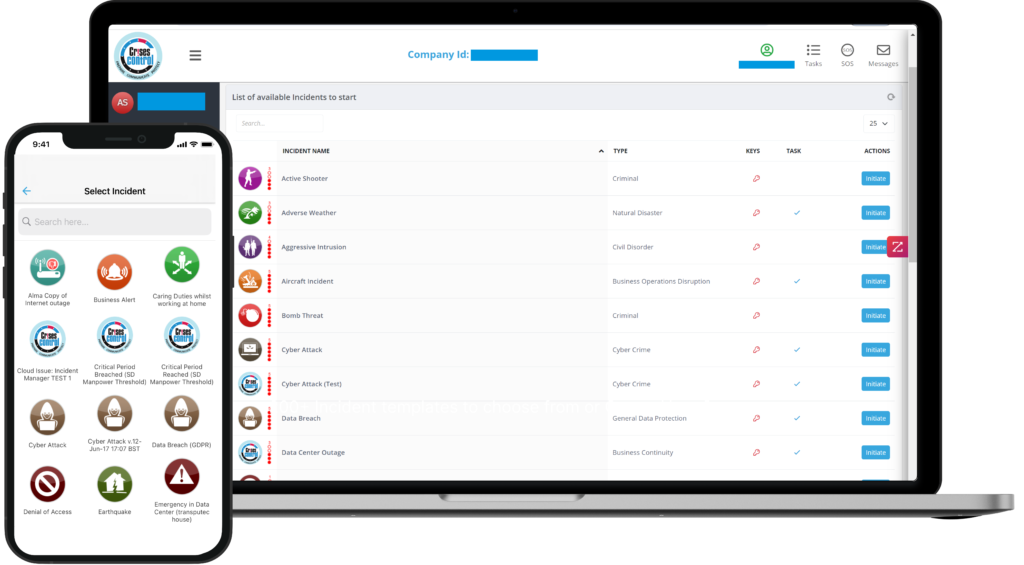
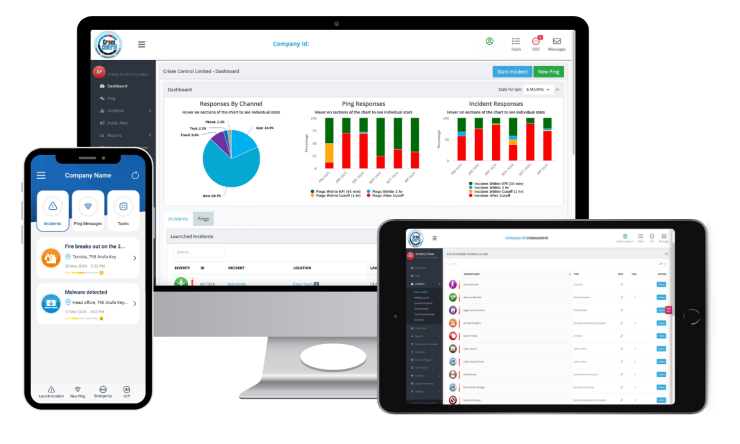
When an alert is triggered, Crises Control delivers the notification simultaneously via push notification, SMS, email, and voice call to every person in the configured recipient list. Delivery and acknowledgement status is tracked per recipient in real time. Unacknowledged recipients are automatically escalated through alternative channels or to their backup contacts after the configured timeframe. The incident commander sees the full acknowledgement picture on the live incident dashboard without making a single follow-up call.
SOS panic button for immediate alert activation
The SOS panic button gives every person on site a one-press mechanism to trigger the mass notification from anywhere on site, without unlocking a phone, navigating a menu, or composing a message. The button transmits the worker’s GPS location alongside the alert, so the incident commander knows both that something has happened and where it has happened from the first second of the notification.
Pre-built alert templates by incident type
Every credible incident type on the site can be pre-configured as an alert template with the correct message, the correct recipient list, and the correct response plan attached. The person triggering the alert selects the incident type. Everything else activates automatically. There is no composition delay, no risk of an inaccurate message, and no dependency on the person triggering the alert being calm and coherent under pressure.
Integrated incident response, not just notification
Crises Control does not stop at the alert. When the mass notification is triggered, the platform simultaneously activates the pre-built incident response plan for that incident type, assigning tasks to named roles with deadlines and automatic escalation if tasks are not acknowledged. The mass communication system becomes the first step of a fully structured response, not a standalone alarm.
Personnel accountability integrated with the notification
A mass notification trigger can simultaneously activate a site-wide or zone-specific roll call, requiring all workers to confirm their safety status through the app. Non-respondents are flagged automatically. The incident commander has a live accountability picture within minutes of the initial alert, built from the same notification infrastructure that delivered the alert, with no additional manual process required.
Compliant audit trail from first alert to incident close
Every alert sent, every delivery confirmation, every acknowledgement, every escalation, and every response action is automatically logged and timestamped by Crises Control. The platform generates post-incident reports that satisfy RIDDOR documentation requirements, support HSE investigation processes, and provide the evidence base required by insurers and clients. The audit trail is also the organisation’s institutional record of how the mass notification system performed, informing improvements to the next version of the emergency preparedness plan.
Mass Notification Software Comparison: Where Other Platforms Fall Short on Construction Sites
The mass notification software market includes several well-established platforms. Understanding where they deliver value and where they have structural gaps is essential for construction organisations evaluating their options.
Everbridge is a market-leading emergency notification system with strong alerting capability, wide channel coverage, and enterprise-grade contact management. For construction sites, the gap is in what happens after the alert is delivered. Everbridge sends the notification. It does not activate a response plan, assign tasks, manage escalation, or produce a compliant incident audit trail integrated with the response workflow. The alert goes out. The response is left to whoever receives it.
AlertMedia provides strong mass communication system capabilities with good multi-channel delivery and contact management. Like Everbridge, its focus is on the notification layer. The coordination, task management, and audit trail that a construction site incident response requires are not native to the platform.
OnSolve delivers reliable notification with good geographic targeting capability. Again, the limitation for construction environments is the absence of an integrated response layer. The notification system and the incident management process are separate, requiring manual coordination between them at the moment when manual coordination is most likely to fail.
Microsoft Teams and Slack are everyday communication tools that some construction organisations attempt to use for emergency notification. Neither was designed for this purpose. Neither has structured escalation logic, delivery confirmation at the level an emergency requires, pre-built response plan integration, or a compliant audit trail. Using them for emergency notification on a construction site is a category error that becomes apparent in the first serious incident.
Crises Control is built to be the complete execution layer: notification, response plan activation, task management, accountability, and audit trail in a single integrated platform. It does not require a separate tool for each function, and the functions are not loosely coupled. When the notification goes out, the response plan activates. When a task is assigned, its completion is tracked. When the incident closes, the full record is preserved.
Implementing a Mass Notification System on a Construction Site: 6 Steps
A mass notification platform that is technically capable but poorly implemented will not deliver its potential under real incident conditions. The following six implementation steps are the minimum standard for a construction site deployment that will work when it is needed.
- Map the site and define notification zones before deployment. Divide the site into named zones with designated local responders for each. Configure zone-specific contact groups so that alerts can be targeted to the right area without broadcasting to the entire site for every incident type. Confirm which areas have signal coverage and document the physical backup protocol for areas that do not.
- Build and maintain the unified contact database before any subcontractor comes on site. Pre-register every subcontractor firm’s operatives as part of the induction process. Configure visitor access for temporary notification coverage during site attendance. Set up role-based groups (all first-aiders, all section foremen, all emergency wardens) that can be used as notification targets without rebuilding the list for each incident.
- Build pre-built alert templates for every credible incident type on the site. Each template should include the correct message, the correct recipient list, the correct response plan, and the correct escalation path. Review and update templates every time the site configuration changes significantly or a new high-risk activity begins.
- Configure delivery confirmation thresholds and escalation rules for each incident type. A medical emergency may require acknowledgement within 60 seconds before escalation. A security incident may allow 120 seconds. Configure these thresholds based on the response time requirements of each incident type, not a single generic setting across all alert categories.
- Test the system before the site goes live and after every significant change. Send a test alert to the full contact list and verify delivery across all channels. Confirm that escalation triggers correctly for unacknowledged contacts. Verify that the alert template activates the correct response plan. Record the test results and any failures identified, and fix them before the system is relied upon in a real incident.
- Review the delivery and acknowledgement data after every alert, including drills. Response times, acknowledgement rates, channel performance, and escalation frequency all provide data about how the mass notification system is actually performing versus how it is expected to perform. Use this data to improve the configuration. The system gets better through use, but only if the data is reviewed.
Regulations and Standards That Govern Construction Site Mass Notification
No single regulation mandates the use of a mass notification system on a construction site by name, but the combined requirements of the following frameworks define what effective emergency communication must achieve, and a manual phone tree does not achieve it.
- The Construction (Design and Management) Regulations 2015 require the principal contractor to have arrangements in place for managing emergencies on site, including the means to alert all workers and coordinate the emergency response. The arrangements must be proportionate to the scale and complexity of the site. On a multi-employer site with a large and changing workforce, a phone tree is not a proportionate arrangement.
- The Health and Safety at Work Act 1974 requires employers to provide adequate means for raising an alarm in an emergency and maintaining safe systems of work. The adequacy test applies to the actual population on site, including subcontractors, not just directly employed workers.
- RIDDOR requires notification of specified incidents to the HSE within defined timeframes and documentation of the response. The automatic audit trail generated by a mass notification platform integrated with the incident management system satisfies this requirement without additional administrative effort.
- ISO 22320 provides the international standard for incident management, including the communication protocols and documentation requirements that a construction site emergency response system should implement. Effective mass notification is a core component of ISO 22320 compliance.
- ISO 22301 governs business continuity. For construction firms managing multiple active projects simultaneously, a serious incident on one site has implications across the portfolio. An emergency notification system integrated with the site’s incident management platform supports the activation of the wider business continuity response in parallel with the on-site emergency response.
- GDPR incident response obligations apply wherever personal data is processed in the course of an emergency response, including the contact data of workers and the communications records generated by the notification system. The Crises Control audit trail is designed to satisfy these obligations while preserving a complete record of the response.
What a Construction Site Mass Notification System Looks Like When It Works
The test is not whether the platform can send a message. Every platform on the market can do that. The test is whether the platform can reach every person on a complex multi-employer construction site, confirm each one has received the alert, escalate automatically to those who have not, activate the structured response plan, support the incident commander with a live operational picture, and preserve a compliant record of every action taken, all within the first 90 seconds of an incident.
A mass notification system that meets this standard has the following properties on a construction site:
- Every person on site is in the contact database, including subcontractors and visitors, before the incident occurs, not assembled after it.
- The alert reaches every person simultaneously across multiple channels. The failure of any single channel does not compromise overall notification coverage.
- Delivery confirmation is tracked per recipient in real time. The incident commander knows who has acknowledged and who has not without making a single follow-up call.
- Unacknowledged recipients are escalated automatically. No manual chasing is required from the incident commander at the moment they are most needed elsewhere.
- Triggering the alert simultaneously activates the pre-built response plan for that incident type, assigns tasks to named roles, and begins the audit trail.
- The system works in low-signal areas, either through offline queuing or documented physical backup protocols.
- Every alert, every delivery confirmation, every acknowledgement, and every response action is automatically logged in a format that satisfies RIDDOR documentation requirements and supports any subsequent investigation or legal proceedings.
See how Crises Control supports mass notification systems in the construction sector on the construction industry page, or request a demo to see it in action against a live construction incident scenario.
FAQs
1. What is a mass notification system and why does construction specifically need one?
A mass notification system is a platform that simultaneously delivers emergency alerts to every person in a contact list, across multiple channels, with delivery confirmation on each recipient. Construction sites need one specifically because the workforce is large, physically dispersed, frequently changing, employed by multiple different firms, and working in environments where traditional communication tools are unreliable. A phone tree takes too long. A radio reaches the wrong people or no one. A mass notification system reaches everyone simultaneously and confirms it.
2. How does a mass notification system differ from a mass communication system?
A mass communication system sends information to a large audience. A mass notification system sends urgent alerts with delivery confirmation, escalation logic for unacknowledged recipients, and integration with emergency response procedures. The distinction matters in practice: a mass communication system is used for operational updates, programme changes, and general information. A mass notification system is built for incidents where confirmation that every person has received the alert is a life-safety requirement, not a nice-to-have. .
3. How do subcontractors get covered by a construction site mass notification system?
Subcontractors are covered by pre-registering their operatives on the site’s notification platform during the induction process, before their first day on site. Contact details are added to the relevant zone and role-based contact groups. Multi-channel delivery, including SMS, ensures that subcontractor operatives without the app installed still receive the alert. Escalation rules are configured to include the subcontractor firm’s supervisor as a backup contact if individual operatives do not acknowledge within the required timeframe.
4. What happens if the mass notification system cannot reach a worker in a low-signal area?
A well-implemented mass notification platform queues alerts locally on the device and delivers them when signal is restored. For areas with persistent or structural signal absence, such as deep basement levels or underground utility corridors, the emergency preparedness plan should include a physical backup protocol: a designated first responder assigned to physically check those areas when an alert is triggered site-wide. The physical protocol is documented alongside the digital notification process so that the incident commander knows coverage is confirmed rather than assumed.
5. What regulations require a construction site to have a mass notification system?
No single regulation mandates a mass notification system by name, but the CDM Regulations 2015, the Health and Safety at Work Act 1974, RIDDOR, and ISO 22320 together define emergency communication requirements that a manual phone tree cannot reliably satisfy on a complex multi-employer construction site. The adequacy of the notification system is assessed against its ability to reach the entire site population quickly, confirm receipt, and support the documented emergency response plan. Crises Control’s mass notification platform is designed to meet all of these requirements.