How critical event management improves emergency preparedness is the question that separates organisations that survive disruption from those that do not. Critical event management is the structured discipline of identifying threats, coordinating responses, and recovering from incidents that carry significant operational or safety consequences. Emergency preparedness is the state of readiness that makes the response effective. The relationship between the two is not theoretical. It is operational, measurable, and directly tied to outcomes.
Most organisations have plans. Very few have the infrastructure to execute them when it matters.
The State of Emergency Preparedness Today
Natural disasters caused 280 billion dollars in global economic losses in 2024, a 19 percent increase above the previous five-year average (UNDRR Global Assessment Report 2025). Eighty percent of organisations that experience a significant disruption without a functioning business continuity plan fail within 18 months of the event (Secureframe 2025). Yet 51 percent of businesses still operate without a comprehensive business continuity plan in place.
The cost of unpreparedness is not abstract. Ninety percent of mid-sized and large enterprises lose 300,000 dollars or more for every hour of downtime (ITIC 2024). For 41 percent of enterprises, that figure reaches between one million and five million dollars per hour. These are not theoretical risk scenarios. They are the operational consequences of the gap between documentation and execution capability.
The gap is not a strategy. Most organisations have crisis management plans, emergency response frameworks, and documented business continuity procedures. The gap is execution. When a critical event begins, the plan sits in a folder while teams lose time establishing who does what, through which channel, and how to confirm it is happening. Understanding how critical event management improves emergency preparedness means understanding how it closes that execution gap, step by step, before the next incident arrives.
25% of businesses that close following a major disruption never reopen. Every dollar invested in preparedness returns an average of $15 in avoided recovery costs (US Chamber of Commerce Foundation).
How Critical Event Management Improves Emergency Preparedness: 6 Steps
The improvement is not passive. It does not happen by purchasing a platform or writing a policy. It happens through six specific steps that together transform emergency preparedness from documentation into operational capability.
Step 1. Conduct a Structured Risk and Threat Assessment
Emergency preparedness begins with knowing what the organisation is preparing for. A critical event management approach forces specificity. It requires organisations to name each threat category, assign a likelihood and impact rating, and map the operational consequences of each scenario. Cyberattacks, natural disasters, infrastructure failures, supply chain disruptions, and public health events: each carries different triggers, different response requirements, and different communication needs.
A generic risk register produces generic readiness. A structured critical event management assessment produces scenario-specific plans that can be activated when the specific threat materialises. The crisis management plan guide covers the full risk assessment lifecycle in practical detail.
Step 2. Build a Coordinated Communication Architecture
The most consistent failure point in emergency response is communication. Not the absence of tools, but the absence of a coordinated architecture that connects the right tools to the right people at the right moment.
Critical event management defines which channels carry which alerts, who receives them, in what sequence, and how confirmation is tracked back to command. SMS, voice, email, push notification, and in-app alerts serve different purposes across different incident types and audience groups. Without a coordinated architecture, each channel operates in isolation, and the result is noise rather than a coordinated response.
See how mass notification systems deliver coordinated alerts across all channels from a single trigger, with two-way confirmation built in at every step.
Step 3. Define Roles, Responsibilities, and Decision Authority
Emergency preparedness collapses when the first question during an incident is who is in charge. A critical event management framework maps every role in the response structure, names the decision owner for each incident type, and defines the escalation path when that owner is unavailable.
This is not organisational bureaucracy. It is the structural clarity that determines whether a response begins in seconds or after ten minutes of internal negotiation, during which the incident is escalating.
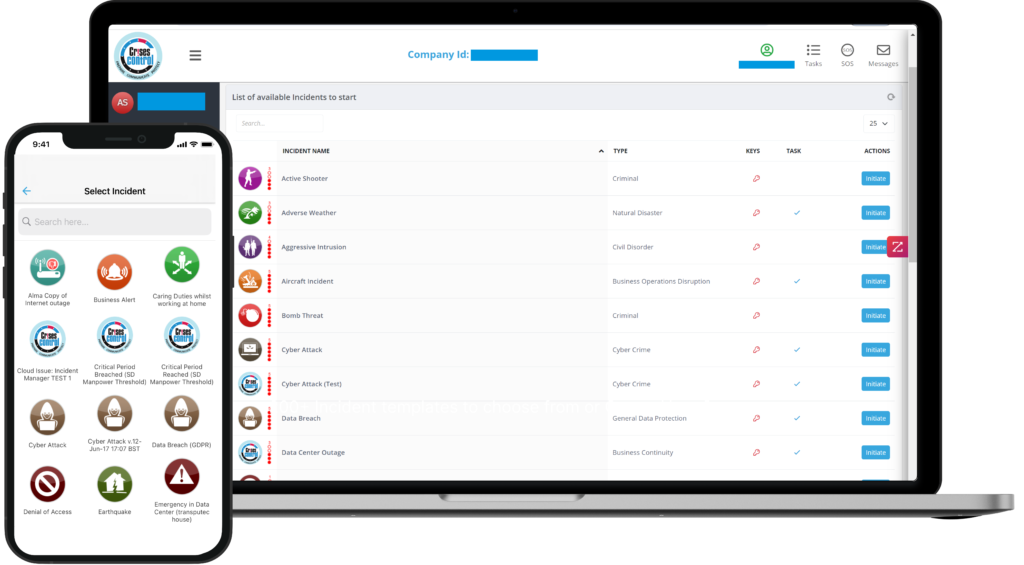
Interested in our Incident Management Software?
Flexible Incident Management Software to keep you connected and in control.
Step 4. Establish Real-Time Monitoring and Situational Awareness
Preparedness is only as effective as the speed at which an organisation detects that a critical event has begun. Critical event management integrates threat monitoring, early warning indicators, and operational data to give decision-makers situational awareness before an incident has reached full impact.
Without real-time monitoring, organisations discover critical events after they have already caused damage, removing the early response window that preparedness is specifically designed to protect. Awareness at the point of impact is not preparedness. It is a damage assessment.
80% of organisations are unprepared for outages, despite 93% of leaders identifying them as a concern and 95% acknowledging existing vulnerabilities. Awareness of risk and readiness to respond are not the same thing (Secureframe 2025).
Step 5. Run Integrated Exercises and Simulations
A plan that has never been tested under realistic conditions is not a preparedness asset. It is a document. Critical event management brings structure to exercises and simulations, ensuring every role is tested, every communication channel is evaluated under load, and every gap is identified before a real incident exposes it. Tabletop exercises for emergency preparedness are one of the most effective ways to stress-test your response framework before a real event demands it.
Only 15 percent of businesses conduct regular continuity testing (Secureframe 2025). The organisations that do test consistently discover their communication architecture fails under network load, their escalation paths are unclear in practice, and their task ownership breaks down at handover. The ones that do not test discover the same things during an actual critical event.
Step 6. Create a Continuous Improvement Loop with Post-Incident Data
Emergency preparedness does not improve through intention. It improves through data. Critical event management platforms generate automatic audit trails: every alert sent, every acknowledgement received, every task completed or stalled, timestamped and logged from the moment an incident begins to the moment it closes.
This record drives post-incident review, identifies precisely where response slowed or failed, and produces the specific changes that make the next response faster and more coordinated. Without this loop, organisations revise their plans based on memory and assumption rather than evidence and repeat the same gaps across successive incidents.
Where Most Emergency Preparedness Programmes Fall Short
Most organisations treat emergency preparedness as a compliance requirement. They produce the documentation, complete the annual exercise, and file the plan. What they do not build is the execution infrastructure that connects the plan to the response in real time.
The tools most commonly used compound the problem. Alerting platforms send notifications but have no coordination layer after the alert goes out. Everyday tools like Microsoft Teams and Slack have no incident-specific structure, no audit trail, and no task-based coordination framework. Risk planning software documents the framework but is not built for the speed of a live response.
The result is a preparedness programme that functions on paper and fails under the conditions it was designed for.
Most competitors either notify people or document plans. Crises Control executes the response. Built for real incidents, not demos.
How Crises Control Strengthens Emergency Preparedness Through Critical Event Management
Crises Control is built around the execution layer that emergency preparedness requires. Its capabilities map directly onto each of the six steps above.
Structured risk and scenario coverage is supported through pre-built incident templates and customisable response plans, so organisations move from threat identification to actionable response without building from scratch.
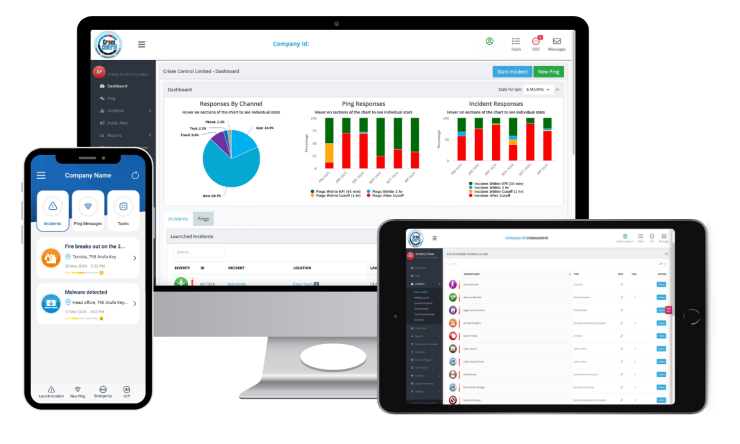
The coordinated communication architecture delivers alerts simultaneously across SMS, voice, email, push notification, and in-app channels from a single trigger. Every alert is tracked. Every recipient confirms receipt. The command team has a live dashboard, not a sent-items folder.
Role definition and decision authority are embedded in the task assignment framework. When a critical event begins, the right person receives the right instruction in the right sequence, automatically.
The automatic audit trail logs every action with a timestamp, producing the post-incident record that powers continuous improvement and satisfies compliance requirements under ISO 22301, ISO 22320, DORA, and GDPR incident frameworks.
Explore how the critical event management platform supports full-cycle preparedness, review the emergency response plan framework for practical planning guidance, and see how mass notification systems deliver coordinated alerts at scale. The crisis management plan guide covers the full planning lifecycle from risk assessment through to post-incident review.
Is Your Emergency Preparedness Built to Execute, or Just to Document?
Most organisations discover the answer to that question during an incident, not before one. The cost of that moment, in downtime, in recovery, and in the 25 percent of businesses that never reopen, is avoidable.
Critical event management gives organisations the platform to move from preparedness as documentation to preparedness as operational capability. Real-time alerts. Coordinated response. Task tracking. Automatic audit trail. All from a single platform built for real incidents.
See how Crises Control works for your organisation before the next critical event begins.
Get a free personalised demo.
No commitment required. One of our crisis management specialists will walk you through a demonstration built around your organisation’s specific threat scenarios and response requirements.
FAQs
1. How does critical event management improve emergency preparedness in an organisation?
Critical event management improves emergency preparedness by closing the gap between documented plans and operational execution. It provides the communication infrastructure, decision frameworks, real-time monitoring, and audit capability that transforms a plan into a coordinated response. When a critical event begins, the platform ensures the right people receive the right information through the right channels, with status confirmed back to command in real time.
2. What is the biggest weakness in most emergency preparedness programmes?
The most common failure is the gap between documentation and execution. Most organisations have plans but lack the infrastructure to activate them under real incident conditions. Communication channels are not coordinated, decision authority is unclear, and there is no audit trail to support post-incident review. Critical event management addresses all three by embedding execution capability into the preparedness framework.
3. How does mass notification support emergency preparedness?
Mass notification is the alert layer of an emergency preparedness programme. It delivers the first communication across SMS, voice, email, push, and in-app channels simultaneously, reaching all stakeholders within seconds of an incident being confirmed. Without a coordinated mass notification capability, the first step in any emergency response depends on manual communication, which introduces the delays that preparedness exists to eliminate.
4. How often should organisations test their emergency preparedness plans?
Organisations should test their plans at operational scale at least once per year, with tabletop exercises run more frequently for specific scenario types. Only 15 percent of businesses conduct regular continuity testing (Secureframe 2025). Those that test consistently identify and close gaps before a real incident exposes them. Post-exercise data should feed directly into plan updates, creating the improvement loop that makes each test more valuable than the last.
5. What compliance frameworks require emergency preparedness and critical event management capability?
ISO 22301 sets the international standard for business continuity management, including emergency preparedness requirements. ISO 22320 covers emergency management and response coordination. DORA requires financial sector organisations to demonstrate operational resilience under ICT-related disruptions. GDPR mandates documented incident response capability for data breaches. Critical event management platforms aligned with these frameworks reduce compliance burden while improving actual response capability.