Critical Event Management is the discipline of identifying, responding to, and recovering from events that materially affect an organisation’s people, operations, assets, brand, or compliance position. The platforms that support the discipline, known as Critical Event Management software or CEM platforms, sit at the centre of the response, providing the integrated monitoring, mass notification, incident orchestration, stakeholder communication, and audit trail capability that turns a developing event into a managed operational episode rather than a reputational incident. A formal Request for Proposal is how serious organisations select that platform.
This guide provides a structured RFP framework for Critical Event Management software procurement in 2026. It is written for senior buyers leading evaluation cycles across enterprise IT, Operations, Risk, Compliance, and Security functions. The framework covers the nine sections every credible Critical Event Management RFP should address, with the specific vendor questions to ask in each section, the form a strong vendor response should take, and the red flags to watch for. The objective is to surface differentiation honestly, score evidence rather than slideware, and arrive at a platform decision the buyer can defend to the board.
Why a structured RFP is essential for Critical Event Management procurement in 2026
Critical Event Management procurement has shifted from a comparative shopping exercise into a regulated buying decision. Three forces have changed the procurement environment in ways that make a structured RFP not optional but operationally necessary.
First, regulatory scope is widening. Under the upcoming UK Cyber Security and Resilience Bill, managed service providers and designated critical suppliers enter formal regulatory scope from late 2026, with 24-hour early warning and 72-hour full incident reports required to both the sector regulator and the National Cyber Security Centre. Financial services firms already operate under FCA operational resilience and DORA. A CEM platform without the audit-trail discipline to satisfy these regimes creates exposure that surfaces at the worst possible moment.
Second, board oversight has intensified. Operational resilience now sits as a named risk category in board reporting frameworks across regulated sectors. The board does not ask whether the CEM platform was demonstrated to be the cheapest. The board asks whether the procurement decision was defensible. Defensibility requires a documented evaluation process, not a vendor shootout.
Third, the market has matured into clearly differentiated platform categories. Mass notification specialists, dedicated incident coordination platforms, broad critical event management suites, and integrated crisis management software each occupy distinct positions in the market with different operational shapes and different commercial models. A buyer evaluating across these categories without a structured framework will compare features that are not directly comparable and miss the architectural differences that determine fit.
A structured RFP is the procurement artefact that turns Critical Event Management selection from a marketing-driven decision into an evidence-driven one. The framework matters more than any individual question on it.
The nine sections of a Critical Event Management software RFP
A credible critical event management RFP organises vendor questions into nine procurement sections, each addressing a distinct dimension of the platform decision. The summary below previews all nine; the sections that follow walk each in depth with the specific questions to ask, the form a strong response takes, and the red flags to watch for.
|
# |
RFP section |
Procurement category |
Why it matters |
|
1 |
Vendor background |
Vendor stability and credibility |
Filters platforms with operational scale and longevity |
|
2 |
Platform architecture |
Technical capability |
Determines resilience and scale ceiling |
|
3 |
Mass notification |
Core operational function |
Tests speed, reach, and reliability under load |
|
4 |
Incident orchestration |
Workflow and coordination |
Differentiates platforms that orchestrate from those that only notify |
|
5 |
Integration |
Interoperability |
Tests fit with existing ITSM, monitoring, and identity stack |
|
6 |
Security and data protection |
Risk and assurance |
Tests vendor security posture and data handling |
|
7 |
Compliance and audit |
Regulatory exposure |
Tests platform fit for the buyer’s regulatory regime |
|
8 |
Implementation |
Customer success and onboarding |
Determines whether the platform actually gets deployed |
|
9 |
Commercial terms |
Pricing and contract |
Tests total cost over a three-year horizon |
SECTION 1 OF 9 · Vendor stability and credibility
Vendor background and accreditation
Section 1 filters the platforms with operational scale and longevity to support a Critical Event Management commitment. The vendor’s own continuity matters because a CEM platform is, by definition, the system the buyer turns to when their own operations are under stress. A vendor that disappears, restructures aggressively, or under-invests in the product over the contract term creates risk that compounds over the relationship.
Q1. Provide the vendor’s full legal name, headquartered country, year of incorporation, parent company structure, and ownership model. Include any acquisitions or sales of the Critical Event Management business unit in the past five years.
Q2. Provide audited financial statements for the most recent three fiscal years, or equivalent commercial evidence if privately held. State annual recurring revenue, growth rate, and customer retention rate over the same period.
Q3. List the vendor’s relevant certifications. Indicate whether each certification is held by the vendor entity itself, by a parent organisation, or referenced as aspirational alignment. Required certifications: ISO 22301 Business Continuity, ISO 27001 Information Security, Cyber Essentials Plus, SOC 2 Type II. Include scope statement and certificate validity dates.
Q4. Provide three named reference customers in the buyer’s sector with a comparable operational profile. Include customer organisation name (subject to NDA), deployment size, length of relationship, primary use case, and a direct customer contact willing to take a reference call. Anonymous references are not acceptable for this section.
WHAT A STRONG RESPONSE LOOKS LIKE Strong vendor responses provide named legal entity, audited financials or equivalent disclosure, certifications held by the entity itself (not by a parent or partner organisation), and three named reference customers willing to take direct reference calls. The references should be in the buyer’s sector with a comparable operational profile, not curated showcase accounts from a different vertical. Vendor longevity should be visible, with stable ownership and consistent platform investment.
WATCH FOR Certifications held by a parent organisation rather than the vendor entity itself, anonymous reference customers, financial disclosure refused, recent ownership changes that have not stabilised, or evidence of significant restructuring that may signal under-investment in the platform. Acquired-and-rebranded products from a different category, repositioned as CEM software, often present accreditation gaps.
SECTION 2 OF 9 · Technical capability
Platform architecture and resilience
Section 2 establishes whether the platform can deliver Critical Event Management capability at the scale and resilience the buyer’s operations require. CEM platforms are themselves operationally critical systems. A platform that runs in a single hyperscaler region as the buyer’s primary stack creates a single point of failure for the very events the platform exists to manage.
Q5. Describe the platform’s hosting architecture. Name the hyperscaler infrastructure, the regions in use, and the failover topology between regions. State the documented uptime SLA with credit-back clauses, and provide the most recent twelve months of actual uptime against that SLA.
Q6. Describe the platform’s data residency options. Confirm availability of UK, EU, and other regional residency choices required by the buyer’s operations. State which control plane and data plane components, if any, route through countries outside the chosen residency boundary.
Q7. Describe the platform’s scale ceiling for mass notification. State the maximum demonstrated number of recipients reached and confirmed within 60 seconds, 90 seconds, and 5 minutes in production deployments. Provide reference scenarios that produced these benchmarks.
Q8. Describe the platform’s disaster recovery testing programme. State the frequency of full failover tests, the documented Recovery Time Objective, the documented Recovery Point Objective, and the most recent test result. Provide a recent disaster recovery test report under NDA.
WHAT A STRONG RESPONSE LOOKS LIKE Strong vendor responses describe multi-region hyperscaler hosting with active-active or active-passive failover documented in technical detail. UK, EU, and other regional data residency options are named and contractually available. The platform’s scale ceiling is supported by named reference scenarios with timestamped evidence. Disaster recovery testing happens at quarterly or better frequency, with full failover tests rather than tabletop exercises, and documented results from the most recent test.
WATCH FOR Single-region hosting with no documented failover, control plane in a country outside the data residency boundary the buyer requires, scale claims that cannot be supported by named customer references, disaster recovery testing limited to annual tabletop exercises, or refusal to share disaster recovery test reports even under NDA. Platforms unable to demonstrate behaviour during a real hyperscaler region event in the past 24 months have not stress-tested their resilience.
SECTION 3 OF 9 · Core operational function
Mass notification capability
Section 3 evaluates the platform’s core mass notification engine under enterprise load. This is the capability most commonly demonstrated by vendors at small scale, where every platform looks adequate. The procurement test is whether the capability holds at 200 to 2,000 recipients, across multiple channels, with two-way confirmation captured per recipient and automatic escalation when acknowledgement does not arrive.
Q9. List the notification channels delivered by the platform natively. Confirm parallel delivery (all channels for all recipients dispatched simultaneously) versus serial delivery (channels queued through a single broker). Provide evidence of parallel delivery at recipient counts of 200, 500, and 1,000.
Q10. Confirm native iOS and Android mobile applications with Apple Critical Alerts framework support and Android high-priority notification channel support. Critical Alerts must break through Do Not Disturb mode. Demonstrate this live in the vendor’s demo using a recipient device the buyer brings into the demo.
Q11. Describe two-way acknowledgement capture. State which channels support acknowledgement capture (SMS reply, voice keypress, push response, email link, mobile app, Microsoft Teams, Slack), and whether acknowledgement is written to the incident record with timestamp and recipient identifier in all cases.
Q12. Describe automatic escalation logic. State whether escalation windows are configurable per incident type, how many tiers of named deputies the platform supports, and what happens if the entire escalation chain does not acknowledge. Demonstrate the full three-tier escalation live during the vendor’s demo.
Q13. Describe multi-language template support. List the languages supported natively, the translation workflow (manual, AI-assisted, or both), and the audit trail captured for translated content. Confirm whether translated templates are versioned alongside source-language templates.
WHAT A STRONG RESPONSE LOOKS LIKE Strong vendor responses describe parallel delivery across all configured channels, with named scale evidence at 200, 500, and 1,000 recipients. Native mobile applications support iOS Critical Alerts and Android high-priority channels, demonstrated live in the buyer’s demo with the buyer’s own device in Do Not Disturb mode. Two-way acknowledgement is captured per channel and written to the incident record with second-level timestamps. Automatic escalation runs across three or more named tiers with full demonstrability. Multi-language template support covers the languages the buyer’s audiences operate in.
WATCH FOR Serial delivery dressed up as multi-channel, push notifications that do not break through Do Not Disturb, acknowledgement capture only on a subset of channels, escalation logic that is hardcoded rather than configurable, or translation workflow that bypasses the audit trail. Vendors who refuse to demonstrate Critical Alerts breaking through Do Not Disturb on the buyer’s own device have either not implemented the framework or hold the iOS entitlement weakly.
SECTION 4 OF 9 · Workflow and coordination
Incident orchestration and workflow
Section 4 separates platforms that orchestrate the response from platforms that only notify. Orchestration is the difference between an alert that mobilises engineers and a workflow that mobilises engineers, assigns named tasks, tracks status, surfaces blockers, and provides leadership with a single consolidated dashboard rather than five fragmented updates. Many platforms market themselves as orchestration tools but deliver only enhanced notification.
Q14. Describe the platform’s playbook capability. State whether playbooks are pre-built and configurable, who can author and modify playbooks (admin, business user, or both), how versioning is handled, and whether playbook execution is auditable end-to-end.
Q15. Describe task assignment, dependency, and status tracking. State whether tasks have named owners with named deputies, whether task completion automatically triggers dependent tasks, and how blocked tasks surface visibly to the Major Incident Manager.
Q16. Describe the live incident dashboard available to leadership during a major event. State which roles can access which views, whether the dashboard is real-time or polled, and how the dashboard handles concurrent active incidents.
Q17. Describe stakeholder communication automation during active incidents. State how customer communications by SLA tier draft from templates, how internal stakeholder updates fire on schedule, and how status page updates publish from the same source as customer communications to ensure consistency across audiences.
WHAT A STRONG RESPONSE LOOKS LIKE Strong vendor responses describe playbooks that are authored and modified by business users (not only by admin staff), with versioning and end-to-end audit trail. Task management includes named owners, named deputies, dependency logic, and visible surfacing of blocked tasks to the Major Incident Manager. Live incident dashboards provide role-based views in real time, handle concurrent active incidents cleanly, and consolidate fragmented updates into a single source of operational truth. Stakeholder communication automation drafts from templates and publishes consistently across all audiences.
WATCH FOR Playbook capability marketed but limited to admin-authored static templates, task management that does not surface blocked tasks visibly, dashboards that lag by minutes rather than refreshing in real time, or stakeholder communication features that do not enforce consistency across audiences. Platforms that handle one major incident at a time but cannot handle concurrent active incidents fail at the scale most enterprises actually face.
SECTION 5 OF 9 · Interoperability
Integration and interoperability
Section 5 tests fit with the buyer’s existing ITSM, monitoring, identity, and collaboration stack. CEM platforms do not operate in isolation. The platform must accept signals from monitoring tools, raise tickets in ITSM platforms, route notifications through collaboration tools, and pull on-call rotas from identity systems. Integration depth varies dramatically across vendors and is one of the most consequential differentiators in CEM procurement.
Q18. List native integrations with ITSM platforms. State whether each integration is bidirectional (ticket updates both directions) or one-way, and whether the audit trails reconcile across systems. Required: ServiceNow, Jira Service Management, Halo, Freshservice, ConnectWise, Autotask, Datto.
Q19. List native integrations with monitoring tools. State whether each integration uses webhooks, polling, or API. Required: Datadog, New Relic, Splunk, Dynatrace, Prometheus, PagerDuty, SolarWinds.
Q20. List native integrations with identity and HRIS systems for shift-aware routing. Required: Azure Active Directory, Okta, Workday, ADP, SAP SuccessFactors. State how on-call rota changes propagate to the platform and the delay between rota change and platform recognition.
Q21. List native integrations with collaboration platforms. Required: Microsoft Teams (full bidirectional integration including incident-to-channel mapping and acknowledgement capture from Teams), Slack (equivalent functionality), Zoom, WhatsApp.
Q22. Describe the platform’s API and webhook capability. State authentication methods supported (SAML SSO, SCIM, OAuth 2.0, API key), rate limits, available SDKs, and documentation completeness.
WHAT A STRONG RESPONSE LOOKS LIKE Strong vendor responses list bidirectional native integrations across ITSM, monitoring, identity, and collaboration categories, with audit trails that reconcile across systems. API and webhook capability is well-documented with SDKs in the buyer’s preferred language stack. Authentication supports SAML SSO and SCIM as a baseline. Rate limits are explicit and sufficient for the buyer’s expected operational load. Microsoft Teams integration in particular should support full bidirectional functionality including acknowledgement capture from Teams without users leaving the application.
WATCH FOR Integration claims with no demonstration during the demo, one-way integrations marketed as bidirectional, API rate limits that throttle during real incidents, or authentication options limited to API keys without SAML SSO support. Platforms that integrate with ServiceNow only via professional services engagement, rather than through a native pre-built connector, will surface integration costs in implementation that were not visible in the licence quote.
SECTION 6 OF 9 · Risk and assurance
Security and data protection
Section 6 evaluates the vendor’s security posture and data handling practices. CEM platforms hold sensitive contact data, real-time location data, organisational hierarchy data, and detailed incident records. The vendor’s security posture becomes the buyer’s regulatory exposure if the platform is breached. Many CEM RFPs underweight this section and discover the gap during the security review board’s review of the shortlist.
Q23. Describe the platform’s encryption posture. State encryption-at-rest standards (AES-256 minimum), encryption-in-transit standards (TLS 1.3 minimum), and customer-managed key support. State whether the vendor or buyer holds the encryption keys.
Q24. Describe the platform’s authentication and authorisation model. State role-based access control granularity, multi-factor authentication support, single sign-on protocols supported, and session management practices.
Q25. Describe the vendor’s penetration testing programme. State frequency (annual minimum), most recent independent test provider, and willingness to share the most recent executive summary under NDA.
Q26. Describe the vendor’s security incident response programme. State how customers are notified in the event of a vendor-side breach, the contractual notification window, and the most recent customer-affecting security incident the vendor has experienced and how it was handled.
Q27. Describe GDPR and UK Data Protection Act compliance posture. State the lawful basis for processing customer data, the data processing agreement template, the sub-processor list, and the data subject access request response process.
WHAT A STRONG RESPONSE LOOKS LIKE Strong vendor responses describe AES-256 encryption at rest, TLS 1.3 in transit, and customer-managed key options for buyers with the highest security requirements. Role-based access control is granular with named role definitions. Multi-factor authentication is mandatory for administrator accounts. Annual independent penetration testing is documented with executive summaries shareable under NDA. Security incident response programmes are transparent, with named contractual notification windows. GDPR compliance is supported with a standard data processing agreement, current sub-processor list, and named data protection officer.
WATCH FOR Encryption claimed but not specified to standard, multi-factor authentication marketed as optional, penetration testing performed by the vendor’s own staff rather than independent providers, refusal to share executive summaries under NDA, vague language around past security incidents, or data processing agreements that require significant negotiation. The willingness to share security artefacts under NDA is the most reliable signal of genuine security maturity.
SECTION 7 OF 9 · Regulatory exposure
Regulatory compliance and audit
Section 7 tests platform fit for the buyer’s specific regulatory regime. Different industries operate under different frameworks: financial services under FCA operational resilience and DORA, healthcare under specific national frameworks, managed service providers under the upcoming UK Cyber Security and Resilience Bill, and any organisation processing EU personal data under GDPR. A CEM platform must produce the audit-trail and regulator-format reporting evidence the buyer’s regime requires.
Q28. List the regulatory frameworks the platform produces native report templates for. Required: UK CSR Bill 24-hour and 72-hour reports, FCA operational resilience reporting, DORA incident reporting, GDPR breach notification, ISO 22301 evidence, ISO 27001 evidence.
Q29. Describe the platform’s audit trail capability. State the granularity (action-level, second-level timestamps), tamper-evidence (cryptographic hashing or equivalent), retention period (configurable per buyer requirement), and export formats (PDF, CSV, JSON, regulator-format templates).
Q30. Describe how the platform supports retrospective review. State how a complete incident timeline is reconstructed for post-incident review, how patterns are surfaced across multiple incidents, and how playbook gaps are identified.
Q31. Confirm the platform’s support for chain-of-custody evidence in regulatory and legal proceedings. State whether audit-trail exports are accepted as evidence in proceedings the vendor has supported, and provide one named example under NDA.
WHAT A STRONG RESPONSE LOOKS LIKE Strong vendor responses list named regulatory framework support with pre-built report templates, particularly the UK CSR Bill 24-hour and 72-hour templates for any vendor selling into UK regulated industries in 2026. Audit trail is captured at action-level granularity with second-level timestamps and tamper-evident hashing. Retention is configurable to meet the buyer’s regulatory requirement. The vendor can name examples (under NDA) of audit-trail exports accepted as evidence in regulatory or legal proceedings.
WATCH FOR Regulatory framework support marketed in slideware but not actually built into the platform, audit trails captured at minute-level rather than second-level granularity, retention periods that cannot be configured to the buyer’s requirement, or evidence handling that has not been tested in real regulatory or legal proceedings. Vendors who treat compliance as a future roadmap rather than a current capability will leave the buyer exposed when the first regulatory event lands.
SECTION 8 OF 9 · Customer success and onboarding
Implementation and customer success
Section 8 evaluates whether the platform will actually be deployed and operationalised, rather than purchased and shelved. The strongest CEM platform fails commercially if the buyer’s team cannot operationalise it in a reasonable timeline. Implementation and customer success quality varies dramatically across vendors and is consistently underweighted in procurement evaluation.
Q32. Describe the typical implementation timeline for an organisation of the buyer’s size. State the major milestones, the buyer-side resource commitment, and the vendor-side resource commitment at each phase.
Q33. State whether implementation is fixed-price with named deliverables or time-and-materials. List the deliverables included in the standard implementation package and the deliverables that are charged separately.
Q34. Describe the customer success model post-implementation. State whether a named customer success manager is assigned, the cadence of structured reviews, and how the customer success function integrates with technical support.
Q35. Describe technical support availability. State business hours, after-hours, weekend, and major incident support coverage. State the contractually committed response time for P1, P2, and P3 issues. State support coverage in the buyer’s primary operational time zone.
Q36. Describe the platform’s training programme. State what is included in standard onboarding, what is available as additional training, and whether training is delivered remotely, on-site, or via self-service learning paths.
WHAT A STRONG RESPONSE LOOKS LIKE Strong vendor responses commit to fixed-price implementation with named deliverables and timeline guarantees. Customer success includes a named customer success manager with structured review cadence. Technical support covers 24/7 with named response time commitments aligned to the buyer’s operational reality. The platform’s training programme is comprehensive, includes admin and end-user paths, and is supported by self-service learning resources. Implementation timelines are realistic (four to twelve weeks for most enterprise deployments) and do not require excessive buyer-side resource commitment.
WATCH FOR Time-and-materials implementation pricing dressed up as flexibility, customer success delegated to support tickets rather than named accountable individuals, support coverage limited to the vendor’s headquarters time zone, training programmes limited to documentation rather than active learning resources, or implementation timelines that quietly assume substantial buyer-side professional services engagement. Six to nine month implementation timelines are a red flag for any deployment shape that does not specifically warrant them.
SECTION 9 OF 9 · Pricing and contract
Commercial terms and pricing
Section 9 tests total cost across a three-year horizon, not just the headline first-year licence cost. CEM platforms exhibit significant pricing variance across vendors, with per-user, per-message, per-incident, and modular pricing models all in active use. Buyers regularly underestimate three-year total cost and overpay at year-three renewal because they did not negotiate renewal terms upfront.
Q37. Describe the pricing model. State whether the model is per-user, per-contact, per-message, modular by capability, or another structure. Provide a pricing example matched to the buyer’s stated operational profile.
Q38. Provide a three-year total cost projection including all licence fees, implementation costs, training costs, support tier costs, and overage fees. State the assumptions underlying the projection.
Q39. Describe the contract renewal terms. State the renewal pricing methodology, the maximum annual increase, the notice period for renewal, and the buyer’s commercial protections if the vendor’s pricing changes significantly between contract terms.
Q40. Describe usage overage handling. State the message volume threshold, the per-overage-message price, and whether overage charges are capped or apply on a rolling basis through the contract term.
Q41. Describe the standard SLA and the credit-back model. State the uptime commitment, the credit applied for SLA breach, and the maximum credit available in any contract year.
Q42. Confirm the standard contract terms and conditions. Provide the standard master services agreement, the standard data processing agreement, and the standard SLA document for legal review during the RFP evaluation period rather than after vendor selection.
WHAT A STRONG RESPONSE LOOKS LIKE Strong vendor responses describe transparent pricing models with named per-unit costs, three-year total cost projections that account for all components, renewal terms with maximum annual increase caps, and standard contract documentation shared during the RFP evaluation rather than after vendor selection. Modular pricing tends to be more predictable for IT Services and IT Consulting firms with rotating contractors than per-user pricing. SLA commitments are concrete with named credit-back clauses rather than vague best-effort commitments.
WATCH FOR Pricing models with hidden variables (custom quotes that move significantly at procurement closure), three-year projections that exclude overage costs or implementation costs, renewal terms with no cap on annual increase, vague SLA language without credit-back commitments, or refusal to share standard contract documentation until after vendor selection. Vendors who deflect commercial transparency during the RFP will deflect commercial accountability after contract signature.
If the procurement framework above identifies the specific Critical Event Management capabilities your shortlist must demonstrate, the next step is to receive demonstrated evidence against each section rather than another marketing presentation. Book a Crises Control demo against the RFP framework.
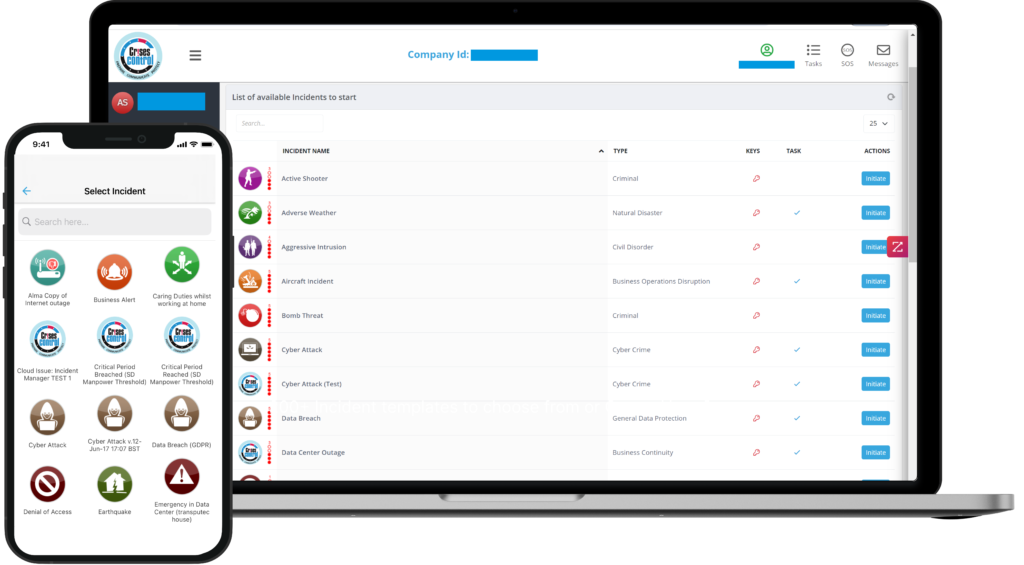
Interested in our Incident Management Software?
Flexible Incident Management Software to keep you connected and in control.
How to score and evaluate vendor responses
An RFP framework only delivers a defensible procurement decision if the evaluation methodology is structured and applied consistently across all vendors. Three principles separate effective RFP evaluation from procurement theatre.
Score the evidence, not the claim
Every vendor will claim to support every capability in marketing material. The evaluation must score what each vendor demonstrates rather than what each vendor claims. The demo, the reference customer calls, the security artefacts shared under NDA, and the contract documentation are the artefacts that produce evidence-based scoring. Marketing slides are background context, not evaluation input.
Weight the sections to operational reality
Not every section carries equal weight for every buyer. A financial services firm under DORA scope weights compliance and audit (Section 7) heavily. A managed service provider weights integration and multi-tenant operations heavily. A retail organisation with distributed workforce weights mass notification and threat intelligence heavily. The weighting should be agreed by the procurement steering group before vendor responses arrive, not adjusted after the fact to favour a preferred outcome.
Use a structured comparison matrix
Once responses are in, score each vendor across each section using a standardised matrix with named criteria. A 1 to 5 scale per question, summed by section, weighted by importance, produces a final score per vendor that the procurement steering group can defend. The matrix becomes part of the procurement record and is increasingly requested by board oversight, internal audit, and external regulatory review.
A structured RFP framework is the procurement artefact that produces a defensible decision. The framework above is the most rigorous test of Critical Event Management capability available to UK and EMEA buyers in 2026.
How Crises Control supports Critical Event Management RFP responses
Crises Control is the integrated Critical Event Management platform purpose-built for UK and EMEA enterprises and IT Services firms operating under tightening regulatory scope. The platform itself holds ISO 22301 and ISO 27001 accreditation, with UK, EU, and global data residency available, and is engineered to respond comprehensively to the nine-section RFP framework above.
Vendor accreditation and operational scale
Crises Control is a UK-headquartered company with a stable ownership model, transparent financial disclosure under NDA, and named reference customers across financial services, healthcare, manufacturing, public sector, and IT Services verticals. ISO 22301 and ISO 27001 accreditation is held by the Crises Control entity itself rather than by a parent or partner organisation. Cyber Essentials Plus and SOC 2 Type II are also maintained against the platform.
Multi-region platform architecture with documented resilience
Multi-region hyperscaler hosting with active-active failover between regions. UK, EU, and other regional data residency available natively. Independent disaster recovery testing conducted quarterly with full failover rather than tabletop exercises. The platform’s scale ceiling for mass notification has been demonstrated at 2,000 recipients reached and confirmed within 90 seconds in production deployments. The Crises Control Ping mass notification system delivers SMS, voice, email, push, native mobile app, Microsoft Teams, and Slack in parallel from independent delivery infrastructure.
Integrated incident orchestration and stakeholder communication
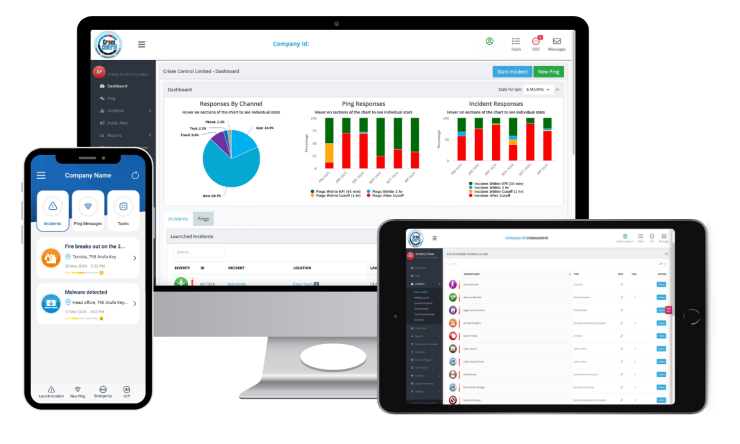
The Crises Control Incident Manager runs pre-built playbooks authored and modified by business users with full versioning and end-to-end audit trail. Tasks have named owners, named deputies, dependency logic, and visible surfacing of blocked tasks. The live dashboard provides role-based real-time views handling concurrent active incidents. The Crises Control Task Manager runs parallel stakeholder workstreams with audience-tier communications drafted from templates and published consistently across channels.
Native integrations across the major UK and EMEA platforms
Bidirectional ITSM integration across ServiceNow, Jira Service Management, Halo, Freshservice, ConnectWise, Autotask, and Datto. Native monitoring integrations across Datadog, New Relic, Splunk, Dynatrace, Prometheus, PagerDuty, and SolarWinds. Identity integrations across Azure Active Directory, Okta, Workday, ADP, and SAP SuccessFactors. Collaboration integrations across Microsoft Teams, Slack, Zoom, and WhatsApp. Comprehensive API and webhook support with SAML SSO and SCIM as baseline authentication.
Regulatory compliance and audit trail by design
The Crises Control audit and reporting module captures every action against the live incident record at second-level granularity with tamper-evident cryptographic hashing. UK CSR Bill 24-hour and 72-hour report templates are built into the audit trail module. FCA operational resilience, DORA, GDPR breach notification, ISO 22301, and ISO 27001 evidence templates are all native to the platform. Exports are available in PDF, CSV, JSON, and regulator-format templates on demand.
Implementation, customer success, and commercial transparency
Implementation is fixed-price with named deliverables and typical timelines of four to twelve weeks depending on deployment shape. A named customer success manager is assigned to every enterprise account with quarterly structured reviews. Technical support covers 24/7 in the buyer’s operational time zone with named P1, P2, and P3 response time commitments. Pricing is modular by capability rather than per-user, with three-year total cost projections shared transparently during the RFP evaluation period and renewal terms capped with maximum annual increase clauses.
If the RFP framework above identifies the capabilities your shortlist must demonstrate, Crises Control welcomes evaluation against every question in every section. Book a Crises Control demo against the full RFP framework.
FAQs
1. What is a Critical Event Management software RFP?
A Critical Event Management software RFP is the formal Request for Proposal document used by enterprise procurement teams to evaluate Critical Event Management platforms across a structured set of vendor questions. The RFP covers vendor background, platform architecture, mass notification capability, incident orchestration, integration, security, compliance, implementation, and commercial terms. The objective is to produce a defensible procurement decision through evidence-based vendor scoring rather than marketing-driven selection. .
2. How many questions should a Critical Event Management RFP include?
Effective Critical Event Management RFPs typically include 45 to 60 questions distributed across nine procurement sections. Fewer than 40 questions produces insufficient depth to differentiate vendors meaningfully. More than 70 questions creates response fatigue that drives vendor quality down. The framework above includes 42 core questions; buyers should add 5 to 15 organisation-specific questions reflecting their vertical, regulatory regime, and operational profile.
3. Who should be involved in evaluating Critical Event Management RFP responses?
Effective evaluation requires representation from at least five functions: IT or Operations leadership owning the operational use case, Information Security reviewing Section 6, Compliance or Risk reviewing Section 7, Procurement leading commercial evaluation in Section 9, and Legal reviewing the contract documentation. Larger evaluations also include the future platform owners and operational super-users who will run the platform day-to-day. The procurement steering group should agree section weighting before responses arrive.
4. How long should a Critical Event Management RFP process take?
Typical enterprise Critical Event Management RFP processes run 10 to 16 weeks from issue to vendor selection. Weeks 1 to 2: RFP issued and vendor questions accepted. Weeks 3 to 5: vendor responses received and initial scoring. Weeks 6 to 9: structured demos against shortlist of 3 to 4 vendors. Weeks 10 to 12: reference customer calls and security artefact reviews. Weeks 13 to 14: commercial negotiation. Weeks 15 to 16: final approval and contract signature. Compressed timelines below 8 weeks typically produce weaker evaluation.
5. What is the difference between Critical Event Management and Emergency Notification?
Emergency Notification is a subset of Critical Event Management. Emergency Notification covers the mass communication function: getting messages to defined audiences across multiple channels with two-way confirmation. Critical Event Management covers the full lifecycle: monitoring, classification, mass notification, incident orchestration, stakeholder communication, recovery coordination, and post-event review. CEM platforms include emergency notification as one of several core capabilities. Pure emergency notification platforms may or may not be classified as CEM depending on the breadth of their incident orchestration capability.