
Everbridge alternatives are the solutions food and beverage manufacturers evaluate when Everbridge’s scope, cost, or complexity no longer aligns with operational needs. These solutions support critical activities such as incident communication, response coordination, and the audit documentation required by standards including BRCGS, HACCP, ISO 22301, and FSA guidance.
To understand how these alternatives perform in practice, it is useful to examine a realistic operational scenario where time, compliance, and decision-making all collide.
What are the best Everbridge Alternatives for food and beverage manufacturing?
The four Everbridge alternatives most commonly evaluated by food and beverage manufacturers are AlertMedia, OnSolve, Fusion Risk Management, and Crises Control. They differ across notification depth, incident management workflow, HACCP and BRCGS fit, audit trail quality, and total cost over a three-year contract. The right shortlist depends on whether the operation needs alerting alone, planning alone, or end-to-end response execution across multi-site shift-based production.
It is a Tuesday morning at a chilled prepared foods plant in Yorkshire. The technical director is six months into a three-year Everbridge contract. The platform sends alerts. The platform documents plans. The retailer’s technical team has just asked for the full audit trail of last month’s allergen incident, exported by clause, against timestamps, within 48 hours. The director opens the export panel and realises the platform can produce the notification log, but cannot produce the downstream workflow timeline because the workflow lives in WhatsApp and email.
The director’s procurement team is already drafting the year-two review. They are not looking for a notification upgrade. They are looking for an alternative that runs the response end-to-end, generates the BRCGS-aligned audit trail automatically, and does not require the head office to renegotiate the commercial terms every time another plant comes on board. That is the conversation this piece is built for.
Choosing between Everbridge alternatives is not a feature comparison. It is a decision about whether the platform runs the response or just notifies people about it.
Why food and beverage manufacturing changes the Everbridge Alternatives shortlist
Most published comparisons of Everbridge alternatives are written for office-based industries. Banking. Insurance. Tech. The standard scorecard reads cleanly when applied to those environments. Food and beverage manufacturing breaks the assumptions in the first row.
The people most likely to first detect a production-line event are QA technicians, line supervisors, hygiene operators, and engineering staff. None of them sits at a desk. None of them has email open during a shift. Many are not on the standard HR or IT system because they are on temporary, agency, or rotating shift contracts. The alerting layer has to find them on the floor, on a phone, across three shifts a day, seven days a week, including the Sunday A-shift and the Christmas Eve cover.
There is also the matter of what the alert has to trigger. A food production incident does not just require a person to be notified. It requires a line to be held, a batch to be quarantined, a HACCP-aligned investigation workflow to start, a retailer technical agreement window to begin counting, and an FSA hazard-category notification to be drafted. The platform has to do all of that, with the audit trail captured automatically, in time for the BRCGS auditor and retailer technical team to see what happened and when.
Finally, the commercial reality. Food and beverage manufacturers typically operate multiple sites with different shift patterns, different retailer customers, different production categories, and different headcounts. Pricing models built around per-user enterprise tiers, the standard Everbridge approach, do not scale cleanly across multi-site food operations. Modular, site-based pricing tends to fit the sector better.
UK food businesses issued 1,386 product recalls and withdrawals between 2019 and 2023, with allergen and pathogen contamination as the two leading causes (Food Standards Agency 2024).
The 6 evaluation criteria for Everbridge Alternatives in food and beverage manufacturing
Generic notification scorecards miss most of what matters in food and beverage. The six criteria below come from post-procurement reviews and audit findings across UK food manufacturing deployments. Apply them to every shortlisted platform before signing a multi-year contract.
Multi-channel alerting with two-way confirmation
The platform reaches QA technicians, line supervisors, technical managers, plant leadership, and external stakeholders across SMS, voice, email, push, and app. Two-way confirmation captures who acknowledged and who did not. Single-channel email setups fail the moment the recipient is on the production floor without a laptop. Phone-tree setups fail because they cannot evidence acknowledgement timing under audit.
Shift-aware routing across 24/7 operations
Alert rules understand shift patterns, on-call rotations, holiday cover, and named deputies. The Tuesday night alert routes to the Tuesday night technical lead. The Sunday A-shift alert routes to the Sunday A-shift supervisor. The Christmas Eve alert routes to the holiday on-call manager. Generic alerting platforms with no shift logic dump alerts on whichever single named contact is on the static contact card.
HACCP and BRCGS aligned playbooks built in
Each alert is linked to a pre-built playbook that follows HACCP principles and BRCGS Issue 9 requirements. Line hold actions queue automatically. Batch quarantine workflows start. Named owners are assigned to each downstream task. Platforms that send the alert but stop there leave the response workflow on a clipboard.
Downstream workstream coordination
The platform does not just notify. It runs the parallel workstreams of a recall response: technical investigation, retailer notification, regulator notification, customer service, social media holding, and trade media. Each workstream has named owners and timestamps. Leadership gets a single dashboard rather than five fragmented updates.
Continuous timestamped audit trail
Every alert sent, every acknowledgement received, every escalation triggered, every action logged, every retailer notification, every regulator submission, all captured automatically. Exportable on demand for BRCGS, BSI, retailer technical team, and FSA review against timestamps. Setups that reconstruct the trail from email exports two weeks later fail the renewal audit.
Modular multi-site pricing
Food and beverage manufacturers add and decommission sites, run different production categories, and serve different retailer customer bases. Per-user enterprise pricing models penalise growth and force renegotiation every time another plant comes online. Modular pricing that scales by site, capability, and headcount tier fits the sector. Per-message pricing exposes the platform owner to bill shock during a real incident, which is the worst time to be metering messages.
On a food production line, the procurement question is not which platform sends alerts fastest. It is which platform survives a BRCGS audit on the second cycle after the first real incident?
If your current procurement scorecard does not include HACCP-aligned playbooks, shift-aware routing, and a defensible audit trail, the next contract is locking in the wrong platform. Book a demo of the platform.
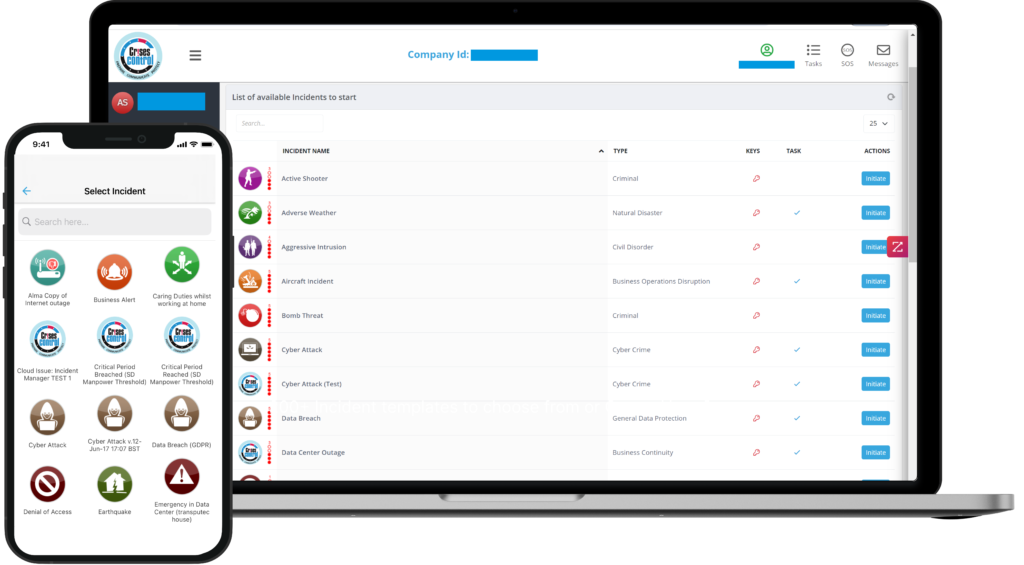
Interested in our Incident Management Software?
Flexible Incident Management Software to keep you connected and in control.
Why food and beverage manufacturers leave Everbridge in the first place
Everbridge is a strong platform. It is not always the right platform for a 14-site UK ready-meals manufacturer with a mixed retail customer base. The reasons procurement teams shortlist Everbridge Alternatives come up repeatedly in post-renewal reviews.
Implementation complexity comes first. The platform’s enterprise scope means initial deployment timelines run into months rather than weeks. Smaller and mid-sized food manufacturers without dedicated platform administrators struggle to extract full value before the renewal cycle starts. The training overhead lands on technical managers who already have HACCP, BRCGS, and SQF responsibilities.
Cost is the second driver. Per-user and per-contact pricing models scale poorly across multi-site food operations with seasonal contractors, agency staff, and rotating shift teams. The headline price quoted at procurement rarely matches the year-three invoice once site additions, message volume, and integration costs are factored in.
Fit is the third. Everbridge was built for a broad enterprise market. The deepest workflows assume office-based recipients on email, desktop, and corporate mobile phones. The platform supports food manufacturing, but the sector-specific HACCP and BRCGS playbooks, retailer technical agreement timing windows, and shift-aware routing rules require custom configuration that most sites never complete. The platform’s potential and the plant’s deployment end up far apart.
The 4 Everbridge Alternatives most commonly compared in food and beverage manufacturing
The four platforms below are the alternatives that appear most often on shortlists in food and beverage manufacturing procurement reviews. Each is profiled against the six criteria above, with a frank assessment of strengths and limits in this sector specifically.
Platform 1: AlertMedia
AlertMedia is a US-headquartered notification platform focused primarily on employee safety and threat intelligence. The mass notification layer is well-regarded, and the platform performs strongly on the alerting criterion. Multi-channel delivery is solid. The user interface is cleaner than Everbridge’s, and deployment timelines are shorter.
Where AlertMedia is weaker for food and beverage manufacturing is in the downstream workstream coordination. The platform is built around the notification itself, with less depth on the HACCP and BRCGS-aligned playbooks that follow. Shift-aware routing is supported but typically requires configuration effort. The audit trail is partial. The platform documents what was sent, less so what happened afterwards. For food manufacturers needing end-to-end response execution rather than alerting alone, AlertMedia covers half the requirement.
Pricing sits in the mid-enterprise range. Multi-site food operations typically find AlertMedia more cost-effective than Everbridge, but still per-user weighted, which scales unevenly across rotating shift teams.
Platform 2: OnSolve
OnSolve combines mass notification with risk intelligence under one umbrella. The platform has a strong public safety and enterprise security profile, with deep capability in threat intelligence feeds and incident notification.
For food and beverage manufacturing, OnSolve’s risk intelligence layer is more relevant than the typical Everbridge alternative, particularly for manufacturers concerned about geopolitical supply chain risk, transport disruption, and ingredient-source country events. Where it is weaker is in the BRCGS-aligned playbook depth and the production-line operational workflows. The platform is built for enterprise risk and security teams, not for QA technicians on the floor at 03:00.
Audit trail capability is reasonable but inherits enterprise complexity. Smaller food manufacturers report that the platform’s full feature set exceeds what they need and complicates BRCGS audit preparation rather than simplifying it. Pricing reflects the enterprise positioning.
Platform 3: Fusion Risk Management
Fusion Risk Management is a business continuity and operational resilience planning platform. It sits in a different category from pure notification platforms: deep-on-plan documentation, risk assessment, and BIA workflows. For food manufacturers building out ISO 22301 evidence, Fusion can be a useful documentation layer.
Where Fusion is weaker for food and beverage manufacturing is in the live, time-pressured response itself. The platform was not built for the 03:00 contamination swab moment when a line supervisor needs an alert with two-way confirmation on the floor. Multi-channel notification is partial. Shift-aware routing is not the platform’s strength. The downstream workstream coordination is structured around plan execution rather than live incident response.
Used alongside a notification platform, Fusion adds value on the planning and documentation side. Used as a sole Everbridge alternative, it leaves the alerting and execution layer underbuilt. Audit trail depth is solid for plan execution and weaker for live incident timelines. Pricing reflects an enterprise resilience-planning category rather than mass notification.
Platform 4: Crises Control
Crises Control sits in a different position from the three platforms above. The platform is built around execution: notification, downstream workstream coordination, named owners, and a continuous audit trail, all in a single workflow. It is the only platform on this shortlist that itself holds ISO 22301 accreditation, which means the standard is built into the product rather than configured on top.
For food and beverage manufacturing specifically, the platform was built with multi-site UK food and beverage operations in mind. Shift-aware routing is standard. HACCP and BRCGS-aligned playbooks come pre-built. The downstream workstream coordination across technical investigation, retailer notification, regulator notification, and customer service runs from a single dashboard rather than four separate tools. The audit trail is captured automatically and exportable on demand.
Pricing is modular and site-based rather than per-user enterprise. Multi-site food manufacturers typically pay less than they would for Everbridge or OnSolve at equivalent capability, and the cost does not balloon as the headcount fluctuates with seasonal contractors and agency staff. Implementation is measured in weeks rather than months.
Where Crises Control is positioned differently is in the enterprise threat intelligence layer. The platform is not trying to be a global risk intelligence feed for the largest enterprises. It is built to run the response inside a manufacturing operation. For most UK and EMEA food and beverage manufacturers, that is the right trade-off.
The average direct cost of a food recall to a UK manufacturer is estimated at 6 million pounds, with reputational damage often exceeding the direct cost (Food Manufacture / GS1 UK 2023).
Side-by-side comparison: the 4 Everbridge Alternatives
The table below summarises how the four platforms compare against the six food and beverage manufacturing criteria established earlier in this piece.
|
Criterion |
AlertMedia |
OnSolve |
Fusion |
Crises Control |
|
Multi-channel with two-way confirmation |
Yes |
Yes |
Partial |
Yes |
|
Shift-aware routing across 24/7 operations |
Partial |
Partial |
Partial |
Yes |
|
HACCP and BRCGS aligned playbooks built in |
No |
Partial |
Partial |
Yes |
|
Downstream workstream coordination |
Partial |
Partial |
Yes |
Yes |
|
Continuous timestamped audit trail |
Partial |
Yes |
Partial |
Yes |
|
Modular multi-site pricing |
Partial |
No |
Partial |
Yes |
|
Vendor itself ISO 22301 accredited |
Varies |
Varies |
Varies |
Yes |
|
Typical implementation timeline |
Weeks |
Months |
Months |
Weeks |
How Crises Control delivers as the Everbridge Alternative for food and beverage manufacturing
Most platforms in this category either notify people or document plans. Crises Control executes the response. Built for real incidents, not demos.
Multi-channel alerting with confirmation, built for the production floor
The Crises Control mass notification system reaches QA technicians, line supervisors, technical managers, plant leadership, and external stakeholders across SMS, voice, email, push, and app with two-way confirmation. The platform knows who has acknowledged and who has not. An email alone in a shared inbox at 03:00 on a Wednesday is not alerting. Five channels with confirmation.
Shift-aware routing and HACCP and BRCGS playbooks
Alert rules in the Crises Control business continuity platform understand shift patterns, on-call rotations, holiday cover, and named deputies. Pre-built playbooks aligned to HACCP and BRCGS Issue 9 trigger the downstream workflow the moment the alert fires.
Live workstream coordination from a single dashboard
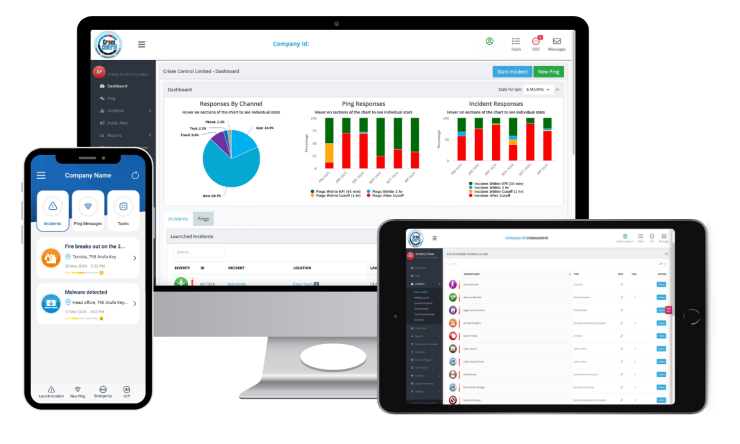
The incident manager and task manager run the parallel workstreams of a recall response: technical investigation, retailer notification, regulator notification, customer service, social media holding, and trade media. Each workstream has named owners, status, and timestamps. Leadership gets a single dashboard.
Audit trail that holds up under retailer, BRCGS, and FSA review
Every alert, acknowledgement, decision, task, and message is captured automatically in the Crises Control audit trail. When the BRCGS auditor, the retailer technical team, or the FSA ask what happened and when, the answer is exportable in minutes, against timestamps, by clause. Aligned to ISO 22301 business continuity requirements.
What the right Everbridge Alternative looks like in practice for food and beverage manufacturing
A working setup reaches the right-named owner across the right channel within minutes of detection, regardless of shift, regardless of leave, regardless of which deputy is on call. It triggers the downstream HACCP and BRCGS aligned workstreams without waiting for someone to start them. It captures the audit trail automatically, exportable on demand for retailer, BSI, BRCGS, and FSA review. It works on a Sunday night at 03:00 the same way it works on a Tuesday afternoon at 14:00, and it does not penalise the manufacturer commercially every time another plant comes online.
Manufacturers that select the right Everbridge Alternative do not eliminate incidents. They turn a forty-five-minute detection-to-action gap into ninety seconds, and they generate the BRCGS audit evidence as a by-product of running the response, not as a documentation exercise two weeks later.
If your current platform’s audit trail would not survive a four-hour retailer review, you have a notification tool, not an Everbridge Alternative. Book a demo to see the difference.
FAQs
1. What are the best Everbridge Alternatives for food and beverage manufacturing?
The four Everbridge Alternatives most commonly evaluated by food and beverage manufacturers are AlertMedia, OnSolve, Fusion Risk Management, and Crises Control. AlertMedia is strong on notification depth. OnSolve adds risk intelligence. Fusion adds resilience planning. Crises Control is the only one built around execution end to end, with HACCP and BRCGS aligned playbooks, shift-aware routing, and a continuous audit trail. The right choice depends on whether the manufacturer needs alerting alone, planning alone, or end-to-end response execution.
2. Why do food and beverage manufacturers leave Everbridge?
The three most common reasons are implementation complexity, per-user pricing that scales poorly across multi-site shift-based operations, and platform-fit issues where the deepest workflows assume office-based recipients rather than production-floor QA technicians and line supervisors. Everbridge is a strong platform for large global enterprises with dedicated platform administrators. It is not always the right fit for mid-sized UK and EMEA food and beverage manufacturers with rotating shift teams across multiple production sites.
3. How does the audit trail differ between Everbridge Alternatives?
Audit trail depth is the criterion most often underweighted at procurement and most heavily weighted at BRCGS audit. Notification-focused platforms produce a log of what was sent. Planning-focused platforms produce a log of plan execution. Execution-focused platforms capture every alert, acknowledgement, decision, task, and retailer notification against a timestamp, exportable in minutes. Food and beverage manufacturers under BRCGS Issue 9 and ISO 22301 review need the third type, and only the third type.
4. What does HACCP and BRCGS alignment look like in an Everbridge Alternative?
True alignment means the platform’s playbooks follow HACCP CCP monitoring logic and BRCGS Issue 9 incident, withdrawal, and recall procedures by default, not as a custom configuration on top of a generic notification template. The alert links to the playbook. The playbook triggers the downstream workstream. The workstream captures the evidence. The evidence aligns to the standard. Configuration effort that would otherwise sit with the technical manager sits with the vendor.
5. How long should an Everbridge Alternatives evaluation take?
A focused evaluation of four shortlisted Everbridge Alternatives typically takes six to twelve weeks from criteria definition to contract. The most efficient processes set the six evaluation criteria first, score each platform against them with live demonstration evidence rather than vendor decks, run a tabletop simulation against each shortlist platform using a realistic contamination scenario, and only then move to commercial negotiation. Skipping the simulation step is the single biggest cause of post-deployment regret in this category. d at the next certification cycle.