FIFA World Cup 2026 is the largest football tournament in history, co-hosted across the United States, Canada, and Mexico from 11 June to 19 July 2026. Running across 16 venues in 11 host cities, it is the first World Cup to span three nations and the first to feature an expanded 48-team format. At this scale, crisis communication is not a back-office function. It is a frontline operational requirement.
Picture Dallas in late June. Temperatures breach 40°C by early afternoon. Eighty thousand fans file into AT&T Stadium. A severe thunderstorm watch drops across the region at 2pm. The game kicks off at 6pm. Three agencies need to move 80,000 people. They have two different alert systems and a group chat.
That is not a crisis plan. That is a gap.
The Scale That Makes FIFA World Cup 2026 Unique
More than 5 million fans are expected to attend matches in person across 104 games (FIFA 2025). Global fan engagement is projected at close to 6 billion people across streaming and digital channels. The United States alone is expected to receive up to 10 million international visitors during the tournament window (FIFA 2025). This makes the 2026 tournament the single largest logistical and event emergency management challenge in modern sporting history.
No other sporting event in the modern era concentrates this volume of people across this many cities in this short a period of time.
Sixteen stadiums. Eleven cities. Three countries. Different emergency services structures, different jurisdiction frameworks, and in some cases different languages. The coordination challenge is not just about alerting fans. It is about synchronising dozens of public agencies, security contractors, venue operators, transport authorities, and broadcasters, all operating on different systems and different protocols.
FEMA invested nearly $900 million to prepare US FIFA World Cup 2026 host cities, including $625 million in security grants and training for more than 238,000 emergency managers and first responders (FEMA 2026).
FEMA has confirmed it coordinated training for more than 238,000 local emergency managers and first responders across host cities, covering large sports venue management, mass casualty events, and coordinated emergency response. When a weather emergency or crowd incident strikes, the organisations involved do not have days to coordinate. They have minutes.
Weather Emergencies Are the Biggest Threat to the FIFA World Cup 2026
Severe weather preparedness is not optional for an event spanning the southern and central United States in high summer. It is a baseline requirement.
A 2025 study by World Weather Attribution found that 14 of the 16 FIFA World Cup 2026 host cities are likely to exceed the extreme 28°C Wet Bulb Globe Temperature threshold under typical summer conditions. Miami, Kansas City, Philadelphia, Dallas, and Houston face near-certain exposure to conditions the scientific community classifies as dangerous for both players and spectators. Wet-bulb globe temperatures in Dallas and Houston could exceed 32°C during afternoon windows (World Weather Attribution 2025).
Climate scientists writing in Scientific American have warned that players and fans at FIFA World Cup 2026 face a greater risk of unsafe temperatures than during the 1994 World Cup, the last time the tournament was held in the United States. Researchers predict five games could take place in unsafe heat conditions, up from three in 1994.
These are not theoretical risks. In June 2024, more than 1,300 people died during the Hajj pilgrimage in Saudi Arabia in a heat event that demonstrated the lethal consequences of inadequate emergency communication at mass gatherings (Saudi Health Ministry 2024). In November 2023, Ana Clara Benevides Machado, 23, died from heat stroke during a Taylor Swift concert in Rio de Janeiro, with temperatures at the venue reaching extreme levels (Brazilian Health Ministry 2023). Both incidents occurred with professional security teams present.
FIFA has announced mandatory three-minute hydration breaks in each half for all 2026 World Cup matches (FIFA 2025). Seattle is exploring air-conditioned buses and water misting stations at fan zones. Dallas and Houston have mandated rest and hydration breaks for outdoor volunteers. Those measures reduce risk. They do not eliminate it. And none of them solves the communication problem when conditions deteriorate suddenly.
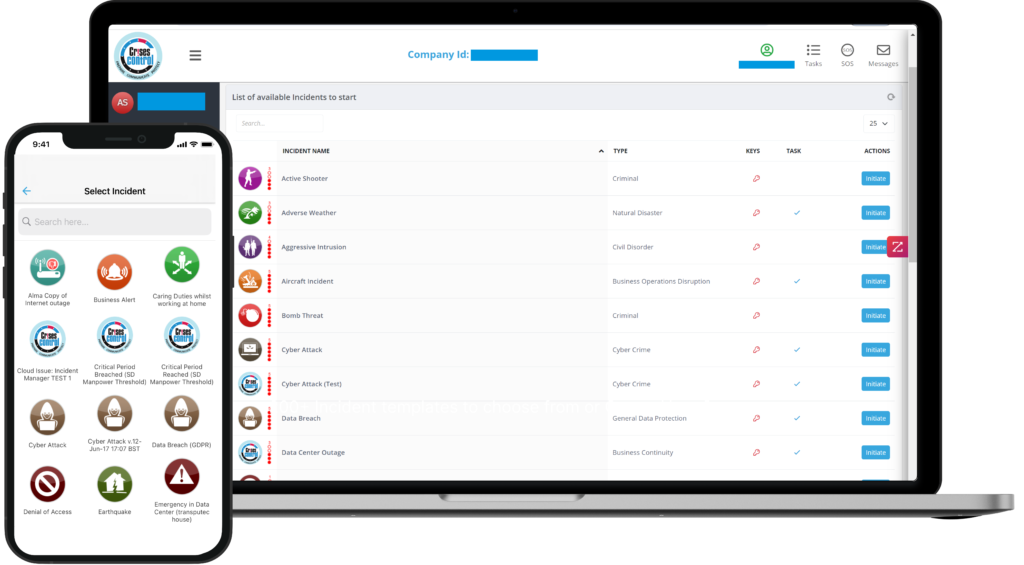
Interested in our Incident Management Software?
Flexible Incident Management Software to keep you connected and in control.
Thunderstorms, Flash Floods, and the Complication No One Plans For
Heat is not the only threat. Research from Inside Climate News confirms that the same weather systems creating high temperatures across Texas, Georgia, and Florida also produce severe thunderstorms, lightning, and flash flooding with very short warning windows. Preparing for weather emergency response at major sporting events means accounting for the full spectrum of risk, not just heat.
When a National Weather Service warning is issued, stadium operators have approximately 30 minutes to execute shelter-in-place or evacuation protocols. That is not much time when the venue holds 80,000 people, transport links are already saturated, and dozens of agencies have separate alert systems. The US National Weather Service issues more than 1,000 tornado warnings per year, and severe thunderstorm warnings number in the thousands annually across the southern and central US states hosting World Cup matches (NOAA 2024).
NOAA classifies Kansas City, Dallas, and Houston as high-frequency severe weather zones, with thousands of severe thunderstorm and tornado warnings issued across these regions each year (NOAA 2024).
The Communication Gap That Turns Incidents Into Disasters
A weather emergency at a major sporting event follows a predictable failure pattern. The alert reaches one agency. That agency calls a contact at another. That contact is in a meeting or on a radio channel. By the time every stakeholder has been notified, the window for proactive response has closed. The response becomes reactive.
This is not a staffing problem. It is a systems problem. And it is the core reason why emergency notification software built specifically for crisis coordination exists as a distinct category from everyday communication tools.
Major sporting events generate an enormous communication load. Stadium operations, transport authorities, local police, national security, medical teams, broadcast crews, catering contractors, and hundreds of volunteer staff all work simultaneously. Each brings their own tools: group chats, email chains, radio networks, and agency-specific software. None of these systems interoperates cleanly under pressure.
At an event of this scale, there is no single person who can see all of this at once. There is no shared operating picture. When something goes wrong, each agency operates from its own partial view.
The Three Points Where Communication Breaks
The first break happens at detection. The threat is identified by one agency or one system. That information does not automatically reach everyone else. It sits in a portal, an inbox, or a radio channel that not everyone monitors.
The second break happens at escalation. Even if the alert is distributed, there is no structured way to confirm who received it, who is acting on it, and what they are doing. Confirmation comes back through informal channels. That confirmation is not auditable. It does not give the command a complete picture.
The third break happens at close-out. The incident resolves, but the after-action record is fragmented across multiple inboxes and personal devices. The next time a similar incident occurs, the organisation will start from scratch.
These three breaks do not occur because the people involved are incompetent. They occur because the tools are not built for this kind of coordinated response.
Most competitor platforms either send the alert or document the plan. What they do not do is execute the response in real time, with task assignment, two-way confirmation, and a complete audit trail.
FIFA World Cup 2026 Emergency Communication Planning: What Good Looks Like
FIFA World Cup 2026 emergency communication planning is not a document stored on a shared drive. It is a system of connected protocols, tested tools, and trained people who can act within seconds of a trigger.
The core requirements are clear:
- Multi-channel alert distribution. A single-channel alert system misses people. SMS fails in areas of congestion. Push notifications fail on older devices. Email is too slow. A credible plan reaches people across SMS, voice, app push, and digital signage simultaneously.
- Two-way confirmation. Sending an alert is not the same as knowing that people received it and acted on it. A functional emergency communication system captures acknowledgement and tracks who has and has not responded.
- Task assignment with live status. When an evacuation starts, someone needs to own each stage. Those tasks need to be assigned, tracked, and visible in real time.
- Cross-agency interoperability. The agencies involved in a FIFA World Cup 2026 incident do not all use the same systems. The emergency communication platform must integrate with existing tools rather than replace them.
- Post-incident audit trail. Regulatory bodies, legal teams, and event insurers will want a record of what happened, when it happened, who was notified, and what actions were taken.
Selecting the right emergency communication software is central to this. The platform needs to handle the full cycle from initial alert through to coordinated response and post-incident reporting, not just the notification moment. Effective business continuity planning for the event ecosystem does not end at the stadium either. Hotels, transport hubs, fan zones, and broadcast centres all carry their own risk profiles. A complete approach covers the full event footprint.
How Crises Control Supports the FIFA World Cup 2026 Emergency Communication
The gap in most event emergency communication setups is execution. Most platforms either notify people or document plans. Crises Control executes the response, with alerts, coordination, task assignment, and a full audit trail built into a single system. Built for real incidents, not demos.
Most competitors in the emergency communications space address one part of the problem. Platforms such as Everbridge and AlertMedia are strong at alert distribution, but they do not include a coordination layer for what happens after the alert goes out. Planning-focused tools such as Fusion Risk Management and Riskonnect produce strong incident plans, but they are not built for real-time response. General communication tools such as Microsoft Teams and Slack are adequate for day-to-day operations but carry no structure, no audit trail, and no design for crisis coordination.
Crises Control closes that gap:
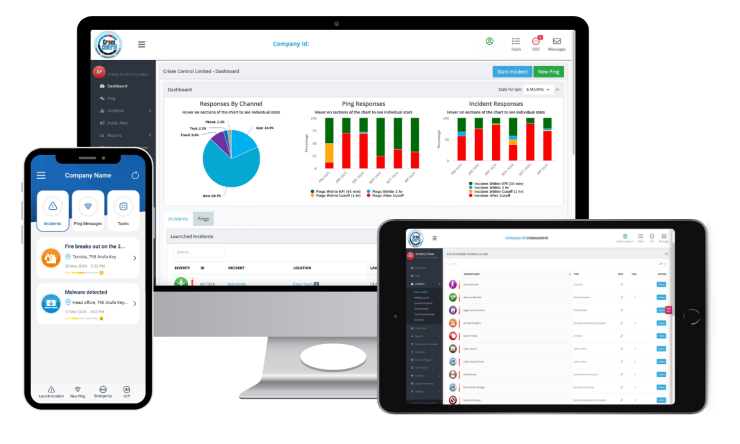
- The Ping Mass Notification System delivers multi-channel alerts across SMS, voice, email, push, and in-app channels simultaneously, reaching every stakeholder regardless of device or network conditions.
- Two-way response confirmation tracks who has acknowledged the alert and who has not, giving command teams a real-time picture of response status.
- Task assignment and live status boards allow incident commanders to allocate actions across teams and track completion in real time, without relying on radio check-ins or informal messages.
- A complete audit trail records every action from alert to close-out, meeting the requirements of post-incident review, insurance documentation, and regulatory reporting.
- ISO 22301 and ISO 22320 aligned workflows mean the platform is built to international standards for business continuity management and emergency management coordination.
- The SOS panic button on the Crises Control mobile app allows staff anywhere in a venue to trigger an alert and share their location instantly.
For organisations reviewing emergency communication solutions ahead of the tournament, the Crises Control approach to mass notification for natural disasters and the role of mass notification in business continuity are worth reviewing before committing to a platform.
For a tournament spanning 11 cities, 16 venues, and millions of fans, a fragmented approach to emergency communication is not a risk that can be absorbed. The cost of a delayed response at a FIFA World Cup 2026 match is not measured in system errors. It is measured in injuries, reputational damage, and legal exposure that follows an organisation for years.
FAQs
1. What makes FIFA World Cup 2026 emergency communication particularly complex?
FIFA World Cup 2026 spans 16 venues across 11 cities in three countries, each with different emergency services structures, jurisdictions, and communication protocols. Coordinating weather emergencies or crowd incidents across this footprint requires a platform that can reach all stakeholders simultaneously, capture two-way confirmation, and maintain a real-time operating picture. No informal communication system is capable of handling that at the speed required.
2. How should organisations prepare for weather-related disruptions during the World Cup?
Organisations should treat weather-related disruptions as a probability, not a possibility. Severe weather preparedness should include multi-channel alert capability, pre-defined escalation protocols, and tested evacuation routes exercised with the relevant agencies before the tournament begins. Fourteen of the 16 host cities face potential extreme heat conditions, and several sit in high-frequency severe weather zones.
3. What is a mass notification system and why does it matter at events like this?
A mass notification system is a platform that delivers alerts simultaneously to large populations across multiple channels, including SMS, voice, push notification, and email. At a FIFA World Cup 2026 match, where tens of thousands of people are in a confined space, reaching every stakeholder within seconds of an emergency trigger is not optional. Confirmation that those alerts have been received and acted on is equally important.
4. What is the role of business continuity planning in major sporting event management?
Business continuity planning for a major sporting event covers the full operational footprint: venues, transport, hotels, fan zones, and media infrastructure. A continuity plan identifies every dependency, maps the response to each failure scenario, and ensures that the event can either continue safely or wind down in a controlled way. At the FIFA World Cup 2026, continuity planning needs to account for extreme weather, crowd incidents, transport disruptions, and the cross-border coordination of multiple national agencies.
5. What should emergency notification software be able to do for event organisers?
Emergency notification software for event management should deliver multi-channel alerts, capture two-way confirmation, support task assignment for response teams, and produce a complete post-incident audit trail. It should integrate with existing agency systems rather than requiring organisations to abandon their current tools. At an event on the scale of the FIFA World Cup 2026, the software also needs to handle simultaneous incidents across multiple venues without degradation in performance.