An Emergency Notification System is the platform layer that delivers urgent alerts to a defined audience across multiple channels in parallel, captures acknowledgement back from each recipient, and escalates automatically when acknowledgement does not arrive. For IT Operations specifically, the audience is the engineering response team. The trigger is a major incident affecting customer services, infrastructure, or regulatory obligations. The benchmark is the speed and reliability at which the right engineers can be reached and confirmed before the operational damage compounds.
At enterprise scale, that benchmark is 200 engineers reached and confirmed in 90 seconds. Every second beyond that window translates into customer impact, regulatory exposure, and operational cost that compounds for hours afterwards. The question for senior IT and Operations leaders is no longer whether their team can be reached in a crisis. It is whether the right people, on the right shift, on the right device, across the right channel, can be reached and confirmed inside the window that matters.
This is the engineering challenge that defines a modern Emergency Notification System for IT Operations. Not whether the platform sends alerts. Whether it can reach 200 engineers in 90 seconds, capture acknowledgement from each one, and escalate automatically to the named deputy when the primary does not respond. At that scale, marketing claims meet engineering reality. Most platforms fail at least one of the four tests below.
Why 200 engineers in 90 seconds is the right benchmark
The 200 / 90 benchmark is not arbitrary. It reflects three operational realities most enterprise IT teams now share, and one regulatory reality that will be live across UK and EU operations by late 2026.
First, scale. A mid-sized enterprise IT operations function now spans 200 to 800 engineers including SRE, NOC, platform, security, application development, and infrastructure teams. A major incident routinely requires mobilising more than 50 of them in parallel across multiple functions. MSPs operating across multiple client tenants face the same scale through different geography: 200 engineers might span eight client teams across three regions.
Second, shift coverage. Enterprise IT operates 24/7 with rotating shifts, on-call rotas, and seasonal contractor cycles. The 200 engineers in scope are not all online at the same time. The notification system must reach the named on-call across whichever shift is currently active, on whatever device that engineer happens to be carrying, in the timezone they are operating in. Single-channel email at 03:00 on a Sunday does not satisfy this.
Third, channel fragmentation. Enterprise engineers work across SMS, voice, email, push notification, native mobile app, Microsoft Teams, Slack, ServiceNow mobile, and PagerDuty. Each engineer typically has two or three preferred channels. A reliable notification reaches them on whichever channel they actually monitor in real time, not whichever channel the platform finds easiest to deliver.
Fourth, regulatory pressure. The UK Cyber Security and Resilience Bill mandates a 24-hour early warning and a 72-hour full incident report to both the sector regulator and the National Cyber Security Centre once Royal Assent lands in late 2026. The audit trail evidencing those reports starts the moment the notification is sent. If the notification took 12 minutes to reach the response team rather than 90 seconds, the regulator will see that gap. The 90-second standard is becoming a defensive procurement requirement, not just an operational one.
The 90-second standard for enterprise IT operations did not exist five years ago. By 2026, it is the operational floor that mature platforms clear and that legacy email-based notification cannot meet.
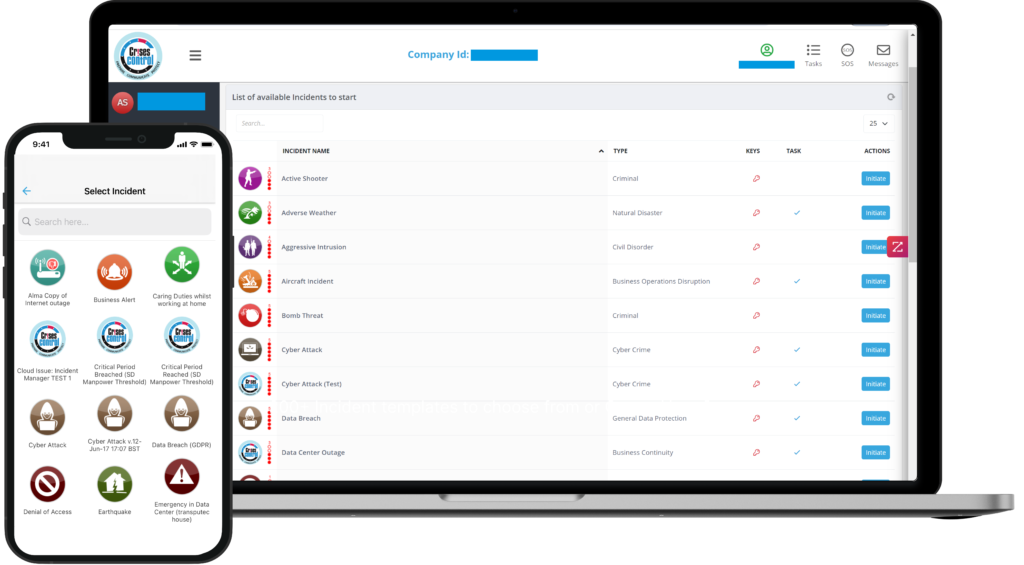
Interested in our Incident Management Software?
Flexible Incident Management Software to keep you connected and in control.
The four engineering tests every Emergency Notification System must pass
An Emergency Notification System claiming to support enterprise IT operations must pass four tests under load. Not pass them in a demo on a quiet Tuesday afternoon with five recipients. Pass them at scale, under real conditions, with hundreds of recipients across multiple channels.
|
# |
Engineering test |
The requirement at enterprise scale |
Primary failure mode |
|
1 |
Parallel multi-channel delivery |
All recipients reached on all configured channels simultaneously |
Serial delivery, broker bottlenecks, dropped messages |
|
2 |
Critical-alert push framework |
Push notifications break through Do Not Disturb on iOS and Android |
Alerts muted by phone settings, never seen |
|
3 |
Two-way confirmation and automatic escalation |
Acknowledgement captured per recipient, deputies paged automatically |
Audit trail shows alert sent but cannot evidence acknowledgement |
|
4 |
Platform resilience independent of customer stack |
Notification platform stays online when customer infrastructure is failing |
Notification platform fails alongside the incident it should announce |
TEST 1 OF 4
Parallel multi-channel delivery
The first test is delivery speed at scale. Many notification platforms claim multi-channel support but deliver messages serially through a single message broker. At small scale this is invisible. At 200 recipients across seven channels, serial delivery introduces queuing delay that turns a 90-second target into a four-minute reality. The first 30 engineers receive their alerts in seconds. The last 30 receive them five minutes later. The audit trail looks consistent. The operational outcome is not.
THE REQUIREMENT The platform must dispatch all configured channels for all recipients in parallel from independent delivery infrastructure. SMS through a regional carrier gateway. Voice through a separate voice infrastructure. Email through SMTP. Push notification through APNS and FCM directly. Microsoft Teams and Slack through their respective enterprise APIs. Each channel and each recipient is its own parallel delivery thread.
HOW TO TEST IT Ask the vendor to demonstrate a live delivery to 200 sample recipients across all configured channels. Time it. Acceptance criterion: 95% of all configured channels for all recipients delivered within 60 seconds, with the remaining 5% delivered within 90 seconds. If the vendor cannot or will not demonstrate this live, the platform does not meet enterprise IT operations requirements.
FAILURE MODE The serial-delivery platform queues messages through a single broker. At small scale this is invisible. At enterprise scale, the last engineer in the queue receives the alert four minutes after the first. During those four minutes, the incident has expanded, the customer has noticed, and the SLA breach is already in train. The audit trail shows all alerts were sent. It does not show the delivery time per recipient. The regulator who reviews the trail six weeks later sees timestamps but not the variance behind them.
Serial delivery is the most common silent failure in enterprise notification platforms. The vendor demonstration with 5 recipients gives no indication of behaviour at 200. Always test at scale before procurement.
TEST 2 OF 4
Critical-alert push framework
The second test is whether the platform’s push notifications can break through Do Not Disturb mode on iOS and Android. This is not a marketing feature. It is the engineering difference between an alert that reaches the on-call engineer at 03:00 on a Sunday and an alert that sits silently on the lock screen until the engineer wakes up at 07:00. Apple’s Critical Alerts framework and Android’s high-priority notification channels both exist for exactly this purpose. Most consumer-grade notification platforms do not implement them. Most enterprise IT operations teams discover this fact during the first major incident after deployment.
THE REQUIREMENT Native iOS and Android applications with full Critical Alerts framework support on iOS, requiring the customer to be enrolled in Apple’s Critical Alerts entitlement, and high-priority notification channel support on Android with appropriate manifest declarations. Push notifications must break through DND mode, silent mode, focus modes, and screen-off states. Voice channel must serve as a fallback when push delivery fails. The engineer’s device must wake up the engineer.
HOW TO TEST IT Configure your phone in Do Not Disturb mode. Ask the vendor to send a test critical alert at the start of a demo. The notification should break through DND and sound the alert audibly on your locked device. If the vendor cannot demonstrate this live with your own device in DND mode, the platform’s push framework is not enterprise-grade. Repeat with an Android device on high-priority channels for full coverage.
FAILURE MODE Push notifications arrive but stay silent because the device is in Do Not Disturb mode. The engineer does not hear the alert. The platform marks the notification as delivered. The audit trail shows the alert was sent and received. The engineer wakes up at 07:00 and discovers the incident has been live for four hours. The on-call deputy was never paged because the primary alert was technically delivered. The customer learns about the outage from Twitter before the engineering team learns about it from the platform.
TEST 3 OF 4
Two-way confirmation and automatic escalation
The third test is whether the platform captures acknowledgement back from each recipient and escalates automatically when acknowledgement does not arrive. Without this, the audit trail proves the alert was dispatched but cannot evidence that anyone received it. Auditors, regulators, and customer procurement teams have learned the difference. Increasingly, contracts and regulatory frameworks distinguish between alerts dispatched and alerts confirmed.
THE REQUIREMENT Each recipient must be able to acknowledge from the channel they received the alert on. Acknowledgement is captured against the incident record with timestamp and recipient identifier. The platform monitors acknowledgement against a configurable window, typically 90 to 180 seconds. When the window expires without acknowledgement, the alert escalates automatically to the named deputy, then the deputy’s deputy, with the same multi-channel parallel delivery. Escalation logic must be transparent and configurable per incident type, not hardcoded by the vendor.
HOW TO TEST IT Ask the vendor to demonstrate the full escalation chain live. Trigger an alert to a test recipient. Deliberately do not acknowledge the primary alert. Verify that the deputy is paged automatically within the configured window across all configured channels. Verify the audit trail captures both the missed acknowledgement and the escalation to the deputy with timestamps. Repeat with the deputy’s deputy. If the vendor cannot demonstrate the full three-tier escalation live, the escalation logic is theoretical, not operational.
FAILURE MODE The platform reports the alert as delivered. The audit trail confirms this. What the audit trail cannot confirm is whether anyone read it, acknowledged it, or acted on it. The deputy was never paged because the platform had no mechanism to detect the missed acknowledgement from the primary. Forty-five minutes later, the customer reports the outage. The audit trail shows the alert was sent. It does not show that the response team never received it operationally.
The most consequential audit-trail distinction in 2026 is between alerts dispatched and alerts confirmed. Platforms that capture only dispatch are operationally and regulatorily unfit for enterprise IT operations.
TEST 4 OF 4
Platform resilience independent of customer stack
The fourth test is the most consequential and the most often overlooked. An Emergency Notification System for IT Operations exists to announce that something has gone wrong with the customer’s infrastructure. If the notification platform runs on the same hyperscaler region as the customer’s affected workloads, a regional outage takes both down simultaneously. The platform that should announce the incident becomes another casualty of it. Most enterprise IT teams discover this fact during their first major hyperscaler region event.
THE REQUIREMENT The notification platform must run on infrastructure that is operationally independent of the customer’s primary stack. Multi-region failover within the platform’s own infrastructure. Independent control plane and data plane. Documented 99.99% uptime SLA with credit-back clauses. The platform’s status page must be hosted on infrastructure independent of the platform itself. The vendor must publish current uptime reports rather than relying on historical SLA documents.
HOW TO TEST IT Ask the vendor where the platform is hosted, in which regions, and on which hyperscaler infrastructure. If the customer’s primary workloads are on AWS eu-west-1, the notification platform should not also be sole-hosted on AWS eu-west-1. Request the vendor’s most recent uptime report. Ask for evidence of platform behaviour during a hyperscaler region event in the past 24 months. Strong vendors share this evidence willingly. Weak vendors deflect.
FAILURE MODE The hyperscaler region experiences a multi-hour event. The customer’s applications go down. The notification platform, hosted in the same region, goes down with them. No alert is sent. The audit trail shows nothing happened. The customer’s IT team learns about the outage from Twitter, fields press inquiries before they have technical visibility, and explains to the regulator six weeks later why the dual-notification clock did not start until 90 minutes after detection. The platform that should have announced the incident became another casualty of it.
An Emergency Notification System that fails during the incident it should announce is the worst single-point-of-failure an enterprise IT team can deploy. Platform independence from the customer’s primary stack is a non-negotiable engineering requirement, not a marketing differentiator.
If your current Emergency Notification System has not been tested at 200-recipient scale, in Do Not Disturb mode, with the full escalation chain, on infrastructure independent of your primary stack, the next major incident is the test you have not yet run. Book a demo and run all four tests.
What a working Emergency Notification System looks like at enterprise IT scale
Mature enterprise IT operations deployments share six observable characteristics. None require the notification platform to be the only investment in incident response. All require the platform to clear the four engineering tests above before any other capability conversation begins.
First, parallel multi-channel delivery to hundreds of recipients within seconds, demonstrated under load, not in slideware. Each channel runs through independent delivery infrastructure, not a single message broker.
Second, native mobile applications on iOS and Android with full Critical Alerts and high-priority notification channel support. Engineers carry the platform on the device they actually carry. The platform wakes them up when it matters.
Third, two-way confirmation captured per recipient against the incident record with second-level timestamps. Acknowledgement is the unit of operational truth, not dispatch.
Fourth, automatic escalation to named deputies and deputy’s deputies within configurable windows. The escalation chain is transparent and tested in the demo, not hardcoded in vendor logic.
Fifth, platform resilience independent of the customer’s hyperscaler region and primary infrastructure stack. Multi-region failover documented and demonstrated.
Sixth, audit trail captured automatically and exportable on demand in regulator-format templates for the UK CSR Bill, ISO 22301, and equivalent regimes globally. Evidence is contemporaneous, not reconstructed.
How Crises Control delivers an Emergency Notification System for IT Operations
Crises Control is the Emergency Notification System purpose-built for enterprise IT Operations teams reaching hundreds of engineers under regulatory and operational pressure. The platform itself holds ISO 22301 and ISO 27001 accreditation, which means the audit-trail standards behind enterprise procurement are engineered into the product rather than configured on top.
Test 1: parallel multi-channel delivery
The Crises Control Ping mass notification system delivers SMS, voice, email, push notification, native mobile app, Microsoft Teams, and Slack in parallel from independent delivery infrastructure. Each channel runs through its own delivery thread. Each recipient is dispatched independently. The platform is engineered for 200-recipient deliveries inside the 90-second window as a baseline capability, not a stress-tested edge case.
Test 2: critical-alert push framework
Native iOS and Android applications with full Critical Alerts framework support on iOS and high-priority notification channel support on Android. Push notifications break through Do Not Disturb, silent mode, and focus modes. Voice channel serves as automatic fallback when push delivery cannot reach the device. The engineer’s phone wakes the engineer.
Test 3: two-way confirmation and automatic escalation
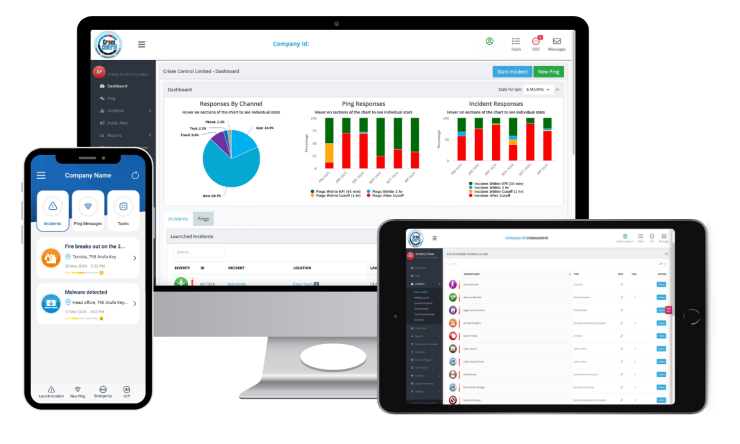
Acknowledgement is captured per recipient across whichever channel the engineer responds on, with second-level timestamps written to the incident record in the Crises Control Incident Manager. Configurable escalation windows trigger automatic paging of named deputies, then deputy’s deputies, with the same multi-channel parallel delivery. Escalation logic is transparent and configurable per incident type by the customer team.
Test 4: platform resilience independent of customer stack
Multi-region failover within Crises Control’s own infrastructure. Independent control plane and data plane. UK and EU data residency available alongside global hosting options. Documented uptime SLA with credit-back clauses. The platform’s audit trail integrates with the Crises Control audit and reporting module for regulator-format exports including 24-hour and 72-hour reports aligned to the UK Cyber Security and Resilience Bill.
Run the four engineering tests against your current platform and any shortlisted alternative. The platform that passes all four under load is the platform built for enterprise IT operations in 2026. Book a Crises Control demo against all four tests.
Final thoughts
The senior IT and operations leaders evaluating Emergency Notification Systems in 2026 are not making a tooling decision. They are making an engineering decision that will determine whether the next major incident is handled inside the regulatory clock or outside it, inside the customer SLA or outside it, with evidence of execution or without it.
Marketing claims have outpaced engineering reality across most of this category. Platforms that demonstrate well with five recipients in a Tuesday afternoon demo fail at 200 recipients on a Sunday at 03:00. Platforms that look multi-channel route serially through a single broker. Platforms that claim escalation logic lack the critical-alert push framework that wakes engineers up in Do Not Disturb mode. Platforms that operate at customer scale fail in the same hyperscaler region event that triggered the incident in the first place.
The four tests in this guide separate the platforms that meet enterprise IT operations requirements from the platforms that do not. They are not theoretical. They are the procurement tests Crises Control encourages customers to run against any vendor on the shortlist, including against Crises Control itself. The platform that passes all four under load is the platform built for the operational and regulatory environment most enterprise IT teams will operate under by the end of 2026.
Crises Control is engineered to clear all four tests at enterprise scale. The Ping mass notification system delivers parallel multi-channel notifications to hundreds of recipients inside the 90-second window. Native iOS and Android applications with Critical Alerts framework support. Two-way confirmation with automatic escalation across the full chain. Multi-region platform resilience independent of customer hyperscaler infrastructure. The audit trail across all four tests integrates with the Crises Control audit and reporting module for regulator-format exports aligned to the UK CSR Bill, ISO 22301, and ISO 27001.
Translating that into a deployed capability requires the right procurement test, run against the right scenarios, with the right scale assumptions. The next step is a structured demo against the four tests at the recipient scale your organisation actually operates.
Run the four engineering tests against your current platform and any shortlisted alternative. The platform that passes all four at scale is the platform built for 2026. Request a Crises Control demo.
FAQs
1. What is an Emergency Notification System for IT Operations?
An Emergency Notification System for IT Operations is the platform layer that reaches engineering response teams during incidents through multi-channel delivery, captures acknowledgement, and escalates automatically when acknowledgement does not arrive. For enterprise IT teams in 2026, the platform must reach hundreds of engineers across SMS, voice, email, push, mobile app, Microsoft Teams, and Slack in parallel within the 90-second window that decides whether the incident response starts on time or late.
2. How quickly should an Emergency Notification System reach the response team?
The 2026 enterprise standard is 95% of configured channels delivered within 60 seconds and the remaining 5% delivered within 90 seconds, with two-way acknowledgement captured per recipient. Anything slower introduces operational delay that compounds for hours afterwards. The benchmark applies across all configured channels and all recipients in parallel, not serially. Platforms that meet the standard at 20 recipients and fail at 200 are not fit for enterprise IT operations use.
3. How does Critical Alerts on iOS work in an Emergency Notification System?
Apple’s Critical Alerts framework allows authorised applications to break through Do Not Disturb mode, silent mode, and focus modes on iOS devices. The application requires entitlement from Apple to use the framework, and the recipient must grant permission within the application. Once configured, push notifications from the authorised application sound audibly on the device even when the device is in DND mode. This is the engineering capability that decides whether the 03:00 alert reaches the on-call engineer or stays silent on the lock screen until the morning.
4. What is the difference between an alert dispatched and an alert confirmed?
Dispatch is the platform sending the notification through the delivery channel. Confirmation is the platform receiving acknowledgement back from the recipient. The audit-trail and regulatory distinction is significant. Dispatch evidence proves the platform tried to reach the recipient. Confirmation evidence proves the recipient received and acknowledged the alert. Regulators, auditors, and increasingly customers’ procurement teams are aware of the difference and weight findings accordingly. Platforms that capture only dispatch are operationally and regulatorily insufficient for 2026 enterprise IT operations.
5. Should the Emergency Notification System integrate with our existing ITSM platform?
Yes. Mature deployments integrate the notification system bidirectionally with ServiceNow, Jira Service Management, Halo, Freshservice, and equivalent ITSM platforms, alongside monitoring tools (Datadog, New Relic, PagerDuty, Splunk) and identity sources (Azure AD, Okta) for shift-aware routing. The Crises Control Microsoft Teams integration guide covers the most common collaboration integration pattern. The notification system sits above the ITSM as the response layer, not as a replacement.