An emergency response plan for food manufacturing industries is the written framework that tells a production site exactly who does what, in what order, and through which channels when an incident threatens product safety, people, or operations. It turns panic into procedure. It exists so the right actions happen in the right order, even when the floor is loud, the line is moving, and decisions cannot wait.
On a food manufacturing line, an emergency response plan also has a second job. It protects the food chain. A single contamination event can move from one batch to one site to one country to one global brand inside 48 hours. The plan is the only thing standing between a controlled withdrawal and a public recall, and the average UK food recall now costs an estimated 6 million pounds before reputational damage is even counted (Food Manufacture / GS1 UK 2023).
What is an emergency response plan in food manufacturing?
An emergency response plan in food manufacturing is a structured framework that defines how a site detects, assesses, contains, communicates, and recovers from incidents threatening product safety. It assigns named roles, sets escalation timings, aligns with HACCP and ISO 22301, and produces an audit trail that holds up under regulator review.
It is 02:14 on a Tuesday. A QA technician at a chilled ready-meal plant flags an unusual reading on a Listeria swab. The line supervisor calls the plant manager. The plant manager tries to contact the head of food safety, who is asleep. The night-shift WhatsApp group has 41 unread messages. The CEO finds out from a journalist 11 hours later. By that point, 96,000 units have left the warehouse.
That is not a hypothetical. Variations of that exact sequence have played out across UK and EU food manufacturing sites for the last decade. The plan existed. The plan was on the shared drive. Nobody could find it, and nobody knew who owned the next move.
Why is an emergency response plan in food manufacturing harder than most
Most published guidance on emergency planning is written for offices, hospitals, or generic facilities. Food manufacturing is a different animal.
Production runs 24 hours a day, often across three shifts, with seasonal contractors who are not in the regular HR system. The people most likely to spot a problem first are not always the people listed in the response plan. The chain of custody on every batch is regulated. Every minute of confusion adds to the recall window. The cost is not just downtime; it is products on shelves that have to come back.
There is also the matter of who needs to know. A contamination event in food manufacturing triggers obligations to the Food Standards Agency, retailer technical teams, environmental health officers, the head office, the brand team, and often the public. The notification list is longer, the timing is tighter, and the audit trail has to be defensible months later.
Common contamination scenarios this emergency response plan covers
Three contamination scenarios account for the majority of food manufacturing incidents in the UK and EU. The phases below are designed to handle all three without modification.
Allergen cross-contact
An undeclared allergen reaches a finished product. Often through shared lines, shared utensils, or supplier ingredient swaps. Detection usually happens through a customer complaint or a routine audit, days or weeks after distribution. Recall windows are tight because allergen incidents carry a direct medical risk.
Pathogen detection
Listeria, Salmonella, E. coli, or Campylobacter is detected in a batch through routine swabbing, environmental monitoring, or post-distribution testing. These incidents move fastest because pathogens replicate during distribution. A 12-hour decision delay can multiply the recall scope by an order of magnitude.
Supply chain contamination
An incoming raw material is found to be contaminated, often after multiple downstream sites have already used it. This is the hardest scenario to contain because the response has to coordinate across organisations, not just within one site. Plans that work internally but break at the supplier interface fail this scenario.
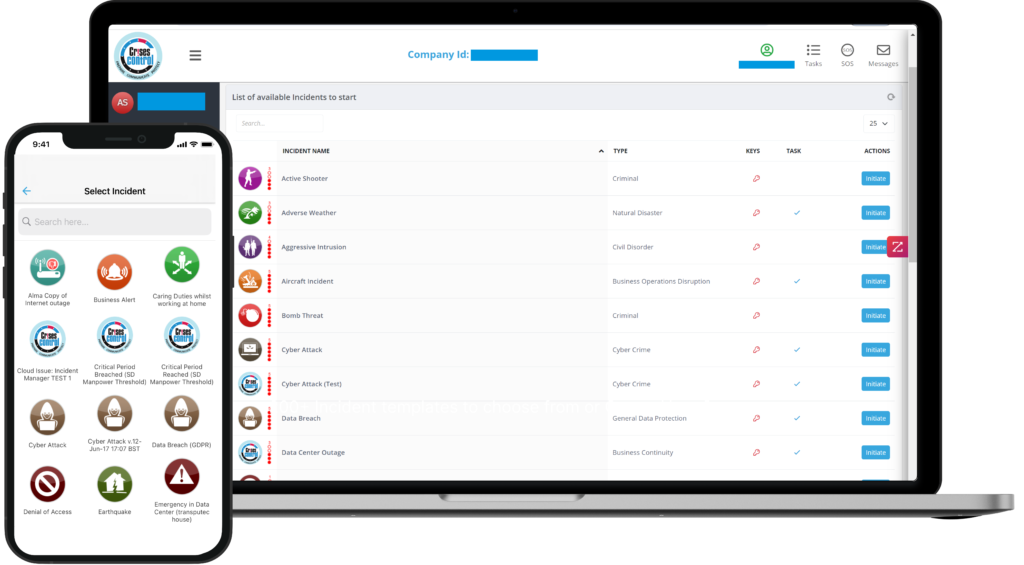
Interested in our Incident Management Software?
Flexible Incident Management Software to keep you connected and in control.
The 6 phases of an emergency response plan when contamination hits
Every workable emergency response plan for a food manufacturing environment moves through six phases. Skip one, and the rest fall apart.
1. Detection: someone has to spot it and be believed
Contamination rarely arrives with a siren. It arrives as a swab result, a customer complaint, a line operator who notices the wrong colour, or a temperature log that drifts out of range. The plan has to define who can raise an incident, how they raise it, and how fast it has to be acknowledged.
The bottleneck is rarely detected. The bottleneck is the window between detection and someone with authority taking it seriously. Teams that rely on phone trees and group chats lose that window every time.
2. Assessment: is this a hold, a withdrawal, or a recall?
The next phase is the most consequential decision in the entire response. It is the difference between holding 4,000 units in the warehouse and recalling 400,000 from supermarket shelves. Most plans rely on a small number of named decision-makers: the head of food safety, the plant manager, and the technical director.
Those people have to be reachable in minutes, not hours. They have to see the same information at the same time. And the decision they make has to be logged against a timestamp, because the regulator will ask for it later.
This phase is also where HACCP principles meet the operational reality. The plan must reference the site’s existing HACCP framework and the trigger thresholds inside it. Anything looser than that is just an opinion under pressure.
3. Containment: stop the line, hold the stock, isolate the batch
Once the call is made, containment has to happen in parallel, not in sequence. The line stops. Affected stock is quarantined. Batch codes are isolated in the warehouse system. Distribution holds are issued. None of these actions can wait for the next one to finish.
The plan needs to assign each containment task to a named role, with a backup, and track completion in real time. A containment action that nobody confirms is a containment action that did not happen.
4. Notification: the right people, on the right channel, in the right order
Notification in a food manufacturing incident is not one message to one group. It is layered. Floor staff need clear, immediate instructions. The technical team needs details. Senior leadership needs a situation summary they can act on. Retailer customers need a formal communication that meets their technical agreement timelines.
If contamination is confirmed, Food Standards Agency notification protocols must be triggered within defined windows. Late notification is its own offence, separate from the contamination itself.
Email cannot do this on its own. SMS cannot do it on its own. The plan has to cover SMS, voice, push, app, and email together, with confirmation that each recipient has acknowledged the message. Anything less is hope.
5. Coordination: tasks, ownership, and a single source of truth
Once the notification is out, the response splits into parallel workstreams. QA is sampling. Production is cleaning down. Logistics is recalling stock. Communications is briefing retailers. Legal is reviewing notification timelines. HR is handling staff.
Each of those workstreams needs a task list, an owner, a status, and a deadline. Without that, the response devolves into a bridge call with 14 people on it where nothing gets resolved, and everything gets discussed twice. Coordination is the phase where most emergency response plans collapse, because most plans never define how the workstreams stay aligned in real time.
6. Recovery and audit: prove what happened, learn what to fix
The incident does not end when the line restarts. It ends when the regulator, the retailer, and the board all have a defensible record of what happened. That record has to show every decision, every notification, every action, and the timestamp on each.
Sites operating under ISO 22301 are expected to evidence this audit trail as part of their business continuity certification. Sites that cannot produce it are at risk of losing both certification and customer contracts.
Recovery also includes the post-incident review. Not the version that gets sanitised for the board pack, but the honest one that surfaces what slowed the response. That review is only useful if the response generated real data in real time. If the data is reconstructed from memory two weeks later, the review is fiction.
Why most emergency response plans fail in food manufacturing
Plans fail for the same reasons across nearly every site reviewed in incident post-mortems. The plan exists in a document nobody reads under pressure. The contact list is out of date. Decision authority is ambiguous when the named lead is unreachable. The notification chain depends on email, and email depends on people checking their inboxes. There is no live status, so the same questions get asked four times.
The deeper issue is that most plans are designed to be filed, not run. They satisfy the audit. They do not survive contact with a real incident. A plan that has never been tested under realistic time pressure is just a hypothesis.
Before and after: what an execution layer changes
The difference between a plan that lives in a folder and a plan that runs on a platform shows up in measurable response outcomes.
|
Response factor |
Plan in a folder |
Plan on an execution layer |
|
Time to acknowledge escalation |
Hours, often unmeasured |
Minutes, with confirmation |
|
Decision visibility |
Phone calls and side messages |
Single live dashboard |
|
Task ownership |
Implicit, ambiguous |
Named, tracked, timestamped |
|
Audit trail for FSA and retailers |
Reconstructed from memory |
Generated automatically |
|
Recall scope |
Wider than necessary |
Contained to affected batches |
The execution layer for a food manufacturing emergency response plan
Most competitors either notify people or document plans. Crises Control executes the response. Built for real incidents, not demos.
Mass notification platforms like Everbridge, OnSolve, and AlertMedia handle alerts well. They get the message out. They do not handle what happens after the alert: the task ownership, the status tracking, the audit trail. Planning platforms like Fusion and Riskonnect are strong on the document side, but they were not built for the live, time-pressured floor of a food manufacturing incident. Teams and Slack are useful for everyday work and useless under audit. None of these tools were built for the specific shape of a contamination response.
Crises Control is the execution layer that sits across detection, assessment, containment, notification, coordination, and recovery as a single workflow.
How execution compares against the alternatives
|
Capability |
Traditional plan |
Notification tools |
Planning tools |
Crises Control |
|
Real-time execution |
No |
No |
No |
Yes |
|
Multi-channel notification with confirmation |
No |
Yes |
No |
Yes |
|
Task ownership and live status |
No |
Partial |
Partial |
Yes |
|
Audit trail for FSA and retailer review |
Partial |
No |
Partial |
Yes |
|
HACCP and ISO 22301 alignment |
Partial |
No |
Yes |
Yes |
Mass notification, but built for confirmation
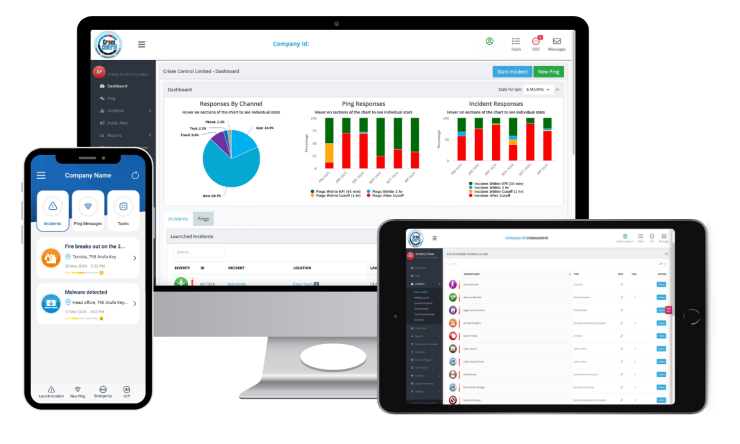
The Crises Control mass notification system reaches floor staff, technical teams, leadership, and external stakeholders across SMS, voice, email, push, and app, with two-way confirmation. The plan knows who has acknowledged and who has not. That is the difference between a notification that went out and a notification that landed.
Incident management with named owners
The incident manager turns the six phases above into a live workflow. Each phase has named owners, escalation paths, and pre-built actions that match the site’s existing HACCP and food-safety protocols. Decisions get logged with timestamps as they happen, not reconstructed afterwards.
Task assignment and live status
The task manager handles the parallel workstreams of a contamination response. QA, production, logistics, communications, legal, and HR each get a live task list. Leadership gets a single dashboard. The bridge call gets shorter because the status is already visible.
Audit trail that holds up under regulator review
Every alert, acknowledgement, decision, task, and message is captured automatically in the Crises Control audit trail. When the FSA, the retailer’s technical team, or the board asks what happened and when, the answer is not a forensic exercise. It is a report.
What a working emergency response plan looks like in practice
A working plan is short enough to read in five minutes and structured enough to run for five hours. It names roles, not people. It assumes the named lead is unreachable and defines the deputy. It uses multiple channels because no single channel works in every incident. It logs everything, because regulators will ask. And it gets tested in conditions that mirror the real thing, not in tabletop sessions where everyone is in the same room with coffee.
Food manufacturing sites that adopt this approach do not eliminate incidents. They turn incidents into controlled events. The contamination still happens. The 96,000 units do not leave the warehouse.
If your current plan would not hold up under a 4-hour recall window, it is time to test it under real conditions. Book a demo to see it run.
FAQs
1. What is an emergency response plan in food manufacturing?
An emergency response plan in food manufacturing is a structured framework that defines how the site detects, assesses, contains, communicates, and recovers from incidents that threaten product safety, people, or operations. It covers contamination, equipment failure, allergen cross-contact, fire, and any event that could trigger a hold, withdrawal, or recall. The plan must align with HACCP, ISO 22301, and the site’s regulatory obligations, and it must be testable under realistic time pressure.
2. How quickly should a contamination incident be escalated?
Industry practice is that any suspected contamination should be acknowledged by a named decision-maker within 30 minutes of detection, and a hold-or-recall decision should be made within four hours of confirmation. Regulator notification windows in the UK can be as short as four hours from confirmation depending on the hazard category. Plans that cannot evidence those timings are exposed.
3. Who should own the emergency response plan on site?
The technical director or head of food safety is usually accountable, but the plan itself needs multiple named owners across QA, production, logistics, and communications. A plan with a single point of ownership fails the moment that person is unreachable. The strongest plans name a primary, a deputy, and a third backup for every critical role.
4. Does an emergency response plan cover regulatory notification?
Yes. A complete emergency response plan defines exactly when and how the Food Standards Agency, environmental health officers, retailer technical teams, and other relevant bodies are notified. It includes pre-drafted templates, defined approval routes, and timestamped logs so that notification timing can be evidenced after the fact. Late notification is treated as a separate offence by most regulators.
5. How often should a food manufacturing emergency response plan be tested?
At minimum, once a year for full live exercises and quarterly for tabletop reviews. Plans should also be re-tested after any significant change to the site, the product range, the supply chain, or the leadership team. Most failures in real incidents trace back to plans that were last tested under conditions that no longer matched reality.