Mass notification software is a platform that delivers urgent alerts to large numbers of people across multiple channels at the same time, with confirmation that each message has been received and read. It replaces phone trees, group chats, and shared inboxes with a single system that gets the right information to the right people in seconds.
In a food and beverage plant, mass notification software has a specific job: it closes the gap between the moment a contamination event is detected and the moment everyone who can stop it from spreading knows about it. That gap is where recalls grow. The average UK food recall now costs an estimated 6 million pounds before reputational damage is even counted (Food Manufacture / GS1 UK 2023).
What is mass notification software in food and beverage manufacturing?
Mass notification software in food and beverage manufacturing is a multi-channel alerting platform that delivers contamination, recall, and safety alerts across SMS, voice, email, push, and app, with two-way confirmation. It integrates with HACCP and BRCGS workflows so the alert triggers the response, not just the message.
It is 04:48 on a Saturday at a beverage bottling plant. A line operator notices a fragment of clear plastic in a sample bottle pulled for QA. The shift manager logs the finding and tries to reach the head of quality, who is on holiday. The deputy is two hours away. The night-shift WhatsApp group has 67 unread messages. By the time anyone with authority sees the alert, 22,000 cases have already shipped to three regional distribution centres. The retailer’s technical team finds out from a customer complaint on Monday morning.
That is not a hypothetical. Variations of that exact sequence have played out across food and beverage manufacturing sites for the last decade. The plan existed. The contact list existed. Nobody could find them under pressure, and nobody could confirm who had actually been told.
An alert that nobody confirms is not an alert. It is a hope that somebody saw the message in time.
Why food and beverage plants need mass notification software built for incidents, not for memos
Most generic communication tools assume a daytime office, a single building, and people who are watching their inboxes. Food and beverage plants meet none of those assumptions.
Production runs across three shifts, seven days a week, often with seasonal contractors, agency staff, and third-party hauliers who are not in the regular HR system. Many of the people most likely to spot a problem first, line operators, QA technicians, and hygiene crews, are the people least likely to be checking email when an incident hits. The chain of custody on every batch is regulated. Every minute of confusion adds to the recall window. The cost is not just downtime; it is product on shelves that has to come back.
There is also the matter of who needs to know, and how fast. A contamination event in food and beverage manufacturing triggers obligations to the Food Standards Agency, retailer technical teams, environmental health officers, the head office, the brand team, and often the public. The notification list is longer, the timing is tighter, and the audit trail has to be defensible months later. Email and phone chains do not survive that load.
UK food businesses issued 1,386 product recalls and withdrawals between 2019 and 2023, with allergen and pathogen contamination as the two leading causes (Food Standards Agency 2024).
The contamination scenarios mass notification software has to handle
The capabilities below are designed against the four scenarios that account for the majority of incidents in food and beverage plants in the UK and EU.
Allergen cross-contact
An undeclared allergen reaches a finished product, often through shared lines, shared utensils, or supplier ingredient swaps. Detection usually happens through a customer complaint or a routine audit, days after distribution. Recall windows are tight because allergen incidents carry a direct medical risk.
Pathogen detection
Listeria, Salmonella, E. coli, or Campylobacter is detected in a batch through routine swabbing, environmental monitoring, or post-distribution testing. These incidents move fastest because pathogens replicate during distribution. A 12-hour delay in notification can multiply the recall scope by an order of magnitude.
Foreign body contamination
Glass, plastic, metal, or other physical contaminants found in the product. Often detected at the line, sometimes by a consumer. The notification challenge is reaching every shift that ran the affected batch and isolating the units before they ship to retailers.
Supply chain contamination
An incoming raw material is found to be contaminated, often after multiple downstream sites have already used it. This is the hardest scenario to contain because the response has to coordinate across organisations, not just within one site. Notification systems that work internally but break at the supplier interface fail this scenario.
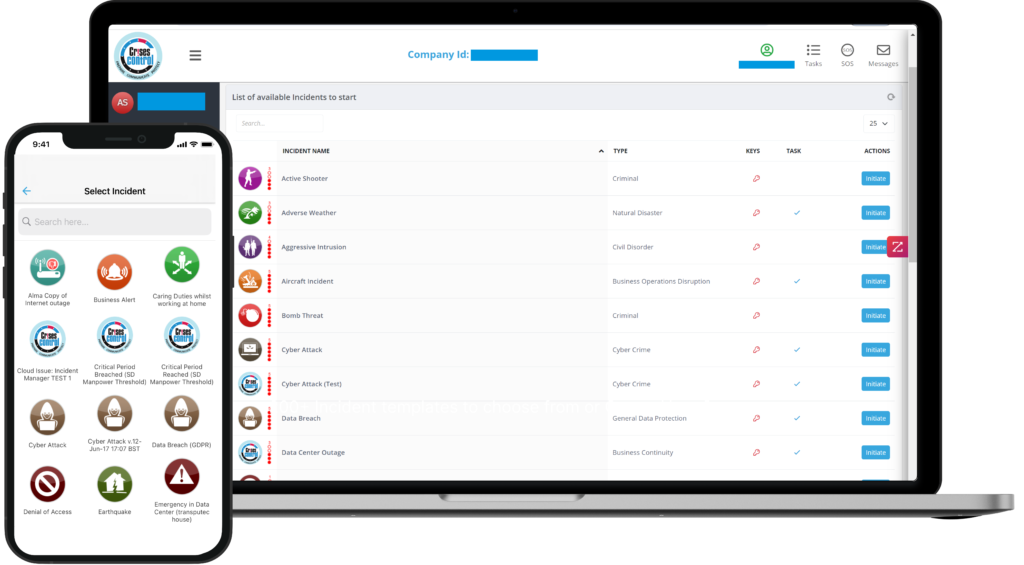
Interested in our Incident Management Software?
Flexible Incident Management Software to keep you connected and in control.
7 capabilities of mass notification software that stop a recall spreading
Each capability below corresponds to a moment in a contamination response when a recall typically widens. Strip any of them out, and the gap returns.
1. Multi-channel delivery across SMS, voice, email, push, and app
A single channel never reaches every relevant person. Floor staff are not at desks. Hauliers are in cabs. Night-shift QA is on the line. The notification has to fire across SMS, voice, email, mobile push, and a dedicated app at the same time, with each recipient set to receive on the channel they are most likely to act on. The capability is not about choice; it is about redundancy. If one channel fails, the others land.
2. Two-way confirmation, not one-way blast
Sending a message is not the same as the message being received. Mass notification software for food and beverages has to capture acknowledgement from each recipient in real time, with the timestamp logged. That is what tells the incident lead whether the night-shift hygiene crew has actually been told to stop the line or whether the message is still sitting in a phone that ran out of battery in the locker room.
3. Pre-built incident templates aligned to HACCP and BRCGS
Drafting an alert during a live contamination event is the worst possible time to draft an alert. Templates have to be pre-built, pre-approved by technical and legal, and aligned to the site’s HACCP plan and BRCGS standards. When the trigger fires, the right message goes out in seconds, not in 25 minutes of nervous editing.
4. Targeted distribution by site, line, shift, role, and supplier
A contamination event rarely affects everyone equally. The line that runs the batch needs detailed instructions. The site next door needs awareness. The supplier that provided the suspect ingredient needs a different message entirely. Mass notification software has to send by site, line, shift, role, supplier, and retailer customer, all from the same trigger, with each recipient group seeing the message designed for them.
A general alert to a thousand people is not the same as the right alert to the right hundred. The first creates noise. The second stops the recall.
5. Escalation paths when the named lead is unreachable
Every plan has a primary contact. Every real incident finds a way to make the primary contact unreachable. The notification system has to define a deputy, a third backup, and an automatic escalation timer so that an unanswered alert moves to the next person in 60 seconds, not in the next hour. Single points of contact are the most common failure mode in food and beverage incidents.
6. Geo-targeted alerts for multi-site and contractor staff
A larger food and beverage business runs multiple plants, regional distribution centres, and a contractor pool that moves between sites. The notification platform has to send alerts based on where people physically are, not just their HR records. A contractor on the affected line gets the operational alert. A contractor at a different site gets the awareness brief. Geo-targeting prevents the panic spread that comes from a blanket message.
7. A live audit trail is captured automatically
Every alert, every acknowledgement, every escalation, and every resend has to be captured automatically against a timestamp. That trail is what the FSA, the retailer technical team, and the BRCGS auditor will ask to see when the incident is over. Without it, the response cannot be evidenced. With it, the site can demonstrate its FSA notification timing, its containment actions, and its decision points in a report rather than a forensic exercise.
The average direct cost of a food recall to a UK manufacturer is estimated at 6 million pounds, with reputational damage often exceeding the direct cost (Food Manufacture / GS1 UK 2023).
Why most food and beverage plants do not have working mass notification software
Most plants have a notification system in name. The number is in the binder. The contact list is on a shared drive. The on-call rota is on a spreadsheet that was last updated nine months ago. Under pressure, none of these survives contact with a real incident.
The deeper issue is that most setups were never designed for the specific shape of a food and beverage contamination response. They were designed for office fire drills, then asked to handle pathogen detection at 04:48 on a Saturday. The mismatch shows up the moment a real incident hits.
Before and after: what mass notification software changes in the response
The difference between a manual notification chain and a platform-based notification system shows up in measurable response outcomes.
|
Response factor |
Manual notification chain |
Mass notification software |
|
Time to first acknowledged alert |
30 to 90 minutes, often unmeasured |
Under 5 minutes, with confirmation |
|
Channel coverage |
Email and phone |
SMS, voice, email, push, app |
|
Reach across shifts and contractors |
Patchy, depends on personal contact |
Complete, role and site targeted |
|
Escalation when the primary is unreachable |
Manual, depends on memory |
Automatic, timed, logged |
|
Audit trail for FSA and retailer review |
Reconstructed from memory |
Generated automatically |
|
Recall scope |
Wider than necessary |
Contained to affected batches |
If your alerts still depend on calls, emails, and group chats, the recall has already started spreading. Book a demo of the platform.
How Crises Control delivers mass notification software for food and beverage plants
Most competitors either notify people or document plans. Crises Control executes the response. Built for real incidents, not demos.
Mass notification platforms like Everbridge, OnSolve, and AlertMedia handle alerts well. They get the message out. They do not handle what happens after the alert: the task ownership, the status tracking, and the audit trail. Planning platforms like Fusion and Riskonnect are strong on the document side, but they were not built for the live, time-pressured floor of a food and beverage incident. Teams and Slack are useful for everyday work and useless under audit. None of these tools was built for the specific shape of a contamination response in a 24/7 plant environment.
Crises Control delivers all 7 capabilities above on a single platform, with the execution layer that turns a notification into a coordinated response.
How Crises Control compares against the alternatives
|
Capability |
Manual setup |
Notification tools |
Planning tools |
Crises Control |
|
Multi-channel delivery with confirmation |
No |
Yes |
No |
Yes |
|
HACCP- and BRCGS-aligned templates |
Partial |
No |
Yes |
Yes |
|
Site, line, shift, supplier targeting |
No |
Partial |
No |
Yes |
|
Automatic escalation with timed backup |
No |
Partial |
No |
Yes |
|
Audit trail for FSA and retailer review |
Partial |
No |
Partial |
Yes |
|
Execution layer beyond the alert |
No |
No |
No |
Yes |
PING: multi-channel mass notification with confirmation
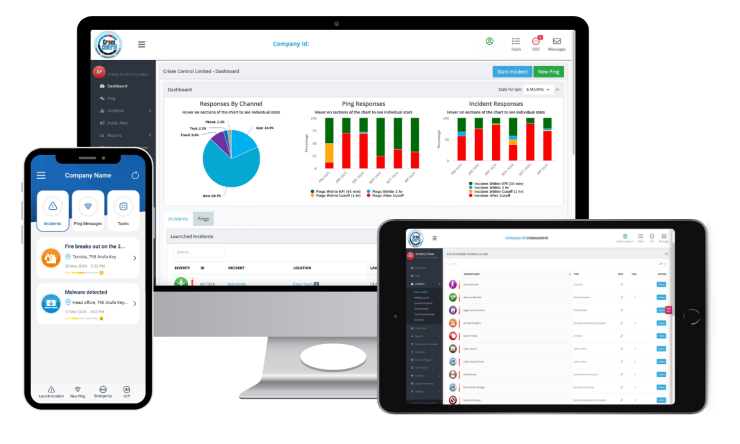
The Crises Control mass notification system reaches floor staff, technical teams, leadership, and external stakeholders across SMS, voice, email, push, and app with two-way confirmation. The plan knows who has acknowledged and who has not. That is the difference between a notification that went out and a notification that landed.
Incident management with named owners and timed escalation
The incident manager turns each contamination scenario into a live workflow. Each phase has named owners, escalation paths, and pre-built actions that match the site’s existing HACCP and BRCGS protocols. Decisions get logged with timestamps as they happen, not reconstructed afterwards.
Task assignment and live status across QA, production, and logistics
The task manager handles the parallel workstreams of a contamination response. QA, production, logistics, communications, legal, and HR each get a live task list. Leadership gets a single dashboard. The bridge call gets shorter, because the status is already visible.
Audit trail that holds up under regulator and retailer review
Every alert, acknowledgement, decision, task, and message is captured automatically in the Crises Control audit trail. When the FSA, the retailer technical team, or the BRCGS auditor ask what happened and when, the answer is not a forensic exercise. It is a report.
What working mass notification software looks like in a food and beverage plant
A working setup is short enough to read in five minutes and structured enough to run for five hours. It names roles, not people. It assumes the named lead is unreachable and defines the deputy. It uses multiple channels because no single channel works in every incident. It logs everything, because regulators will ask. And it gets tested in conditions that mirror the real thing, not in tabletop sessions where everyone is in the same room with coffee.
Sites that adopt this approach do not eliminate incidents. They turn incidents into controlled events. The contamination still happens. The 22,000 cases do not leave the warehouse.
If your current notification setup would not hold up under a 4-hour recall window, it is time to test it under real conditions. Book a demo to see it run.
FAQs
1. What is mass notification software for a food and beverage plant?
Mass notification software for a food and beverage plant is a platform that delivers urgent alerts across SMS, voice, email, push, and app at the same time, with two-way confirmation that each recipient has received the message. It is built to reach floor staff, technical teams, leadership, hauliers, and external stakeholders across multiple shifts and sites in seconds and to log every alert and acknowledgement against a defensible audit trail.
2. How quickly should a contamination alert reach the team?
Industry practice is that any suspected contamination should reach the named decision-makers within five minutes of detection, with acknowledged confirmation logged. Regulator notification windows in the UK can be as short as four hours from confirmation, depending on the hazard category. Plans that rely on phone trees or email cannot evidence those timings.
3. Does mass notification software replace HACCP or BRCGS?
No. Mass notification software does not replace HACCP, BRCGS, or any food safety management system. It executes against them. The platform takes the trigger thresholds defined in HACCP and the response procedures aligned to BRCGS, and turns them into a live, timed workflow with named owners and a complete audit trail.
4. How does mass notification software handle multi-site and contractor staff?
Modern platforms target alerts by site, line, shift, role, and supplier rather than by HR record alone. Geo-targeting reaches people based on where they physically are. Contractors and hauliers are included on the same workflow as full-time staff, so the alert covers everyone who could affect the response, not just the people on the payroll.
5. What evidence does mass notification software produce for an FSA or retailer review?
A complete audit trail covering every alert sent, every acknowledgement received, every escalation triggered, every decision logged, and every task completed, against a timestamp. This trail is what the Food Standards Agency, retailer technical teams, and BRCGS auditors ask to see when an incident is over. Plans that cannot produce it on demand are exposed at the next audit cycle.