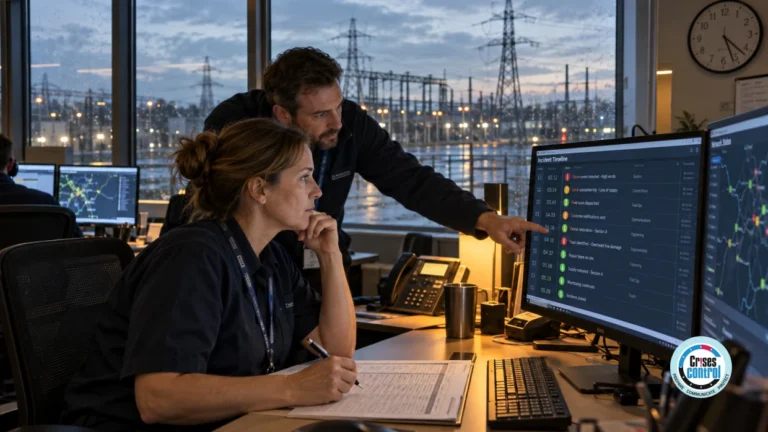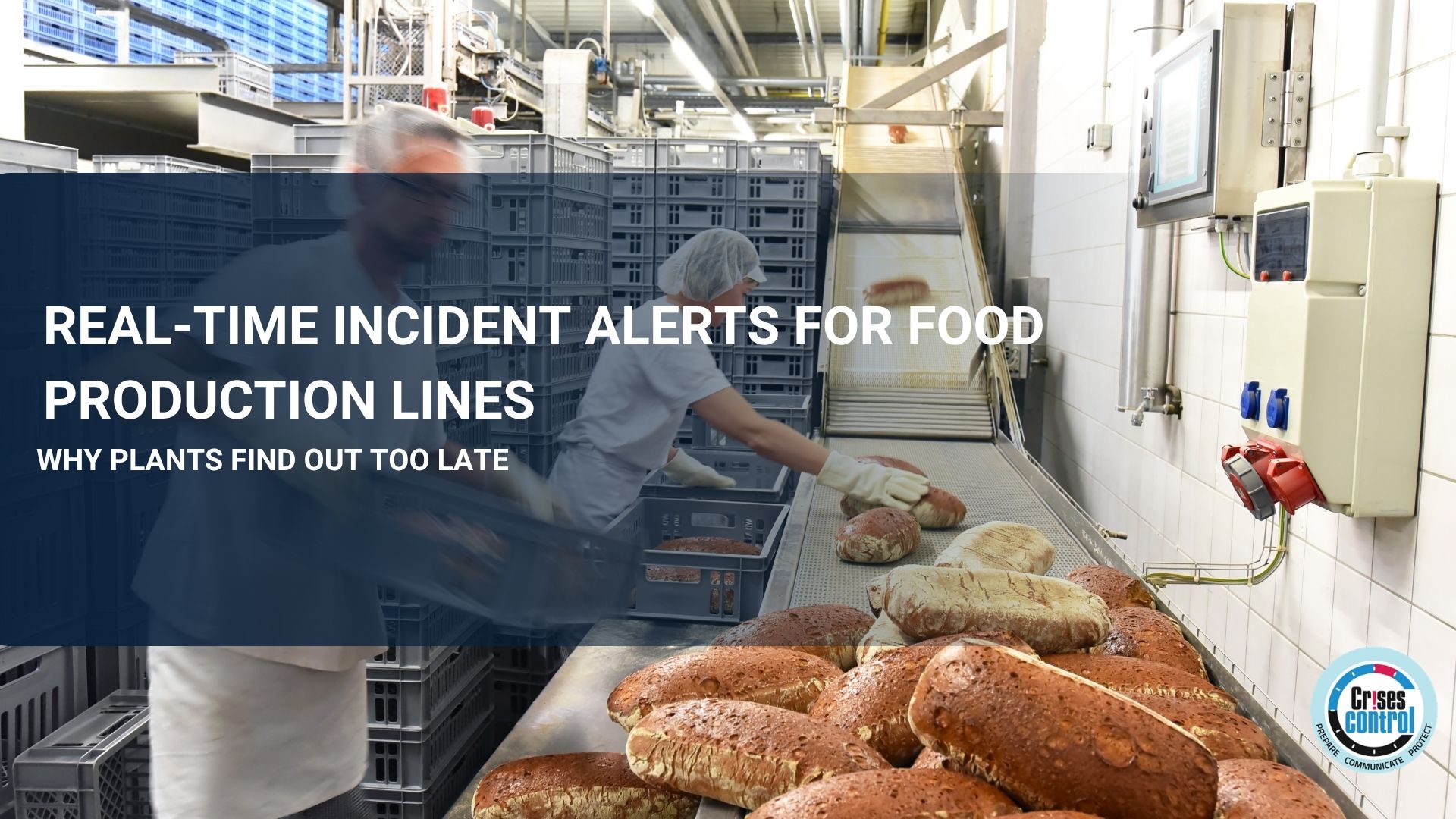
Real-time incident alerts are instant, multi-channel notifications sent to named owners the moment an operational event is detected, with two-way confirmation, routed against the role and shift pattern of the recipient. They are not emails. They are not group chats. They are the structured layer that closes the gap between detection and action, with the timestamped audit trail that regulators and retailers now require.
For a food production line, real-time incident alerts have a sharper purpose. They are the difference between a contamination event caught at the source and a retailer-issued precautionary withdrawal forty-five minutes later. The average UK food recall already costs an estimated 6 million pounds before reputational damage is counted (Food Manufacture / GS1 UK 2023), and most of that cost is locked in inside the detection-to-action window.
What are Real-Time Incident Alerts on a food production line?
Real-time incident alerts on a food production line are instant, multi-channel notifications triggered by an operational event such as a contamination swab, foreign-body detection, allergen breach, or utility failure, sent to named owners with two-way confirmation and a timestamped audit trail. They run against shift patterns, integrate with HACCP and BRCGS workflows, and remove the email-and-WhatsApp delay that costs plants their detection-to-action window.
It is 03:00 on a Wednesday at a ready meal plant in the North West. A contamination swab on line 4 comes back positive. The QA technician on the night shift logs the result into the lab system. The line supervisor is on the floor 200 metres away. The technical manager is at home asleep. The plant manager has a phone on do-not-disturb. The QA technician sends an email to a shared technical inbox, then messages the night shift WhatsApp group with 23 unread messages.
Forty-five minutes pass before the line supervisor opens the email. Line 4 has been running the whole time. By the time the supervisor reaches the QA office, 3,200 product units have come off the line. By 06:00, the technical manager is briefed. By 09:30, the retailer’s technical team is contacted. By 14:00, the precautionary withdrawal is in motion. The contamination was caught. The window to stop the line at the source was missed by forty-five minutes.
That window between 03:00 and 03:45 is the most expensive forty-five minutes the plant will see this year. Real-Time Incident Alerts turn those forty-five minutes into ninety seconds. Email and group chat turn them into a recall.
On a food production line, detection without alerting is just a logged result. The cost of the gap between them is paid in product units, retailer trust, and regulatory exposure.
Why Real-Time Incident Alerts in food production are different from other operational environments
Most published guidance on real-time alerting is written for IT teams in office environments. The standard playbook assumes that the recipient is at a desk, has email open, and is checking notifications. A food production line breaks all three assumptions inside the first hour.
The people most likely to first detect a production-line event are QA technicians, line supervisors, hygiene operators, and engineering staff. None of them sits at desks. None of them has email open during a shift. Most are not on the standard HR or IT system because they are on temporary, agency, or rotating shift contracts. The alerting layer has to find them on the floor, on a phone, across three shifts a day, seven days a week, often on a Sunday night when the head office is closed.
There is also the matter of what the alert has to trigger. A food production incident does not just require a person to be notified. It requires a line to be held, a batch to be quarantined, a HACCP-aligned investigation workflow to start, a retailer technical agreement window to begin counting, and an FSA hazard-category notification to be drafted. The alerting layer has to be aware of the downstream workstreams, not just the contact list.
Finally, the audit trail. Every alert sent, every acknowledgement received, every escalation triggered, and every action logged, all needed in a format the BSI auditor, the BRCGS auditor, the retailer technical team, and the FSA will ask to see. A real-time alert that nobody can prove was sent on time is the same as no alert at all.
UK food businesses issued 1,386 product recalls and withdrawals between 2019 and 2023, with allergen and pathogen contamination as the two leading causes (Food Standards Agency 2024).
The 5 reasons food production plants find out too late
Post-incident reviews of UK food production events between 2020 and 2024 surface the same five failure modes again and again. Each one is fixable. None of them is fixed by buying a faster email system.
The alert lives in an unmonitored shared inbox
QA results, contamination swabs, and foreign-body reports get sent to a shared technical inbox. Nobody is logged in at 03:00 on a Wednesday. Nobody is logged in on Sunday night. The alert arrives instantly and sits there for thirty, sixty, or ninety minutes before anyone sees it. Detection happened. Alerting did not.
The named contact has changed since the plan was last updated
The technical manager on the plan left in February. The plan still names them. Their email forwards to no one. Their phone is disconnected. The deputy is named only verbally. When the alert goes out, it goes to a person who no longer works at the plant, and the deputy waits for the primary to acknowledge an alert they will never see.
The notification depends on a single channel
Email-only setups fail when the recipient is on the floor without a laptop. Phone-tree setups fail when the recipient is in a meeting with the phone on silent. App-only setups fail when the recipient is on a personal phone with notifications disabled. Single-channel notification is the most common failure mode in food production. A working setup uses SMS, voice, email, push, and app in parallel, with two-way confirmation.
Shift patterns are not encoded in the alert routing
The plan names a single technical manager. It does not specify who covers Tuesday night, who covers the Sunday A shift, who is on call during the Christmas holiday window. The alert routes to one person regardless of shift, and that person is asleep, on annual leave, or running a different production line at the time of the event.
The audit trail is reconstructed, not captured
When the retailer’s technical team or the Food Standards Agency asks for the alert timeline, the plant assembles it from email exports, WhatsApp screenshots, and memory. The reconstruction takes days. The gaps are visible. The conclusion the auditor reaches is that the plant cannot evidence its own response. Certification renewal becomes a problem.
A real-time alert that nobody can prove was sent on time is the same as no alert at all. The audit trail is half the alert.
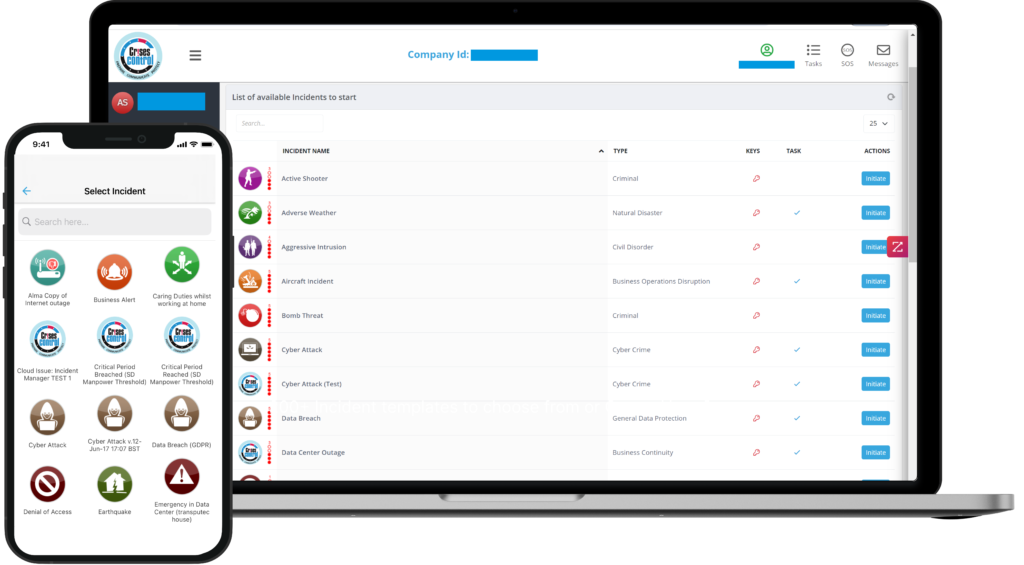
Interested in our Incident Management Software?
Flexible Incident Management Software to keep you connected and in control.
What real-time means in HACCP and BRCGS terms
Real-time in a food production context is not just about technical latency. It is about the gap between detection at a critical control point and a documented response action. HACCP principles require that monitoring procedures at each CCP detect deviations in time to allow corrective action before the product is released. BRCGS Issue 9 requires documented procedures for managing incidents, withdrawals, and recalls, including communication to relevant parties.
In practical terms, real-time means three things. The alert reaches a named owner with confirmation within minutes of the detection event, not hours. The downstream workflow triggers automatically rather than waiting for someone to start it. The full chain is captured against timestamps so the BRCGS auditor and the retailer technical team can see what happened and when, exportable in minutes rather than reconstructed in days.
The average direct cost of a food recall to a UK manufacturer is estimated at 6 million pounds, with reputational damage often exceeding the direct cost (Food Manufacture / GS1 UK 2023).
Before and after: what working Real-Time Incident Alerts change on a food production line
The difference between email-and-WhatsApp alerting and a platform-based alerting layer shows up in measurable detection-to-action outcomes.
|
Alerting factor |
Email + group chat |
Platform-based alerting |
|
Time from detection to acknowledgement |
30 to 90 minutes overnight |
Under 5 minutes, any shift |
|
Reach when primary is unavailable |
Manual, depends on memory |
Automatic escalation to deputy |
|
Shift-aware routing |
None |
Built into the alert rules |
|
Multi-channel confirmation |
Single channel, no confirmation |
SMS, voice, email, push, app |
|
Downstream workflow trigger |
Manual, started by recipient |
Automatic, pre-built playbook |
|
Audit trail for BRCGS and FSA |
Reconstructed from email exports |
Captured automatically, exportable |
|
Outcome on a real event |
Retailer-issued withdrawal |
Line held at source, controlled withdrawal |
How Crises Control delivers Real-Time Incident Alerts on a food production line
Most competitors either notify people or document plans. Crises Control executes the response. Built for real incidents, not demos.
Mass notification platforms like Everbridge, OnSolve, and AlertMedia handle alerts well. They get the message out. They do not run the downstream workstreams that a food production incident requires, and they do not encode shift-aware routing or HACCP-aligned playbooks. Planning platforms like Fusion and Riskonnect are strong on the document side, but they were not built for the live, time-pressured floor of a 03:00 contamination event. Teams and Slack are useful for everyday work and useless when the recipient is on the line and the auditor is asking for a timeline. Email and WhatsApp are the most common setups and the ones that produce the forty-five-minute gap.
Crises Control runs the alerting layer as a live, multi-channel workflow with shift-aware routing, automatic escalation, two-way confirmation, a downstream workstream trigger, and a continuous audit trail. The platform itself holds ISO 22301 accreditation, so the standard is built into the product rather than bolted on after.
How Crises Control compares against the alternatives
|
Real-Time Incident Alerts requirement |
Email + chat |
Notification tools |
Planning tools |
Crises Control |
|
Multi-channel with two-way confirmation |
No |
Yes |
No |
Yes |
|
Shift-aware routing across 24/7 operations |
No |
Partial |
Partial |
Yes |
|
Automatic escalation to named deputy |
No |
Partial |
No |
Yes |
|
HACCP and BRCGS aligned playbooks |
No |
No |
Yes |
Yes |
|
Downstream workstream trigger |
No |
No |
Partial |
Yes |
|
Continuous timestamped audit trail |
No |
Partial |
Partial |
Yes |
Multi-channel alerting with confirmation
The Crises Control mass notification system reaches QA technicians, line supervisors, technical managers, plant leadership, and external stakeholders across SMS, voice, email, push, and app, with two-way confirmation. The platform knows who has acknowledged and who has not. Email alone in a shared inbox at 03:00 on a Wednesday is not alerting. Five channels with confirmation is.
Shift-aware routing built into the alert rules
Alert rules in the Crises Control business continuity platform understand shift patterns, on-call rotations, holiday cover, and named deputies. The Tuesday night alert routes to the Tuesday night technical lead. The Sunday A-shift alert routes to the Sunday A-shift supervisor. The Christmas Eve alert routes to the holiday on-call manager. Configuration sits with the plant, not with IT.
Automatic downstream workflow trigger
Each alert is linked to a pre-built HACCP and BRCGS aligned playbook in the Crises Control incident manager. When the alert fires, the playbook starts. Line hold actions queue automatically. The task manager assigns named owners to each step. Nobody starts the workstream because the workstream starts itself.
Audit trail captured automatically
Every alert sent, every acknowledgement received, every escalation triggered, and every action logged are all captured automatically in the Crises Control audit trail. When the BRCGS auditor, the FSA, or the retailer technical team ask for the 03:00 to 04:00 timeline, the answer is exportable in minutes, against timestamps. Aligned to ISO 22301 business continuity requirements.
If your current alerting layer cannot evidence the first five minutes of a contamination event on demand, you have a recall waiting to happen. Book a demo to see it run.
What working Real-Time Incident Alerts look like on a food production line
A working alerting layer reaches the right-named owner across the right channel within minutes of detection, regardless of shift, regardless of leave, regardless of which deputy is on call. It triggers the downstream HACCP and BRCGS aligned workstreams without waiting for someone to start them. It captures the audit trail automatically, exportable on demand for retailer, BSI, BRCGS, and FSA reviews. It works on a Sunday night at 03:00 the same way it works on a Tuesday afternoon at 14:00.
Plants that adopt this approach do not eliminate contamination events. They turn forty-five minutes into ninety seconds. The line is held at the source. The product on the shelf does not need a public recall. The brand survives the next twelve months. The reputational cost stays on the supplier side of the contractual line.
If your current alerting layer would not produce a defensible 03:00 Wednesday timeline under retailer review, the next event is the one that proves the cost of the gap. Book a demo of the platform.
FAQs
1. What are Real-Time Incident Alerts on a food production line?
Real-Time Incident Alerts on a food production line are instant, multi-channel notifications triggered by an operational event such as a contamination swab, foreign-body detection, allergen breach, utility failure, or supplier issue, sent to named owners with two-way confirmation and a timestamped audit trail. They route against shift patterns, integrate with HACCP and BRCGS workflows, trigger downstream workstreams automatically, and produce the evidence the BRCGS auditor and retailer technical team require.
2. Why do food production plants find out about incidents too late?
The most common reasons are alerts sent to unmonitored shared inboxes, named contacts that have left the business, single-channel notifications that fail when the recipient is on the floor, shift patterns that are not encoded in the alert routing, and audit trails reconstructed from email after the event rather than captured automatically during it. Each of these failure modes appears in nearly every post-incident review across UK food production between 2020 and 2024.
3. How fast should a Real-Time Incident Alert reach a named owner?
Industry practice is that the first acknowledged alert should be confirmed by a named owner within five minutes of detection, regardless of shift or time of day. Setups built on email and group chat routinely run thirty to ninety minutes overnight. Platform-based alerting with multi-channel delivery and two-way confirmation routinely meets the five-minute threshold. The cost of the gap is measured in product units off the line and retailer technical agreement breaches.
4. Do Real-Time Incident Alerts replace HACCP monitoring?
No. HACCP monitoring detects the deviation. Real-Time Incident Alerts run the response to that deviation. The two are complementary. HACCP defines the critical control points and the monitoring procedures. The alerting layer ensures the right people are notified within the right window when a CCP deviation is detected, triggers the downstream corrective action workflow, and captures the audit trail. Strong plants run both, with the alerting layer aligned to the HACCP plan rather than separate from it.
5. What does a Real-Time Incident Alert audit trail need to include for BRCGS and FSA review?
The audit trail must capture every alert sent, the channels used, the named owners notified, the timestamp of acknowledgement, the escalation path triggered if the primary did not acknowledge, every action logged in the downstream workflow, every decision recorded against a timestamp, and every retailer notification timed against the contractual window. The trail must be exportable on demand in minutes rather than reconstructed in days. Setups that cannot produce this on request are exposed at the next certification cycle.