Operational incident management for utilities is the set of processes, capabilities and technologies that determine how an energy, water or gas organisation detects, coordinates and resolves operational disruptions, and how it learns from them to perform better the next time. It is not a single product or a single department. It is the operational layer that sits between the detection of a problem and the return to normal service, covering everything from the first alert through to the post-incident record that satisfies the regulator. How well that layer functions is what separates organisations that absorb disruption from organisations that are destabilised by it.
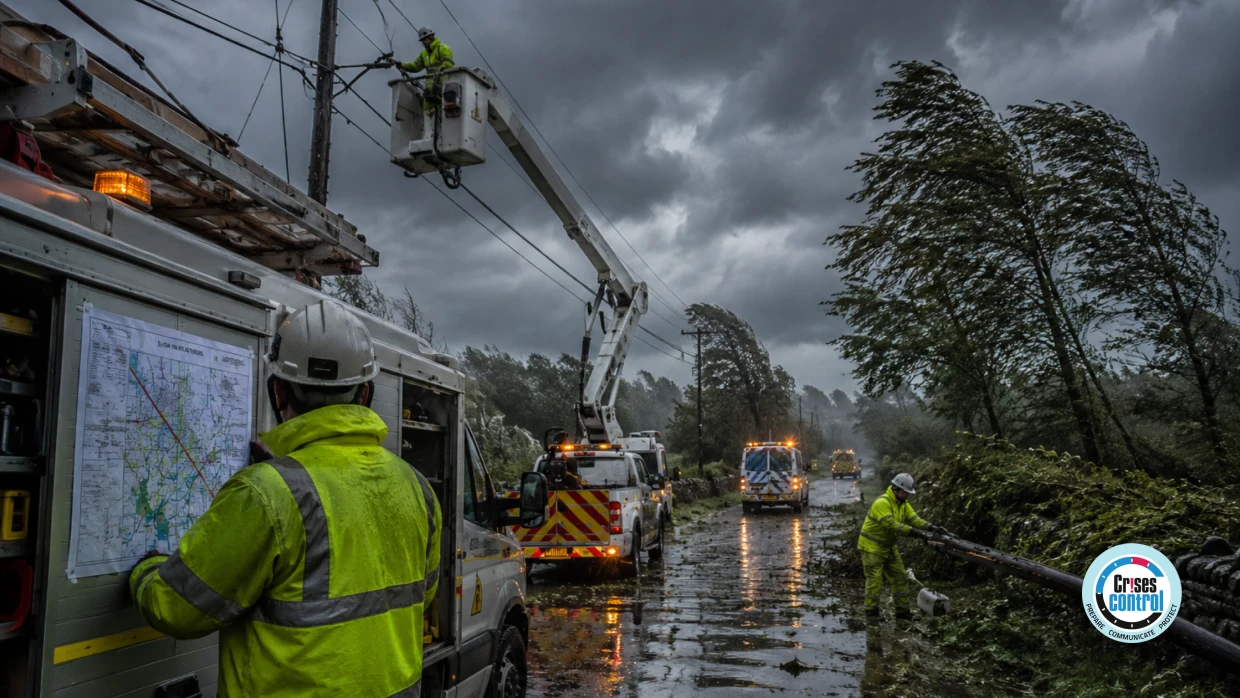
In February 2021, Winter Storm Uri caused catastrophic failures across the Texas power grid, leaving more than four million customers without electricity, some for more than a week, in temperatures that fell to historic lows. The physical failures that caused the event, gas supply disruptions, frozen wind turbines and thermal generation plant tripping offline, were compounded by coordination failures: utilities operators struggling to communicate across fragmented systems, regulators unable to get a coherent operational picture in real time, and communities unable to get reliable information about when power would be restored. The event resulted in over 200 confirmed deaths and an economic loss estimated at over $195 billion (Federal Reserve Bank of Dallas 2021).
Winter Storm Uri was an extreme event. The coordination failures it exposed, however, are not extreme. They are the same failures that appear in smaller form in utilities incidents across the UK every week: fragmented communication between distributed teams, absence of a single operational picture, delayed escalation and inadequate documentation for regulatory purposes.
Resilience is not about preventing every incident. Infrastructure of the complexity and scale managed by energy, water and gas utilities will experience faults, failures and unexpected events as a matter of operational certainty. Resilience is about what happens when those events occur. How quickly does the response activate? How effectively does the organisation coordinate across its teams? How completely does it document what happened? And how systematically does it use that experience to perform better in future?
What Operational Resilience Actually Requires
Operational resilience in utilities is frequently described in terms of infrastructure investment: network redundancy, grid reinforcement, backup generation capacity, diversified supply chains. These are important. But infrastructure resilience and operational resilience are not the same thing. An organisation can have extensive physical redundancy and still fail operationally when an incident occurs, because the problem is not in the infrastructure. The problem is in the response.
True operational resilience for utilities requires four connected capabilities. The first is the ability to activate a structured response immediately when an incident is detected, reaching every relevant team member simultaneously across multiple channels without depending on manual contact list searches or informal notification chains. The second is the ability to coordinate that response effectively across distributed sites, rotating shift teams and multiple functional groups, maintaining a single operational picture for the incident commander throughout.
The third is the ability to track every action and decision to verified completion, not through callbacks and assumptions, but through a system that records completion status in real time and escalates automatically when actions are overdue. The fourth is the ability to produce a complete, accurate and defensible post-incident record that satisfies the requirements of Ofgem, the HSE, the Environment Agency and insurers, not as a retrospective exercise but as a natural output of the response itself.
Organisations that have all four capabilities absorb operational disruption. Those that have some but not others amplify it.
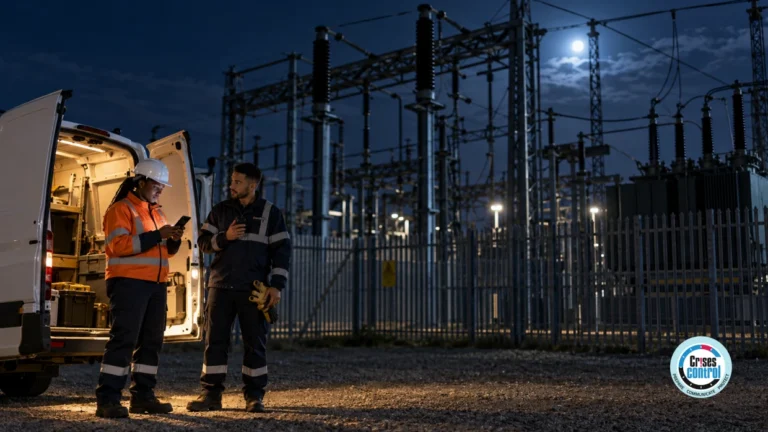
Operational incident management for utilities is not an abstract concept. It is the answer to a practical question: when something goes wrong on your network at 2 am on a bank holiday, how long does it take you to have every relevant person tasked, tracked and working from the same information? The answer to that question determines your Customer Minutes Lost, your regulatory exposure and your field worker safety outcomes.
Interested in our Incident Management Software?
Flexible Incident Management Software to keep you connected and in control.
The Regulatory Landscape Shaping Operational Resilience Requirements
The regulatory environment for utilities operators in the UK creates direct, measurable consequences for operational resilience performance. Understanding the framework is essential to understanding why operational incident management capability is not optional.
Ofgem regulates electricity and gas distribution and transmission operators under licence conditions that include explicit performance standards for network reliability and quality of service. The Customer Interruptions and Customer Minutes Lost metrics place distribution network operators under direct financial scrutiny: poor performance results in penalty payments, strong performance results in rewards. Every minute of uncoordinated response that extends an outage beyond what effective incident management would have produced represents a direct financial consequence under these frameworks (Ofgem 2024).
The Health and Safety Executive enforces the Health and Safety at Work etc. Act 1974, the Management of Health and Safety at Work Regulations 1999 and RIDDOR across utility and industrial sites. For field-intensive operations with workers in hazardous environments, the HSE’s enforcement record in the sector is extensive. According to the Health and Safety Executive (HSE), 138 workers were killed in work-related accidents across Great Britain during 2023/24, reinforcing the importance of effective risk management, safe systems of work and robust incident response in hazardous industries.
The Environment Agency oversees environmental permitting and enforcement across water and gas infrastructure. Incidents involving environmental impact, whether a water main failure that contaminates a watercourse or a gas release that requires emergency response, generate regulatory obligations that depend directly on the organisation’s ability to demonstrate what it did and when.
The combined regulatory exposure from Ofgem performance penalties, HSE enforcement action and Environment Agency obligations means that poor operational incident management for utilities is not only a safety risk. It is a financial risk that compounds through penalty payments, prosecution costs, insurance consequences and reputational damage. A structured response platform is risk management at the organisational level.
What Operational Incident Management for Utilities Looks Like When It Works
In an organisation where operational incident management for utilities is functioning effectively, the difference from an organisation that is not becomes visible at the moment an incident begins.
When a fault is detected, whether by SCADA, sensor alert, field team report or customer contact, the response activates within seconds. Every relevant team member receives a notification simultaneously across their preferred channel. The incident commander has an immediate view of who has acknowledged and who has not. Tasks are assigned with named owners. The incident timeline starts building automatically.
Across the response, every action is visible. The field engineer isolating the fault, the communications lead preparing the customer update, the senior manager monitoring from the control centre, all operate from the same real-time operational picture. When tasks are completed, the record updates. When actions are overdue, escalation triggers automatically. There is no gap between what the incident commander thinks is happening and what is actually happening.
When the incident is resolved, the post-incident record is already complete. Every notification, every acknowledgement, every task, every decision. Regulatory enquiries, insurer audits and internal reviews all benefit from coherent, timestamped accounts of the response that require no reconstruction and contain no gaps.
And when the organisation reviews the incident in the following weeks, the data is there: response times by stage, task completion rates, escalation patterns, communication gaps. The lessons from this incident inform the response to the next one.
How Crises Control Supports Operational Resilience for Utilities
Most competitors either notify people or document plans. Crises Control executes the response. Built for real incidents, not demos.
SCADA platforms and monitoring systems provide excellent detection capability. They do not provide a coordination layer. Alerting platforms reach people quickly and confirm receipt, but do not manage what happens after the alert. Enterprise resilience platforms offer broad governance and planning capability but are frequently too complex and expensive for the day-to-day operational response requirements of utilities teams.
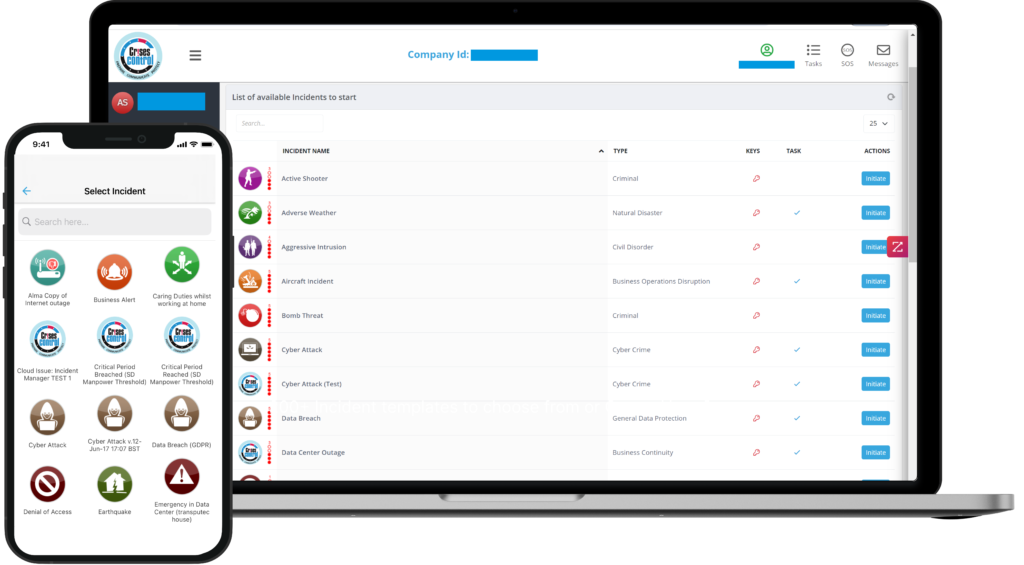
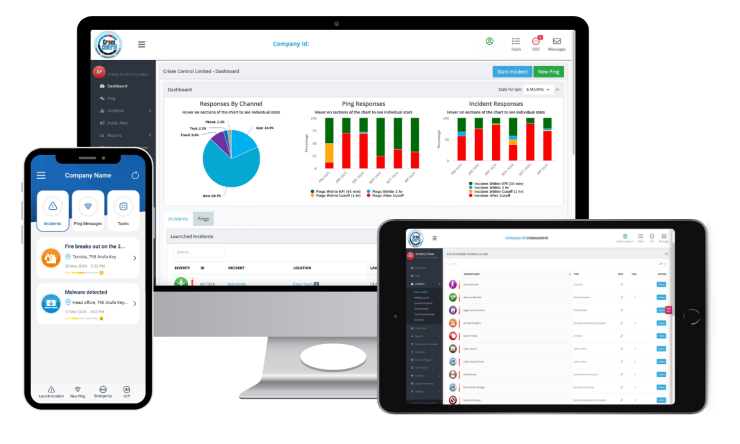
Crises Control provides the execution layer that connects detection to resolution. Crises Control connects detection with coordinated response. Ping activates simultaneous multi-channel alerting and collects response confirmation in real time. Incident Manager provides structured coordination, role assignment and a live incident timeline. Task Manager tracks field and operational actions to verified completion. Control Centre gives leadership a real-time view of the entire response. Audit and Reporting generates the post-incident record automatically. SOS provides lone worker monitoring and emergency alerting for field crews in remote or hazardous locations.
For utilities organisations, this means operational incident management for utilities that covers the full incident lifecycle: from the moment a fault is detected to the moment a defensible post-incident record is produced. The platform supports ISO 22301 and ISO 22320 alignment and is designed to operate under pressure without requiring specialist users. Explore the platform to understand how Crises Control delivers operational resilience for energy and utilities operators. Related reading: incident coordination software for utilities and worker safety incident management software for connected capability areas.
FAQs
1. What is operational incident management for utilities?
Operational incident management for utilities is the combination of processes, capabilities and technologies that determine how a utilities organisation detects, coordinates and resolves operational disruptions, and how it learns from them over time. It covers the full response lifecycle: initial alerting and team activation, structured coordination across distributed teams, task assignment and tracking, real-time operational visibility and post-incident documentation. The quality of this capability determines how quickly an organisation returns to normal service and how well it satisfies regulatory requirements after an incident.
2. How does operational incident management for utilities differ from general incident management?
Utilities incident management involves specific characteristics that general-purpose incident management platforms do not address: distributed physical infrastructure across large geographies, field crews working in hazardous and remote environments, regulatory frameworks specific to the energy, water and gas sectors, and multi-agency responses that may involve the emergency services, the Environment Agency and Ofgem simultaneously. A platform designed for utilities operational response is built for these specific demands, rather than adapted from IT incident management or general crisis communication tools.
3. How does Ofgem regulation connect to operational incident management capability?
Ofgem measures distribution network operator performance through Customer Interruptions and Customer Minutes Lost metrics, which are directly linked to financial incentives and penalties under the RIIO regulatory framework. Every minute of extended outage that results from uncoordinated response, delayed task completion or fragmented team communication represents a measurable financial consequence. Effective operational incident management for utilities reduces outage duration, improves documentation of the response and provides the evidence base that supports constructive engagement with Ofgem during post-incident reviews.
4. What does good post-incident documentation look like for a utilities operator?
Post-incident documentation for a utilities operator should capture a complete timestamped record of every notification sent and its delivery confirmation, every task assigned and its completion status, every decision made by the incident commander and the basis for that decision, and a full chronological timeline of the response from initial detection to service restoration. This record should be produced automatically by the incident management platform during the response itself, not reconstructed from memory or informal notes afterwards. A platform-generated record is both more complete and more defensible than a manual reconstruction.
5. What should utilities organisations prioritise when building operational resilience?
The highest-impact investment in operational resilience is the coordination layer between detection and resolution. Most utilities organisations already have strong detection capability through SCADA and monitoring systems. The gap is in what happens immediately after detection: how quickly the right people are reached, how effectively they are coordinated, how clearly tasks are assigned and tracked, and how completely the response is documented. Closing that coordination gap with purpose-built operational incident management for utilities delivers direct improvements in outage duration, regulatory performance and worker safety outcomes.